Skip to content

在您的網絡上查找 Microsoft Exchange Server

GTSC, a Vietnamese security firm, recently discovered two zero-day vulnerabilities that affect Microsoft Exchange Server 2013, 2016, and 2019. These two vulnerabilities are being tracked as CVE-2022-41040 and CVE-2022-41082. According to Microsoft, they are aware of “limited targeted attacks using the two vulnerabilities to get into users’ systems.” In order for attackers to successfully exploit the vulnerabilities, they must have authenticated access to the vulnerable Microsoft Exchange Server. 

What is the impact?

The first vulnerability, CVE-2022-41040, is a Server-Side Request Forgery (SSRF) vulnerability. The second vulnerability, CVE-2022-41082, allows remote code execution (RCE) when the attacker has access to PowerShell. According to GTSC, it appears that attackers can exploit the vulnerabilities to place webshells on exploited systems and set the stage for post-exploitation activities.

Are updates available?

As of September 30, 2022, both CVEs have not been patched, but Microsoft has indicated they are actively working on an accelerated timeline to issue a fix. According to their guidance, Microsoft Exchange Online Customers do not need to take any action. However, on-premises Microsoft Exchange customers should review and apply Microsoft’s mitigation steps on URL Rewrite Instructions and block exposed Remote PowerShell ports.

How do I find Microsoft Exchange Servers with runZero?

To get started, you can scan your network with runZero to collect your asset inventory. Then, from the Asset Inventory, use the following query to locate Microsoft Exchange Servers on your network:

product:"exchange server"

Check out our Queries Library for other useful inventory queries.

About Version 2 Digital

Version 2 Digital is one of the most dynamic IT companies in Asia. The company distributes a wide range of IT products across various areas including cyber security, cloud, data protection, end points, infrastructures, system monitoring, storage, networking, business productivity and communication products.

Through an extensive network of channels, point of sales, resellers, and partnership companies, Version 2 offers quality products and services which are highly acclaimed in the market. Its customers cover a wide spectrum which include Global 1000 enterprises, regional listed companies, different vertical industries, public utilities, Government, a vast number of successful SMEs, and consumers in various Asian cities.

About runZero
runZero, a network discovery and asset inventory solution, was founded in 2018 by HD Moore, the creator of Metasploit. HD envisioned a modern active discovery solution that could find and identify everything on a network–without credentials. As a security researcher and penetration tester, he often employed benign ways to get information leaks and piece them together to build device profiles. Eventually, this work led him to leverage applied research and the discovery techniques developed for security and penetration testing to create runZero.

控制測試執行:自定義執行器

Test execution is the process of running tests to verify a specific functionality in a system. It’s a great way for us to find bugs in our applications, but over time we realized that we needed to improve the speed and efficiency of our test execution method. Here’s how we did it.

The story so far
After four years of automated test development, we now have a significant collection of tests we can run. These tests can be organized and executed on demand and provide us with valuable data about the current state of our system.

Most popular automated test development platforms offer us some level of control over test execution: parallel suites, for example, to reduce execution times. Some platforms even allow us to dynamically inject test cases during runtime, depending on the current system state.

But what if it’s not enough? What if we need even more control over execution? What if we want to use mixed-type pipelines and dynamically change test data or execution pool thread capabilities?

The problem
We execute tests from several different IPs because some of the functionality can be tested only while using a specific tunnel connection. This brings us to Cloudflare accessibility problems, request limit issues, and, occasionally, authentication errors.

Some more complex scenarios require the alteration of test data. This can only be done via microservice-based endpoints. Some of those endpoints are only accessible from an internal network. After a tunnel connection is established with an external server, a test execution bot can no longer reach the internal resources required for this test run.

Another problem is the number of requests being generated during test runs. For security purposes, all environments have strict request limits, but our test activity can easily reach those limits. Dynamic IPs prevent us from whitelisting IP addresses, and it becomes impossible to execute all test collections from one IP address.

The solution
After several solutions failed, we finally came up with a test strategy that involved modifying test data upfront.

If access cannot be gained from specific IP, we get access tokens before making the connection. If the alteration of test data via internal endpoints is needed, we execute this before the test run. We also bypassed request limits by switching IPs during the test run.

All of this would be impossible if we did not design a more sophisticated test executor.

The executor
We had to design a system that allowed full control of dynamic test execution. The project goal was to have control over the parallel and serial execution of tasks, bound with one executor.

First, data gathering and alteration happen via internal endpoints. A tunnel connection is established, and then parallel test execution takes place to minimize execution time.

Some test suites generate more requests than others, so we must be aware of how many requests are being made and how many suites are in parallel segments. At some point, the IP address has to change, and a new set of test suites are executed again in parallel. This pipeline continues until all tests have been executed.

The result
Thanks to this solution, we can take full control of the test execution pool and execution sequence. In practice, that means we are able to adapt to ever-changing security measures and still provide valuable test execution reports. Our tests allow us to identify bugs faster than ever, enhancing the security and efficiency of all our applications.

About Version 2 Digital

Version 2 Digital is one of the most dynamic IT companies in Asia. The company distributes a wide range of IT products across various areas including cyber security, cloud, data protection, end points, infrastructures, system monitoring, storage, networking, business productivity and communication products.

Through an extensive network of channels, point of sales, resellers, and partnership companies, Version 2 offers quality products and services which are highly acclaimed in the market. Its customers cover a wide spectrum which include Global 1000 enterprises, regional listed companies, different vertical industries, public utilities, Government, a vast number of successful SMEs, and consumers in various Asian cities.

About Nord Security
The web has become a chaotic space where safety and trust have been compromised by cybercrime and data protection issues. Therefore, our team has a global mission to shape a more trusted and peaceful online future for people everywhere.

Pandora FMS 成為 M81 合作夥伴,讓 IBM i 系統監控更輕鬆

Pandora FMS, an international benchmark in system monitoring, becomes technology partner of the French company M81.

The French platform has extensive experience in the sector since its creation in 1988 and is currently considered one of the great experts when it comes to monitoring IBM i systems.

Thanks to this agreement, Pandora FMS will transfer this type of solutions to Spanish companies to improve IT management and the efficiency of the different work areas.

Pandora FMS and the French company M81 become partners

The alliance between Pandora FMS and M81 represents a notable developing point in the Spanish technology sector, since in recent decades no national company had been able to count on monitoring solutions for IBM i systems.

Formerly known as AS400, it is widespread among big companies with IT infrastructures that deal with large amounts of data.

The M81 monitoring software for IBM i, considered a legacy or outdated system, allows to improve the efficiency of the resources of companies that are based on large IT infrastructures.

In addition to increasing the ability to manage and organize internal data, it saves time for employees, who can devote their efforts to other  company areas.

M81 was founded in 1988

Since then, it has been developing solutions for IBM i to become one of the world’s leading experts in these systems.

The French company works for large insurance companies such as the American Marsh & McLennan or AXA, for banks such as the German DZ Bank or the Portuguese Caixa Geral de Depósitos; for companies in the industry such as ArcelorMittal (considered the largest steelmaker in the world) and for logistics companies such as Heppner.

In addition, it is also established in the pharmaceutical, luxury and oil sectors.

The M81 solution ranges from advanced monitoring to the recovery of failed databases.

Despite being aimed at performing very complex tasks, its implementation is characterized by its simplicity and easy handling for teams, achieving the objective of reducing the workload of the workforce and reorienting those efforts in areas most in need.

M81 and Pandora FMS

After the agreement reached with Pandora FMS, this type of technology will be available for large Spanish and international companies that continue to use the IBM i system, also known as AS400 and considered a legacy system.

“The agreement is not only good for our company, but it means ending decades of delay in the Spanish sector that works with IBM i Systems,” says Sancho Lerena, CEO of Pandora FMS.

The Spanish company, a specialist in system monitoring, has taken its solutions to international giants such as Rakuten, Toshiba or Repsol.

Also Spanish reference companies such as El Pozo or Prosegur, in addition to working for public administrations such as the EMT or the Digital Madrid area.

In total, more than 50,000 installations in 53 different countries, a figure that will continue increasing now following the agreement reached with M81.

“M81 is a reference company in the sector, so the alliance reached is a success. But, in addition, it means opening a window for opportunities for companies that have IBM i because they will be able to reduce costs and improve their management following the steps of the great international brands “, explains Lerena.

About Version 2 Digital

Version 2 Digital is one of the most dynamic IT companies in Asia. The company distributes a wide range of IT products across various areas including cyber security, cloud, data protection, end points, infrastructures, system monitoring, storage, networking, business productivity and communication products.

Through an extensive network of channels, point of sales, resellers, and partnership companies, Version 2 offers quality products and services which are highly acclaimed in the market. Its customers cover a wide spectrum which include Global 1000 enterprises, regional listed companies, different vertical industries, public utilities, Government, a vast number of successful SMEs, and consumers in various Asian cities.

About PandoraFMS
Pandora FMS is a flexible monitoring system, capable of monitoring devices, infrastructures, applications, services and business processes.
Of course, one of the things that Pandora FMS can control is the hard disks of your computers.

Keepit 如何將用戶體驗放在首位

Keepit is known for delivering a certain quality of User Experience (UX), which is reflected in customer feedback examples, such as: 

Keepit’s user-friendliness is a financial win-win’ and ‘I like to call Keepit a Steady Eddie. I know it’s working; I know it’s running, and I don’t have to sweat it.’.

Behind Keepit’s simple design and ease of use lies a deliberate approach, rooted in the idea that our whole system, from the deepest backend layers to the user interface, is built to support a solid User Experience.

However, in the software field, UX has been interpreted in various ways and caused confusion in how it differs from User Interface Design. So, what is UX to Keepit? And how does Keepit go about all this in practicality?

Foundation

UX goes beyond the immediate visual impression and beyond isolated interactions within the product. It is a silent ambassador that ensures a seamless experience throughout any touchpoint. A journey sprinkled with an undefined X factor that leaves our user with instant recognition without the need for explanation -a quality that flows through every vein of Keepit.

An experience starts before the product is even used by our customers. As Don Norman, the inventor of UX, puts it, ‘No product is an island […] It is a cohesive, integrated set of experiences […] Make them all work together seamlessly.’

Leveled circulation

On both conscious and unconscious levels, a human experience is perceived and processed as a sum of different events. The more you know about people, the better experience you will be able to design. To translate such a complex sum into a consistent Keepit experience, we use our Design System as a single documented source.

Here all Keepers will find Design Principles, components, guidelines, patterns, and themes. However, the UX circulates on more levels. To grasp this in a software context, mapping out different levels of the experience can help.

Interaction level

On this level, we work with both look and feel when interacting with the product, from visual design to Information Architecture to navigation. The focus is to design the experience of a certain interaction that a user has with Keepit to perform a task, such as restoring data in Keepit’s application.

However, a user interaction can also exist outside the product interface. One example is receiving support. Each of these interactions are single strokes of experiences that play a role in the relationship with our customer.

On the interaction level, our Design Principles, guidelines, and patterns play a central role. We operationalize this with a pyramid logic in layers, with a theme on the top level and dos and don’ts on the bottom level. Here is an example:

Design Principle: Keepit Sets Me Free

  • What users should feel: In every interaction, I as a user should feel the freedom of being in control. This means being offered the most relevant choices at the right time. The choices should lower my cognitive load so that I feel enabled to effortlessly succeed at my tasks.
  • Examples of what users should think: ‘I control the situation’ – ‘This is unbelievably easy’- ‘Keepit makes me better at my job’- ‘I get what I need when I need it’
  • Examples of what users should see: Recognizable patterns – An easy first entry to the system – Understandable language
  • What designers should do: Always give feedback – Build a strong visual hierarchy – Know and understand the user – Always remember what problem we are solving for the user
  • What designers should not do: Don’t make the user wait, don’t speak in system language, don’t overload the user with information

Journey level

Zooming into the journey level, we recognize that putting UX first is not isolated in the product interaction itself. The key word here is ‘journey’. Mapping out journeys enables us to discover user needs and pain points, in the quest of providing seamless and consistent experiences across Keepit’s channels.

There are methods to identify key needs and transform them into design challenges. Apart from organized methods, such as usability tests, analytics, and organized customer interviews, there are also more organic user dialogues. From support, through live events, from sales, and so on. In all these touchpoints there are chances to identify key user needs and discover how the Keepit product can solve real user problems.

The key point here is to identify where the needs and pain points are rooted; define the root problem and translate this into design challenges. Further down the road, when ideating on design solutions, the user experience should be consistent in every chosen design solution. Again, this is where the User Experience pyramid, with its design principles at the top, plays its role as a foundation for the other experience levels.

A level connecting the dots

This means that UX is related to the spirit of Keepit, across the whole company. Throughout the different areas of expertise of Keepit, UX connects the dots and remembers to keep the users’ needs at the core of what we do: to deliver simple and safe backup solutions that can set our customers free from the worries of losing data. Keepit’s UX delivers this X factor in its tone of voice, the product’s look and feel, user touchpoints, and customer dialogues.

Keepit’s UX goal is to deliver a consistent heartbeat of look and feel throughout the user journey, anytime, anywhere – pumping it through Keepit’s veins.

UX metrics

As designers, we recognize the challenge in measuring UX, since we are dealing with human behavior and attitude. Here we use deliberate approaches such as confirmation bias. When working on improvements to Keepit’s UX, our main goal is to gather insight, combined with quantitative results.

We want to understand the context and situation that the user is in when encountering Keepit, as well as how this context affects the user.

We also want to know what works, what doesn’t, and why. These insights are gathered through activities such as user interviews and observations. The outcome should be an understanding of user values, supported by quantitative data on average numbers or rates. Additionally, usability metrics give value to the work of measuring. Our different approaches have the common mission of delivering an excellent User Experience, based on data-informed decisions.

About Keepit
At Keepit, we believe in a digital future where all software is delivered as a service. Keepit’s mission is to protect data in the cloud Keepit is a software company specializing in Cloud-to-Cloud data backup and recovery. Deriving from +20 year experience in building best-in-class data protection and hosting services, Keepit is pioneering the way to secure and protect cloud data at scale.

About Version 2 Digital

Version 2 Digital is one of the most dynamic IT companies in Asia. The company distributes a wide range of IT products across various areas including cyber security, cloud, data protection, end points, infrastructures, system monitoring, storage, networking, business productivity and communication products.

Through an extensive network of channels, point of sales, resellers, and partnership companies, Version 2 offers quality products and services which are highly acclaimed in the market. Its customers cover a wide spectrum which include Global 1000 enterprises, regional listed companies, different vertical industries, public utilities, Government, a vast number of successful SMEs, and consumers in various Asian cities.

Pandora FMS 在服務器監控軟件和 APM 的 Capterra 入圍名單中名列前茅

The work is hard and there are high expectations, but we don’t give up! The fight goes on and every day we are happier with what we achieve and what we mean to our users.

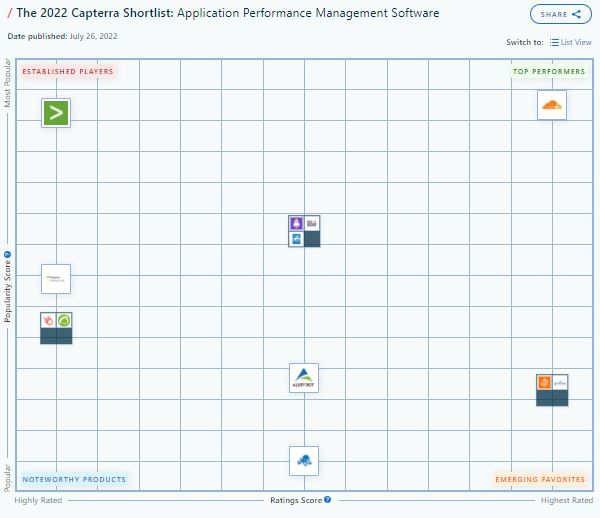
Therefore, Pandora FMS is proud to announce its mention as an  Emerging Favorite  in 2022 Shortlist for Server Monitoring Software and APM by   Capterra, a free online service that helps organizations find the right software.

Pandora FMS is always among the favorites. Capterra knows this

Capterra Shorlist

*As many of you may already know, Capterra Shortlist is an independent assessment that evaluates user reviews and online search activity to generate a list of market leaders in the software space that offer the most popular solutions. (Have a look at the Capterra Shortlist methodology here.)

As it could not be otherwise, our CEO and colleague Sancho Lerena has wanted to make some comments on this achievement:

“The first thing I would like to say is thank you. Sometimes it seems that one does not give enough thanks and there is much to thank, both to our coworkers and users, and even the Capterra platform itself. 

Especially because there are so many contributions and because it is absolutely always a huge honor to receive this kind of mention.”

Here is a sample of our recognition in table format:

APM

More achievements

Well, and that’s not all.

Pandora FMS is also recognized as a Noteworthy Product in Capterra Shortlist for Application Performance Management Software.

Our users have made it possible!

With an overall rating of 4.6 out 5, we received some stellar reviews on Capterra:

“For a long time, we were looking for a monitoring solution that could ensure the resiliency of our web applications and finally, with the help of the Pandora FMS team, we found the right tool. 

Pandora FMS is an out-of-the-box monitoring solution that allows you to monitor your applications and systems and has a very intuitive interface that allows you to build your dashboards in no time. We can not wait to see what the future holds for Pandora FMS.”

[Kumar B.]

“Pandora FMS is a very handy monitoring tool for daily use. Accurate with metrics and useful reporting function for analysis of server performance. 

We are planning to widely distribute the agent across more servers for our customers.”

[Neil W.]

“Pandora FMS the perfect balance between price and quality.”

[Oskar R.]

The question now is, do you want to be the only one not to get on board with such a popular, effective and acclaimed product as Pandora FMS? As you see, you will hardly regret it! We’re counting on you!

About Version 2 Digital

Version 2 Digital is one of the most dynamic IT companies in Asia. The company distributes a wide range of IT products across various areas including cyber security, cloud, data protection, end points, infrastructures, system monitoring, storage, networking, business productivity and communication products.

Through an extensive network of channels, point of sales, resellers, and partnership companies, Version 2 offers quality products and services which are highly acclaimed in the market. Its customers cover a wide spectrum which include Global 1000 enterprises, regional listed companies, different vertical industries, public utilities, Government, a vast number of successful SMEs, and consumers in various Asian cities.

About PandoraFMS
Pandora FMS is a flexible monitoring system, capable of monitoring devices, infrastructures, applications, services and business processes.
Of course, one of the things that Pandora FMS can control is the hard disks of your computers.

在不中斷運營的情況下增強 OT 安全性

What is Operational Technology?

Cybersecurity has come a long way in the recent past. Its importance is felt in all aspects of modern life, both personal and industrial. The current digital and network advancements are steadily pushing Information Technology (IT) and Operational Technology (OT) towards integration. While IT systems interact with each other for data-centric computing, OT systems involve hardware and software that monitors or controls physical devices and processes to detect or cause changes in an industrial environment or enterprise.   

OT plays a significant role in Industrial Control Systems (ICS) and encompasses a wide variety of programmable systems such as Supervisory Control and Data Acquisition systems (SCADA) and Distributed Control Systems (DCS). These are found in many aspects of the environments we interact with daily, which makes keeping these systems secure a top priority.  

Industrial systems traditionally have relied on human monitoring and management through proprietary control protocols and software. Today, however, more industrial systems are automating these processes in a bid to boost efficiency and deliver better and smarter analytics through the convergence of OT and IT systems. This fills in the  gap that previously that isolated OT from IT. This bridge ensures that the information passed down to the people, sensors, devices, and machines is accurate and on time.  

How IoT Adoption Affects OT Systems

Anyone who has been around long enough to see how the internet and modern technology have changed the world can attest to its benefits. The shift to making most aspects of human life ‘smart’ has had both positive and negative effects. In a bid to make OT systems more efficient and reliable, most people have adopted integrated enterprise software and analytic data services. This makes processes and systems such as cooling efficient and also monitoring devices easy and more cost-effective. 

This action comes with one main downside; an increase in security risks. The connection of these systems leaves industrial networks and components vulnerable to OT security deficiencies such as lack of encryption, buffer overflow, backdoors and other tailored attacks on physical components. 

The digital attack surface also grows massively. For instance, in a configuration where things go through a switch, it would be difficult to monitor the traffic or detect changes. This makes the network vulnerable to targeted attacks. Some economies or communities could face utter devastation should their industrial systems be attacked due to the high cost of some of the industrial equipment.  

On the brighter side, industrial networks can be protected without risking non-compliance or disruption of operations. While IT security deals with data flow and its protection, OT security is focused on the safety and efficiency of industrial operations. By implementing proper security strategies and policies that ensure the visibility of all network control traffic, you can effectively reduce security risks and protect operations. 

Modern OT Security Approaches

The integration of OT and IT systems has led to the development of OT security. This is done in a bid to protect lives and assets and ensure that there is no operating downtime leading to production losses. The common standards and practices for secure OT systems are detailed by bodies such as The National Institute of Standards and Technology and the UK’s National Cyber Security Center. Their reports have detailed information on OT risk management, vulnerabilities, recommended practices and guidelines. These form the framework for different ways to secure OT systems.

When protecting OT systems, one must first understand the vulnerabilities that they face. Now that OT, IT, and IoT systems have become part of an indistinguishable system, any margins of error could mean a collapse in the whole network. Some of the ways OT networks are compromised by malignant elements include:   

  • Unauthorized Changes: This could consist of disabling safety sensors and alarms. This also increases the risk of bad actors inputting instructions that could lead to downtime. 
  • Interference With Critical Infrastructure: Access to sites and operational systems should only be granted to authorized personnel. Interference of control units and equipment protection systems could lead to irreparable damage, 
  • Manipulation or Modification of Sent Information: Hackers use this technique to disguise unauthorized changes and breaches as they penetrate the system. 

It is always essential to understand that attacks could come from within. It could be rogue employees with infected USBs or even poor coding. This means that industrial security has to be both preventive and offensive. Apart from the conventional security protocols, OT protection must be based on a fully visible IT/OT infrastructure. This means employing monitoring and analysis tools that can detect even the most minute anomalies.  

Best Practices for OT Security

An efficient OT security plan should incorporate three main levels of protection and include the following practices: 

Using Next-Generation Firewalls (NGFW) in OT Networks

Traditional firewalls had their drawbacks in terms of network speed, awareness limitations and their inability to adapt to new threats. Next-Generation Firewalls (NGFWs), on the other hand, offer the best security against threats by giving you complete control of the industrial systems. These firewalls are made to meet any configuration in the ICS for maximum visibility and monitoring. Organized architecture in terms of control ensures efficient and uninterrupted workflow.  

Having Efficient System Restore Plans

Should there be any breaches or failures of certain components within the OT network, there should be protocols to restore functionality without delaying operations. The SRP should take the least amount of time. Moreover, despite the conditions or challenges faced, the industrial environment should be designed in a way that ensures operations can continue running, awaiting restoration. This means enabling the workforce access to manual control and emergency operations.  

Risk-Based Vulnerability Management

The RBVM system provides comprehensive information on possible threats and the extent of their effects. In collaboration with network analytics such as mapping constant monitoring, it is possible to anticipate the risks that the threats pose and prepare the security team with efficient responses or possible SRP.  

These layers of protection also need to be coupled with other general security practices. For instance, access to OT network devices and systems should be restricted to unauthorized parties. This can be achieved by separating the cooperate network from the OT network. On the other hand, remote access solutions should be available.  

Remote access is a contentious security measure. One of the channels used by bad actors is the backdoors that remote access leaves. To counter this vulnerability, remote access sessions can be restricted and monitored by time and user activity. When it comes to safeguarding data, the best solution is encryption. Backups and restore points also need to be in place. Using these tools and security protocols means that the OT network remains secure while the industrial environment remains fully operational. 

What the Future Holds for OT Security

The best part of technology is its nature and tendency to evolve. This means that cybersecurity will only get better. At the moment, OT security faces a couple of minor setbacks primarily due to its nature. A fact that is evident in the design of these systems. Since they are meant to run for years, the focus is placed more on their reliability rather than security. As more OT systems are connected to a network, their lack of initial security and use of legacy protocols poses significant risks.  

As mentioned, however, the beauty of technology is adaptation. To maneuver these challenges, businesses are adding newer devices to their OT enterprises and taking OT cybersecurity seriously. It is clear that the future of OT security is bright due to the growing investment in OT security. Professionals in this sector are increasing in number every day after its necessity was realized.  

Cloud technology has also improved the industrial environment by connecting workplaces. This game-changer is poised to boost production and ensure efficiency while still maintaining low production costs. 

Controversial as it may sound, even hacking and other unauthorized breaches help increase OT security. This inverse effect is due to the fact that by revealing the gaps and vulnerabilities in the system, light is shed on the areas that require patching or even upgrading.

Final Thoughts on OT Security

In conclusion, every party involved in this industry must acknowledge the need for upgraded and efficient OT security solutions. There is a need to pool resources and specialize in OT Cybersecurity if its development is to be sustainable and future-proof.

About Version 2 Digital

Version 2 Digital is one of the most dynamic IT companies in Asia. The company distributes a wide range of IT products across various areas including cyber security, cloud, data protection, end points, infrastructures, system monitoring, storage, networking, business productivity and communication products.

Through an extensive network of channels, point of sales, resellers, and partnership companies, Version 2 offers quality products and services which are highly acclaimed in the market. Its customers cover a wide spectrum which include Global 1000 enterprises, regional listed companies, different vertical industries, public utilities, Government, a vast number of successful SMEs, and consumers in various Asian cities.


About Portnox
Portnox provides simple-to-deploy, operate and maintain network access control, security and visibility solutions. Portnox software can be deployed on-premises, as a cloud-delivered service, or in hybrid mode. It is agentless and vendor-agnostic, allowing organizations to maximize their existing network and cybersecurity investments. Hundreds of enterprises around the world rely on Portnox for network visibility, cybersecurity policy enforcement and regulatory compliance. The company has been recognized for its innovations by Info Security Products Guide, Cyber Security Excellence Awards, IoT Innovator Awards, Computing Security Awards, Best of Interop ITX and Cyber Defense Magazine. Portnox has offices in the U.S., Europe and Asia. For information visit http://www.portnox.com, and follow us on Twitter and LinkedIn.。

IT 公司 Pandora FMS,是西班牙第一家提供與 IBM i 集成的監控系統的公司

The technology company Pandora FMS, specialized in system monitoring, takes a step further towards growth becoming the first national technology capable of offering monitoring solutions, both for IBM i systems (formerly known as AS400) and for much more modern systems.

A development that, after several decades, means the full coexistence of IBM i with more recent systems.

PFMS and monitoring system integrated with IBM i

Pandora FMS, through the solution developed by the French company M81, will provide this service to multiple important customers. 

*M8 developed monitoring software for IBM i. 

After the agreement, Pandora FMS will be the first and only one in Spain to be able to combine solutions for both up-to-date systems and IBM i.

The agreement with M81 is a key alliance

The French company has been working in the sector since 1988, becoming one of the benchmarks both nationally and internationally. 

In addition to being specialized in IBM i, they provide solutions such as database recovery after serious failures or advanced monitoring to improve IT team operations.

IBM i, also known as AS400, is a system considered as legacy or obsolete that has 34 years of history

Its versions have been updated and improved throughout all this time. The evidence is that many multinationals keep it still in their structure. 

The so-called IBM Power System and the IBM i operating system continue to be recognized, but IT managers and CEOs are choosing to work with open servers and operating systems that offer many possibilities available in the market.

Therefore, they stopped working with IBM Power System and IBM i.

Due to this legacy system status, companies that use IBM i recognize the need to develop their own verifications or buy solutions that improve their IT structure performance and optimize their costs. 

Until now, they could only hire specialized monitoring systems as far as IBM is concerned. 

However, after the development of Pandora FMS and M84, Spanish companies will be able to implement a single powerful monitoring system that combines the management of both newer systems and IBM i.

On a global scale

As a sign of the potential IBM i has, there are institutions such as the Government of Andorra that have this type of technology. 

Although it is usually the financial and logistics sectors the ones that are managed the most through the old AS400, now known as IBM i. 

Logistics giants such as Cargo Partner, banks such as DZ Bank or insurance companies such as Marsh & McLennan are some of the examples of large formations related to the world of IBM i.

Monitoring and growth

Monitoring, it should be remembered, is one of the bases of the efficient growth of any company today. 

According to internal data from Pandora FMS, there are digital administrations that have improved their response time by 200%

In the retail sector, the workload can be reduced by up to 30% thanks to resource optimization. 

Percentages that translate into cost savings for large multinationals and, above all, IT resource optimization for other areas.

“From now on, Spanish companies that used IBM i will no longer have to acquire different monitoring services to be able to manage their entire infrastructure.

Thanks to the M81 software and its integration with Pandora FMS solution, a legacy system like IBM i will be easy to monitor like any other system,”

explains Sancho Lerena, CEO of Pandora FMS

“This also shows that the IT sector continues to grow in Spain.

Despite having waited for a long time, this development is a turning point for companies that still have systems, such as IBM i, which, despite being legacy, continue to have a lot of influence on IT management for the business of many companies,” highlights the chairman of the Spanish company.

About Version 2 Digital

Version 2 Digital is one of the most dynamic IT companies in Asia. The company distributes a wide range of IT products across various areas including cyber security, cloud, data protection, end points, infrastructures, system monitoring, storage, networking, business productivity and communication products.

Through an extensive network of channels, point of sales, resellers, and partnership companies, Version 2 offers quality products and services which are highly acclaimed in the market. Its customers cover a wide spectrum which include Global 1000 enterprises, regional listed companies, different vertical industries, public utilities, Government, a vast number of successful SMEs, and consumers in various Asian cities.

About PandoraFMS
Pandora FMS is a flexible monitoring system, capable of monitoring devices, infrastructures, applications, services and business processes.
Of course, one of the things that Pandora FMS can control is the hard disks of your computers.

5 個數字化工作場所錯誤讓您望而卻步

What’s going wrong in your digital workplace and how to fix it.

Having worked with a breadth of different brands reaching from the far corners of education and health to lifestyle and entertainment, we’ve seen a diverse range of digital workplaces and how they’re used.

Whether you’ve been using a digital workplace for a long time, or if you’re new to the Cloud, we see the same mistakes holding workforces back from reaching their fullest potential.

Here are five of the biggest mistakes and the straightforward solutions to fix them.

Email Signatures

Mistake: Whether your business is large or small, a clean and consistent look is essential for professional communication, especially when you’re juggling multiple departments and sub-brands. There’s nothing worse than email signatures with inconsistent branding and fonts, which can be really damaging to your reputation.

Solution: Using an Email Signature Management tool (a popular feature of CloudM) unifies control of signatures across the board while allowing designs to be tailored to specific teams or sub-brands. Automated cohesivity is at your fingertips with just the touch of a button, giving your email signatures a clean, professional, and brand-aligned look with no extra stress.

Shared calendars

Mistake: Not utilizing the full potential of your digital calendars is a tough habit to break, but there are many intuitive features you should embrace if you use a cloud/shared calendar across your business. It would be a huge mistake to not use the brilliant features available to you in order to maximize your efficiency.

Solution: Whether you’re using Microsoft 365 or Google Workspace, each productivity suite offers a range of different features so you can get the most out of your time (and your colleague’s time). Whether you want to set working hours so meetings can’t be scheduled on your days off, make appointment slots for people to book, or take some focus time to get on with those looming deadlines, it’s well worth researching the amazing features available to you… Speaking of which, if you want to know more about Microsoft 365 and Google Workspace Calendar, please read our blogs on getting to know their features.

Instant messaging

Mistake: Instant messaging could be something that doesn’t appeal to many businesses because it reminds us of relaxed communication, which might conflict with the professional culture you want in your business, but there are many benefits of embracing instant messaging.

Solution: Instant messaging is a great way to embrace hybrid working whilst still maintaining a good rapport with your colleagues. Instead of piling up a long email chain, or taking up huge chunks of time by hosting meetings, it’s a quick and efficient way to get the answers and solutions you need whilst working. If you’re using Google Workspace, you’ll be familiar with its chat function, Google Chats and Spaces, and its ability to format text the same way you would in a Google Doc. Likewise, you can utilize instant messaging if you’re using Microsoft 365 via Microsoft Teams.

Licenses

Mistake: Along with the licenses for your chosen productivity suite (whether that’s Microsoft 365 or Google Workspace) you’ll be buying licenses left, right, and center for all your other SaaS solutions. This isn’t a bad thing; subscriptions are unavoidable if you want to utilize the true freedom and power of the cloud, but keeping on top of your license count can be tricky and time-consuming.

Solution: Licensing can be one of the leading costs eating up your budget, and managing and maintaining licenses properly can be a huge contributor to saving money. With CloudM, you can automatically manage your most used licenses so the costs don’t build up.

DIY Migrations

Mistake: Many businesses want to make the most of their amazing staff, and so a DIY migration seems like the best opportunity for their IT team to step up to the challenge. But as data migrations require a niche skillset, this can cause spiraling costs, long and drawn-out projects soaking up important resources, and data loss.

Solution: The solution to this is easy. Trust the experts. Many believe experts will end up coming hand in hand with enormous costs, but on the contrary; experts are there to help you save money by keeping the project running smoothly. Having worked with a large breadth of established household names in the past, we’ve saved companies millions.

Step into the future with CloudM

At CloudM, we have an extensive track record of helping our customers with their migrations, digital workplace management, and their data archiving needs. We’re proud to have worked with a huge number of household brands who’ve praised CloudM and our people. We’re ready to help you with any projects you have on the horizon.

Don’t believe us? Ask our customers.

“The time you get back from having a simple user interface you click into compared to our process of how we would restore things is night and day. It used to take a full afternoon to restore something and now it’s literally a few clicks.” – Jamie Tanner, Digital Innovations at Kingston & Sutton Council

The team at CloudM is communicative and supportive. The regular product demonstrations help us to stay up to date with new features and exciting updates to the platform. We feel listened to and valued as customers, and our feedback has gone on to help develop the software.” – Dan Morley, Head of I.T Infrastructure and Service Delivery at Village Hotels

“The customer success team has worked with us to not only better understand the CloudMproduct, but also how we can better utilize Google Workspace. The ongoing support is great. If we’ve had any issues with the product the support team has replied almost immediately, it’s a first-class experience and I believe the best platform for managing your user data. We’ve actually recommended your product to other companies and partners, we have no plans to move away from CloudM, and it really has become an integral part of our role.” – Noberasco

About CloudM

CloudM is a management platform designed for Microsoft 365 and Google Workspace. It simplifies IT management with core functions that include: seamlessly migrating data to the cloud, automating employee onboarding and offboarding processes, and securely backing up and archiving data. Its goal is to save businesses time, reduce errors, and efficiently utilize cloud resources.

About Version 2 Digital

Version 2 Digital is one of the most dynamic IT companies in Asia. The company distributes a wide range of IT products across various areas including cyber security, cloud, data protection, end points, infrastructures, system monitoring, storage, networking, business productivity and communication products.

Through an extensive network of channels, point of sales, resellers, and partnership companies, Version 2 offers quality products and services which are highly acclaimed in the market. Its customers cover a wide spectrum which include Global 1000 enterprises, regional listed companies, different vertical industries, public utilities, Government, a vast number of successful SMEs, and consumers in various Asian cities.

使用 runZero 掃描您的外部攻擊面

While runZero is mostly used for asset inventory behind the firewall, you can also use its scanner to discover your external attack surface.

External scans are beneficial for a number of use cases, such as:

  • Getting visibility into external hosts and exposed services
  • Assessing infrastructure of corporate acquisition targets
  • Performing vendor security screening
  • Reconnaissance for penetration testing

Differences between runZero and EASMs

New users sometimes wonder about the differences between runZero and solutions for external attack surface management (EASM), such as Censys and ShodanHQ. Many of these solutions scan the whole world so you can query their host database. However, network owners can ask to exclude their IP ranges for all users (i.e., not all hosts show up in your search). Some vendors will have tools or services that discover all of your externally-facing assets.

By contrast, runZero:

  • Is primarily an internal asset inventory and network discovery tool, but also has the ability to discover public-facing hosts.
  • Collects data through a combination of active scanning and integrations.
  • Takes inputs in the form of ASNs, domains, IPs, and FQDNs (as well as public IPs discovered in internal scans).
  • Can integrate with Shodan & Censys to identify hosts and augment data.
  • Augments scans with other sources through integrations (e.g., cloud hosting providers, vulnerability scanners, and EDR platforms).
  • Offers a much richer data set per asset.

How to scan your public-facing hosts

If you don’t have access to runZero Enterprise Edition, you can sign up for a free 21-day trial to follow this walkthrough. The free Starter Edition doesn’t contain some of the features described in this blog post.

Step 1: Determining domains and ASNs to scan

The easiest way to get started with external scans is through:

  • Domains – There are several options for finding the domains associated with your organization. Best to check with the person who’s managing your domain registrations and renewals. Doing a reverse WhoIs lookup hasn’t been a good option for a couple of years now, but if you lack alternatives, use Whoxy to find all domains registered to the same company.
  • ASNs – If you don’t know the ASN for your company, you can use a lookup service, such as ASNLookup to identify the ASNs for your organization.

For this example, let’s scan the external attack surface of a real organization and its properties, but blur any identifying data to ensure that the organization doesn’t become a target as a result of this post.

ASN lookup

Step 2: Adding Censys or Shodan integrations

You can also discover your external hosts via Shodan or Censys integration. The integration can pull in additional machines that may not be in your ASN or domain scope. To use the integration, go to Inventory > Assets in your navigation menu and select Censys search or Shodan search from the Connect dropdown menu. You’ll have to set up credentials with an API key to build the query.

Censys Search configuration

In the Censys configuration, we query acme.org in our search. This will also find any hosts that use the string acme.org in the common name of a TLS certificate. You can run this import either once or on a schedule.

Alternatively, you can set the Censys search mode to All external assets, which will not discover new assets, but enrich the assets already captured in runZero with Censys data. However, for this use case, we’ll go with the former setting.

The import will pull any information about the matching hosts, including services and attributes, into your inventory. You should now see some assets with limited data being populated in your runZero inventory. You can view the details for one of the imported hosts and see the following information:

Censys attributes

Step 4: Starting an external scan using hosted zones

In runZero, set up a new organization or project, then go to the inventory, click the Scan button and select Standard scan.

From the scan configuration page:

  • Choose US – New York as the Hosted zone (this is a runZero-hosted Explorer in the cloud).
  • Increase the scan rate from 1,000 to 5,000 (to accelerate the scan).
  • In the Discovery scope, enter the following data:
    • public:all: This will scan all the public IPs that were pulled in via Shodan or Censys in the previous step. If you are scanning your internal network with runZero, this will also add all public IPs discovered by any other means into the scope.
    • asn4:12345: Enter all ASNs in this format to target all IP addresses registered to this ASN. Note the digit 4 after ASN in the notation.
    • domain:acme.org: Add all domains that you are targeting. runZero will add all subdomains connected to these domains.
Scan configuration

Click Initialize scan. runZero now looks up both the IPs registered under the ASNs as well as all subdomains associated with the domains you are looking to scan and displays a sample for confirmation. Confirm your scan settings.

Scan configuration confirmation

Once the scan task has completed, go view your populated inventory.

View your populated inventory

runZero hosted zones are deployed with Digital Ocean. If you prefer to host your own Explorer, we recommend Digital Ocean because AWS, Azure, and GCP all rate-limit or filter outbound scan traffic in a way that impacts the quality of scan results. The runZero hosted zones performed much better than running a scan from an ISP as well, regardless of whether a VPN was used or not.

Step 5: Digging into your inventory

Looking at this data set, there are quite a few hosts with EOL operating systems. You can use the following query to find these:

os_eol:<now

Some operating system vendors will enable you to purchase extended support services. To only view systems that are outside the extended support period, use the following query:

os_eol_extended:<now

Assets can often leak secondary IP addresses, often within the RFC 1918 range. These machines are potential pivot points into private network spaces. To find those quickly, use the query:

has_private:t

Best practices are to have as few services on a single host as possible, especially when they are public-facing, to avoid the risk of one vulnerable service compromising another one. Sorting the column with the number of services per host reveals one host with eight services. After opening the Asset Details page, we can see these in the Services section.

Services list

Each one of these services has an extensive list of attributes that provide more information.

Step 6: Finding problematic SSH services

Looking at the SSH service on port 22, we see that it supports the authentication method of both password and public key. Allowing a simple password authentication may indicate elevated risk to your infrastructure.

SSH service

Clicking on the magnifying glass with the + sign next to the attribute name reveals that there are a total of 24 hosts that allow this kind of authentication.

Auth method results

Clicking on the attribute value or the count will display a list of hosts that match the query.

Back on the Asset Details page, clicking the magnifying glass next to the banner shows an overview of all the different SSH versions deployed in the infrastructure.

SSH versions

This works for all of the banner versions for other protocols as well. For example, you can very quickly and easily get a list of all of the Microsoft SQL Servers deployed in the environment, sorted by version number.

Going back to the Asset Details page, clicking the magnifying glass next to ssh.hostKey.md5 displays the frequency report for this attribute. It shows that several machines share the same SSH private key. This presents a security risk because if one of the hosts is compromised, it would also compromise other hosts sharing the same SSH private key. This typically happens when virtual machines are cloned without regenerating the SSH keys.

SSH host keys

Step 7: Identifying databases exposed to the Internet

Generally, databases should be accessible only to the applications that require access. They should never be accessible on a public IP. The same host exposes MariaDB version 10.5.15 on port 3306, which has several associated security vulnerabilities.

Identify databases exposed to the Internet
Is runZero a vuln scanner?

runZero is an asset inventory and network discovery solution, not a vulnerability scanner, but its findings can sometimes point to security vulnerabilities.

Step 8: Looking at exposed services

Let’s move on to the Services Inventory now. A great way to find unusual services exposed on an external IP is to sort the ports by high numbers first.

Services Inventory

In this environment, we’re seeing a Prometheus Node Exporter metrics server on port 9100, three IRC services, a mySQL/MariaDB service, NFS on port 2049, and RSYNC on three different machines. These may all provide options to an attacker. For example, insecurely configured Rsync servers are found during network penetration tests about a third of the time.

Step 9: Browsing web service screenshots

The Screenshots Inventory lists all screenshots taken from Web services. runZero uses the Google Chrome browser to render and screenshot any web pages. If you are using the cloud-hosted explorer as described above, you’re all set. If you are hosting your own explorer, please ensure that you have Chrome installed on the same machine to enable this feature.

Screenshots Inventory

Browsing through the screenshots is a great, visual way to inspect exposed websites. In our example, we’re seeing Jitsi Meet and GitLab sites, which may be OK to host externally as long as they’re updated and use strong authentication.

Step 10: Looking at software inventory

runZero can also infer installed software if it can be deduced either from a network scan or an integration. runZero’s Software Inventory provides a great way to get insight into software installed on hosts that are reachable over the Internet.

Software Inventory

A view that may be even better in understanding your product exposure is the Most seen products report on the dashboard. To access the report, go to the Dashboard and look for the Most seen products card. After you find it, click View more.

Most Products Seen

The results for least seen products are actually more interesting than the most seen ones because these show the long tail of the software inventory. If a piece of software is only installed once in your environment, it is less likely to be well configured and patched.

Step 11: Create a report for your external assets

Now that you have discovered and analyzed all of your externally-facing assets, you can also generate a report for others to review. Go to Reports, find the External Assets Report, and launch it.

External Assets Report configuration

From the External Assets Report configuration screen, you can choose what you’d like to include in the results. Additionally, if you need to view it regularly, you can set up a schedule and email it to yourself (and any other runZero user who wants a copy). Initialize the report when you’ve finished configuring the settings. The generated report will display and show you the results. You can save the report as a PDF to easily share with others.

External Assets Report

Step 12: Get alerted on changes to your external asset inventory

If you work in enterprise security, you probably want to know about any changes to your external asset inventory. In this case, you should set up a Censys or Shodan import and run the hosted scan on a schedule. Then, you can set up alerts to trigger post-scan, so you know everything that has changed in your environment.

In this example we’ll use email as the method of communication. To set up an alert, go to Alerts > Channels and click Create channel. Pick a name for your channel, select Email as Channel type and enter the email address you want to notify. Then click Save channel.

New channel

Go Alerts > Rules, and click Create rule. Select new-assets-found and click Configure rule.

Rule event

When the New rule configuration page appears, enter the following:

  • Name:
    • A name for your rule.
  • Conditions:
    • Enter 0 to the right of is greater than. This will trigger the rule if there are any changes to assets.
    • In Limit to organization, select an organization if you have several in your account. You may choose a different organization (or site) for your external point of view rather than your internal assets.
  • Action:
    • Choose the notification channel you just created.
New rule

You’ll now be notified after each import or scan if the assets have changed.

Use runZero for your internal asset inventory

runZero is primarily made for discovering your internal asset inventory. As you can see, it can also be useful for understanding your externally-facing assets.

As a next step, you should set up another organization and to scan your internal network to get a better understanding of your asset inventory. You can sign up for the free 21-day trial of runZero Enterprise Edition (no credit card required). If you are a private user or work for a company with less than 256 assets, you can use runZero Starter Edition for free.

About Version 2 Digital

Version 2 Digital is one of the most dynamic IT companies in Asia. The company distributes a wide range of IT products across various areas including cyber security, cloud, data protection, end points, infrastructures, system monitoring, storage, networking, business productivity and communication products.

Through an extensive network of channels, point of sales, resellers, and partnership companies, Version 2 offers quality products and services which are highly acclaimed in the market. Its customers cover a wide spectrum which include Global 1000 enterprises, regional listed companies, different vertical industries, public utilities, Government, a vast number of successful SMEs, and consumers in various Asian cities.

About runZero
runZero, a network discovery and asset inventory solution, was founded in 2018 by HD Moore, the creator of Metasploit. HD envisioned a modern active discovery solution that could find and identify everything on a network–without credentials. As a security researcher and penetration tester, he often employed benign ways to get information leaks and piece them together to build device profiles. Eventually, this work led him to leverage applied research and the discovery techniques developed for security and penetration testing to create runZero.