Skip to content

CISA 敦促組織為未來的量子威脅做好準備

As the world anticipates quantum computing, many believe it has potential benefits for every industry. Equally excited and awaiting its rollout is the hacker community who could use these powerful quantum computers to compromise the digital systems we use daily including online banking and email software

The US Cybersecurity and Infrastructure Security Agency (CISA) has already warned that organizations need to take action to protect network infrastructure for the transition to post-quantum cryptography.

Many governments believe that quantum computers can be used to break public-key encryption methods that countless networks use today. A fully-functioning and stable high-qubit quantum machine could potentially wreak havoc across the internet. It will lead to the vulnerability of secure networks and loss of public confidence in major institutions and businesses

The good news is that these governments are developing post-quantum encryption schemes. For instance, the US National Institute of Standards and Technology (NIST) has been running multi-year effort since 2016 calling upon cryptographers around the world to devise quantum-resistant encryption methods. It aims to standardize one or more quantum-resistant cryptographic schemes to foster a transition to seamless security for the general public.

What is Quantum Computing?

Quantum Computing focuses on the development of computer-based technology hinged on the principles of a quantum theory. Experts believe the present experimental quantum computers can render the conventional system obsolete. Its benefits include advanced research, higher-level simulation, and accelerated growth of artificial intelligence models.

Is Quantum Computing a Risk?

Despite these promising benefits, there are concerns about some negative implications which include ethical and security risks for businesses, quantum attacks from hostile nation-states, and exacerbating current issues like data harvesting.

CISA’s Stance on Quantum Threats

CISA asserts that critical infrastructure is more at risk largely due to the public-key cryptography that U.S. networks rely on to secure sensitive data.

CISA provides insight to all critical infrastructure owners to have a successful transition in their Post-Quantum Cryptography Roadmap. The roadmap stipulates the following measures:

  • Taking actionable steps like inventory assessments of current cryptography technologies.
  • Developing acquisition policies for post-quantum cryptography.
  • Training staff about the upcoming transition from conventional to quantum computers is necessary.
  • Increasing engagement with standards developments relating to necessary algorithms and dependent protocol changes.
  • Managing inventory assessments and the security of critical datasets for an extended time.
  • Organizations must identify systems where public key cryptography is used and mark these systems as quantum vulnerable.

Preparing Organizations for the Quantum Threat to Cryptography

Many believe the time to worry about quantum computers threats is in a decade — but it’s sooner than we think. The process of adopting new standards usually takes years so it is crucial to begin planning for quantum-resistant cryptography now.

Organizations need to make arrangements and budget for a transition plan. This should include upgrading IT systems and deploying standardized quantum-resistant cryptography. They also need to be aware of how vendors plan to upgrade software and hardware. The preparation process should include software upgrades, and system patch delivery to systems using cryptography. They should also ensure the security of these upgrades and authenticate the source.

Moreover, organizations need to take advantage of agencies promoting awareness of quantum computers’ impact on cryptography. These agencies also provide steps to prepare for the transition to quantum-resistant cryptography when it comes.

The agencies partner with others to evaluate the next generation of quantum-resistant cryptography. The aim is to replace current cryptographic applications.

The Challenges With the Quantum Resistance Ahead

New technologies come with new opportunities and new risks — and quantum computers are no exception.

Building a large-scale quantum computer already has several challenges – fabrication, verification, and architecture. The technology derives its power from the ability to store a complex state in a single bit. Unfortunately, this also rather complicates the process of building, designing, and verifying. The verification issue is a cause of concern since it affects communication mechanisms, control circuitry for quantum operations, and more. Moreover, there’s no telling if it impacts the security of data within the technology itself.

Code breaking is another area of focus. An easy way to break codes in conventional computers is to try all possible keys. However, it is a much longer and difficult process. Quantum computing uses Grover’s algorithm to speed up this process. Another method called Shor’s algorithm is capable of breaking or weakening cryptographic algorithms within hours.

The potential for harm from quantum threats here becomes huge. Once encryption methods get broken, trust in data transmission becomes low. Cybercriminals will find it easy to create bogus certificates that call for the validity of a digital identity.

The technology’s effect would render communications as insecure as if encoding didn’t even exist. While there are a lot of worries about quantum computing, these fears remain hypothetical. Today’s quantum computing cannot break any commonly used encryption methods. However, concern for the vital security of our global network infrastructure and data drives the immense effort to counter a potential future of quantum threats.

About Version 2 Digital

Version 2 Digital is one of the most dynamic IT companies in Asia. The company distributes a wide range of IT products across various areas including cyber security, cloud, data protection, end points, infrastructures, system monitoring, storage, networking, business productivity and communication products.

Through an extensive network of channels, point of sales, resellers, and partnership companies, Version 2 offers quality products and services which are highly acclaimed in the market. Its customers cover a wide spectrum which include Global 1000 enterprises, regional listed companies, different vertical industries, public utilities, Government, a vast number of successful SMEs, and consumers in various Asian cities.

About Portnox
Portnox provides simple-to-deploy, operate and maintain network access control, security and visibility solutions. Portnox software can be deployed on-premises, as a cloud-delivered service, or in hybrid mode. It is agentless and vendor-agnostic, allowing organizations to maximize their existing network and cybersecurity investments. Hundreds of enterprises around the world rely on Portnox for network visibility, cybersecurity policy enforcement and regulatory compliance. The company has been recognized for its innovations by Info Security Products Guide, Cyber Security Excellence Awards, IoT Innovator Awards, Computing Security Awards, Best of Interop ITX and Cyber Defense Magazine. Portnox has offices in the U.S., Europe and Asia. For information visit http://www.portnox.com, and follow us on Twitter and LinkedIn.。

IT 監控將零售商的工作量減少了約 30%

Food retailers reduce the workload accumulated by their IT areas by almost 30% thanks to monitoring.

Controlling data and extensive information from the whole company, by controlling, supervising and ordering everything through the same system, allows to reduce the times of action in the face of possible errors and failures, improves resource management and organization and increases the effectiveness of the business activity.

In addition, monitoring saves costs.

IT monitoring and retailers, what you need to know

Large food distribution firms carry out continuous processes to guarantee the supply of products on the shelves, so the volume of information generated by executing these tasks throughout the day is remarkable. 

If you add to that amount of data the diversity of systems in the IT structure with which retailers work on a daily basis, the route to obtain valuable, clear and practical information becomes even more complicated. 

The difficulty is greater if, in order to analyze these data, there are unqualified personnel without the support of a reliable platform to make their work easier.

This situation highlights that the fact of not having a monitoring system multiplies the actions necessary to obtain information on the activity of the technological structure of the company or the state of each of its facilities:

This slows down a company’s power to act and its ability to react. 

That, after all, translates into a loss of value both economically and in terms of performance, especially concerning the area of human resources.

What do we achieve with monitoring in the retail sector?

Through monitoring, it is possible to access, even remotely, the entire IT structure of a company. 

That is, by means of a central console you may organize and control an entire technology park. 

This, despite being able to present a heterogeneous panorama with a wide diversity of systems that sometimes do not support each other, goes under the command of a monitoring system by which it can be accessed.

Monitoring makes it possible to replace an existing system and it is also capable of coexisting with others. 

The kind of flexibility that is essential in the sector, because it allows to integrate new stuff to the existing system. 

This observability implies the ability to bring together all data sources and provide useful information for the company. 

The more complex IT systems are, the more important it is to simplify their monitoring.

That way, servers from different operating systems can be monitored by the same controller. 

And in turn, every time an error is detected anywhere in the park, the information can immediately reach those responsible, shortening the reaction time and anticipating more serious internal operating situations.

Monitoring, in addition to making control and error anticipation easier within the company’s performance, it also helps to find out aspects as simple as the state of the toner of a series of printers, or the time workers clocked in. 

Monitoring companies ends up leading to cost savings and service improvement.

Thanks to appliying monitoring systems, retailers in the food sector acquire a tool that enhances the control of the technological infrastructure that guarantees the traceability of their products throughout the distribution chain; from its origin to its arrival to the final customer or to sales establishments. 

In addition, the implementation of this data technology allows monitoring the status of the systems from a centralized position and anticipating breakdowns and errors, saving workload and improving delivery times.

In the food market there have already been companies that have opted for this development of their structures. 

An example of this is Fripozo, belonging to the Fuertes Group, which implemented a monitoring system thanks to its agreement with the Spanish company Pandora FMS

As a result of this adaptation, it achieved higher responsiveness to any system failure that could affect the control and distribution of deep-frozen food.

In this particular case, one of the concerns for the company was to achieve some degree of flexibility. 

That is, that something specific could be monitored without this involving a large investment of time and local resources without external intervention. 

Fripozo, after this association with Pandora FMS, managed to reach that goal.

In addition to Fripozo, other distributors such as Salvesen Logistics have also confirmed operational improvements after monitoring their IT structure. 

The company, which like Fripozo took its chances on the Spanish Pandora FMS, came to reveal a reduction of 24% of the workload of its IT area. 

As revealed from their organization, the attention that was constantly paid to the health of the system was focused on improving services and products.

The sector, with more and more competition, is devoted to a necessary organization of the internal data that are produced throughout the same day in a company. 

Any mistake can lead to a chain failure, a misuse of their own resources and a point in favor of competition in the market.

The monitoring carried out by systems such as Pandora FMS represents clear economic savings for companies that implement it in their IT infrastructure. Reaction times to any failure are shorter and therefore have less impact on the company. But, in addition, internal processes have also been improved as different business models have been discovered“,

explains Sancho Lerena, CEO and founder of Pandora FMS.

About Version 2 Digital

Version 2 Digital is one of the most dynamic IT companies in Asia. The company distributes a wide range of IT products across various areas including cyber security, cloud, data protection, end points, infrastructures, system monitoring, storage, networking, business productivity and communication products.

Through an extensive network of channels, point of sales, resellers, and partnership companies, Version 2 offers quality products and services which are highly acclaimed in the market. Its customers cover a wide spectrum which include Global 1000 enterprises, regional listed companies, different vertical industries, public utilities, Government, a vast number of successful SMEs, and consumers in various Asian cities.

About PandoraFMS
Pandora FMS is a flexible monitoring system, capable of monitoring devices, infrastructures, applications, services and business processes.
Of course, one of the things that Pandora FMS can control is the hard disks of your computers.

GREYCORTEX Mendel 3.9.1 現已推出

September 20, 2022 – We have released GREYCORTEX Mendel 3.9.1 which brings minor improvements and bug fixes.

Enhancements

Event visibility level store its configuration on the user level (keep the last state before logout)

Improved performance and reliability for Failsafe mode

Improved subnet filtering by substring search in filter

Fixed issues with

  • Performance in the network capture module
  • Invalid license during Sensor&Collector upgrade
  • Default firewall configuration for an asset discovery tool
  • Checkpoint firewall rule policies
  • Detecting TOR traffic by IDS signatures
  • Resizing LVM storage on AWS
  • Two or more DNS servers on the management interface
  • Empty subnet graph for subnets filtered by tag(s)
  • User permissions
  • SSL configuration for Fortigate firewall plugin
  • Invalid CSV header in subnet import
  • Malformed input for network parsers
     

About Version 2 Digital

Version 2 Digital is one of the most dynamic IT companies in Asia. The company distributes a wide range of IT products across various areas including cyber security, cloud, data protection, end points, infrastructures, system monitoring, storage, networking, business productivity and communication products.

Through an extensive network of channels, point of sales, resellers, and partnership companies, Version 2 offers quality products and services which are highly acclaimed in the market. Its customers cover a wide spectrum which include Global 1000 enterprises, regional listed companies, different vertical industries, public utilities, Government, a vast number of successful SMEs, and consumers in various Asian cities.

About GREYCORTEX
GREYCORTEX uses advanced artificial intelligence, machine learning, and data mining methods to help organizations make their IT operations secure and reliable.

MENDEL, GREYCORTEX’s network traffic analysis solution, helps corporations, governments, and the critical infrastructure sector protect their futures by detecting cyber threats to sensitive data, networks, trade secrets, and reputations, which other network security products miss.

MENDEL is based on 10 years of extensive academic research and is designed using the same technology which was successful in four US-based NIST Challenges.

政治家不是唯一面臨風險的人:如何判斷您的手機或 PC 密碼是否被盜

The increasing use of new technologies by the population has increased the risk of theft. Not only on the street can one fall victim to thieves, but one can also lose sensitive information such as passwords or banking keys in the cloud.

In this case it is even easier not to realize that virtual robbers are committing a crime. 

In addition, security no longer depends on you, but the security of third parties, those we shared our data with, becomes important.

What you don’t know about the security of your platforms

How can you maximize individual security on the network? 

Easy-peasy. 

Periodically modifying passwords and following some basic tips. 

The first thing is to know whether the user has been affected by any breach in any platform. The process could be complex for someone who is not really used to all of this, but there are free and secure portals where you may just enter some identifying data of your account to find out whether the passwords are in danger.

Haveibeenpwned.com is one of the examples. 

*As if it were a Google search engine, users only have to enter their email or phone number to find out whether the passwords of that profile have been leaked. 

In case that leak is confirmed (a message appears in just one second and in a very intuitive red color), the procedure is simple

Go to all those accounts and change the password

As experts indicate, you have to set different passwords depending on the platform.

Cuida la seguridad de tus plataformas.
“It makes no sense to set the same password on all applications and systems. 

That equals making things easier for thieves, because by taking profit from a single security breach they can take control of all your accounts for not having different passwords”, explains Sancho Lerena, CEO of the monitoring company Pandora FMS.

The fact of setting different passwords is usually a problem for the user, who risks either forgetting some of them if they do not keep them safe or losing some speed in the accessibility processes to the different applications. 

Despite this, it is essential to reinforce the security barrier. 

And that is because not only large entities should be protected.

One of the easiest things to verify is the strength of the passwords used, and implementing a system that monitors this may seem simple and innocent, but it is the first step to a safer system. 

Security monitoring

Security monitoring is used to control key security aspects, such as backup verification, or the execution of anti-virus security programs.

The most powerful organizations on the market are a clear example of the importance of cloud security and data protection

Until recently there was a specific department to manage all IT information and its protection, but the increase of that data bag and the increase of the danger in the cloud have turned monitoring into the most effective solution

Monitoring the IT structure of a company means centralizing the control of all the information and, in addition, it allows to alert and anticipate each error. 

In addition, those in charge, both of the IT structure and of data security, do not have as much workload and can perform their functions 100%. 

“Our monitoring solution, for example, strengthens security where it is installed. 

Businesses are placing increasing emphasis on the security of their IT information, and monitoring is critical to that end. 

Any failure or error is reported instantly, so action is faster and losses smaller. 

However, ordinary users should not forget that their information is also valuable for cyber criminals”, underlines the expert at Pandora FMS, aware of the interest of large organizations in protecting their data with systems such as monitoring.

Conclusion

Cybercrime has increased over time

Users, given the number of processes that must be developed online, share more and more information. 

A scenario that has made companies take their chances on monitoring systems such as that of Pandora FMS and that extends to individuals the need to protect their data on the network.

About Version 2 Digital

Version 2 Digital is one of the most dynamic IT companies in Asia. The company distributes a wide range of IT products across various areas including cyber security, cloud, data protection, end points, infrastructures, system monitoring, storage, networking, business productivity and communication products.

Through an extensive network of channels, point of sales, resellers, and partnership companies, Version 2 offers quality products and services which are highly acclaimed in the market. Its customers cover a wide spectrum which include Global 1000 enterprises, regional listed companies, different vertical industries, public utilities, Government, a vast number of successful SMEs, and consumers in various Asian cities.

About PandoraFMS
Pandora FMS is a flexible monitoring system, capable of monitoring devices, infrastructures, applications, services and business processes.
Of course, one of the things that Pandora FMS can control is the hard disks of your computers.

駭客組織Worok鎖定亞洲、非洲發動攻擊

全球網路犯罪分子每年因人們的誤點網路釣魚連結、重要軟體忘記更新以及沒有使用雙重身份驗證 (MFA)等行為而賺取數萬億美元,他們藉由不同的攻擊媒介,竊取帳號資料,或透過各種工具、網路犯罪行為及不法網站等,來取得交易訊息;且潛伏的時間越長,造成的損失就越大,後果可能也就越昂貴,因此,如能越早發現越好,所以主動進行一些確認或檢查也是有其道理的。據FBI指出,去年(2021年)有847,000家企業和消費者遭遇網路犯罪事件,損失金額近70億美元,ESET資安專家提醒千萬不要為時已晚才採取行動。

如果不想成為網路犯罪的受害者,請留意以下十個跡象,代表您的電腦設備可能已被駭客入侵:

1.您收到勒索軟體訊息
最顯而易見的是,當您開機時不是出現一般的啟動畫面,而是看到勒索訊息,那麼您很有可能已成為勒索軟體的受害者了,它通常會給一個很短的支付時限及說明如何支付贖金,但不幸的是,即便您確實遵守了指示,也有三分之一的機會無法重新獲得這些加密文件的存取權限。

2.電腦跑很慢
當惡意軟體(包括特洛伊木馬、蠕蟲和加密貨幣挖礦)植入於電腦設備時,它們通常會使運行變慢,尤其是加密劫持攻擊,它會佔用大量的效能,當然電腦跑很慢不全然是惡意因素所造成,也有可能是電腦設定不佳等問題。

3.視訊鏡頭自行開啟
駭客使用的一些間諜軟體除了可以取得您在電腦設備的資料外,還能偷偷打開視訊鏡頭和麥克風,藉由這樣記錄和竊取您和您家人的視頻,進而用於勒索,所以請密切留意視訊鏡頭,檢查它是否會自行開啟,ESET資安專家建議最好利用貼布貼住,來確保不會使用到它。

4.您的朋友收到來自您電子信箱的不明郵件
還有一個證明您的電腦設備已被入侵的指標是,如果您的朋友和客戶開始收到來自您的不明電子郵件或社交媒體帳戶的垃圾郵件;典型的網路釣魚就是劫持受害者的​​帳戶,然後向他們的所有朋友發送垃圾郵件或網路釣魚。若所有帳戶都有使用雙重身份驗證(MFA)的機制,則可以輕鬆緩解這種威脅。

5. 頻繁地彈出視窗
廣告軟體通常透過受害者接觸過多的廣告量來讓攻擊者賺錢,因此,如果您的電腦頻繁地彈出式廣告,這代表某處可能安裝了一些惡意代碼或可能不需要的軟體。

6.工具列突然出現新的圖標
惡意軟體還可能在您的瀏覽器上安裝其他工具列,如果您發現任何您不認識或不記得下載的內容,則可能意味著您的電腦設備已被駭客入侵;如果您遇到 APT 團體的惡意軟體攻擊,則可能需要將您的電腦設備恢復至出廠設定才能將其刪除,若是PUA (Potentially Unwanted Application,潛在有害應用程式)的話,只要刪除應用程式和工具列就可以了。

7.出現隨機圖標
當惡意軟體安裝在受感染的電腦設備時,通常會出現新的桌面圖標,只要桌面整齊地排列成少量的文件、文件夾和程式,就可以輕易發現。ESET資安專家建議整理一下電腦桌面,以便更好地追踪電腦設備上的圖標。

8.密碼無法使用/無法登錄
如果駭客入侵了您的電腦設備,他們很有可能已經劫持了各種在線帳戶,例如您的電子郵件,並更改了密碼,將您拒之門外,這也是所有網路攻擊中最嚴重的情況之一。

9.個資和登錄資訊在暗網流通
如果您收到與您有業務往來公司之資料外洩通知,請務必嚴肅看待並在可以提供第三方確認任何違規行為,如HaveIBeenPwned之類的網站進行驗證。另外利用暗網監控工具還可以在網路犯罪的相關論壇搜索您的資料,以更主動的方式來了解您的個資和登錄資訊之暗網流通狀況。還有若您能迅速進行更改密碼、凍結信用卡等行為,也可以降低被駭客利用或攻擊的風險。

10.您收到來自防毒軟體的警告
來自反惡意軟體工具的警告也應慎重看待,儘管耳聞有假冒的電腦防毒軟體彈跳視窗,但仍請確認訊息是否來自於您購買的電腦防毒軟體供應商,並按照說明嘗試查找並刪除您電腦設備上的惡意文件。

#若有任何資安需求,歡迎洽詢台灣二版資安專業團隊,服務電話:(02)7722-6899,或上官網查詢:https://version-2.com.tw/

原文出處:https://www.welivesecurity.com/2022/08/09/howto-check-hacked-pc/

關於ESET
ESET成立於1992年,是一家面向企業與個人用戶的全球性的電腦安全軟體提供商,其 獲獎產品——NOD32防病毒軟體系統,能夠針對各種已知或未知病毒、間諜軟體 (spyware)、rootkits和其他惡意軟體為電腦系統提供實時保護。ESET NOD32佔用 系統資源最少,偵測速度最快,可以提供最有效的保護,並且比其他任何防病毒產品獲 得了更多的Virus Bulletin 100%獎項。ESET連續五年被評為“德勤高科技快速成長500 強”(Deloitte’s Technology Fast 500)公司,擁有廣泛的合作夥伴網絡,包括佳 能、戴爾、微軟等國際知名公司,在布拉迪斯拉發(斯洛伐克)、布里斯托爾(英國 )、布宜諾斯艾利斯(阿根廷)、布拉格(捷克)、聖地亞哥(美國)等地均設有辦事 處,代理機構覆蓋全球超過100個國家。

關於 Version 2 Digital
資安解決方案 專業代理商與領導者
台灣二版 ( Version 2 ) 是亞洲其中一間最有活力的 IT 公司,多年來深耕資訊科技領域,致力於提供與時俱進的資安解決方案 ( 如EDR、NDR、漏洞管理 ),工具型產品 ( 如遠端控制、網頁過濾 ) 及資安威脅偵測應 變服務服務 ( MDR ) 等,透過龐大銷售點、經銷商及合作伙伴,提供廣被市場讚賞的產品及客製化、在地化的專業服務。

台灣二版 ( Version 2 ) 的銷售範圍包括台灣、香港、中國內地、新加坡、澳門等地區,客戶涵 蓋各產業,包括全球 1000 大跨國企業、上市公司、公用機構、政府部門、無數成功的中小企業及來自亞 洲各城市的消費市場客戶。

駭客組織Worok鎖定亞洲、非洲發動攻擊

國際資安大廠ESET發現名為Worok的駭客組織,約自今年2月開始,將中亞的能源公司,以及東南亞的公部門實體視為主要目標,研判是要竊取資訊,攻擊範圍橫跨亞洲與非洲。該駭客組織早在2020年底,就瞄準了多個國家的政府和公司,但發現2021年5月到2022年1月,則消聲匿跡了一段時間,直到2022年2 月又捲土重來。 攻擊手法為駭客利用ProxyShell漏洞攻擊受害企業的Exchange伺服器,並植入Web Shell來持續在網路環境進行後續行動,接著,駭客利用Mimikatz、EarthWorm、ReGeorg、NBTscan進行偵察,然後部署PowerShell後門程式PowHeartBeat,以及惡意程式載入器PNGLoad。 #若有任何資安需求,歡迎洽詢台灣二版資安專業團隊,服務電話:(02)7722-6899,或上官網查詢:https://version-2.com.tw/ 原文出處:https://www.welivesecurity.com/2022/09/06/worok-big-picture/

關於ESET
ESET成立於1992年,是一家面向企業與個人用戶的全球性的電腦安全軟體提供商,其 獲獎產品——NOD32防病毒軟體系統,能夠針對各種已知或未知病毒、間諜軟體 (spyware)、rootkits和其他惡意軟體為電腦系統提供實時保護。ESET NOD32佔用 系統資源最少,偵測速度最快,可以提供最有效的保護,並且比其他任何防病毒產品獲 得了更多的Virus Bulletin 100%獎項。ESET連續五年被評為“德勤高科技快速成長500 強”(Deloitte’s Technology Fast 500)公司,擁有廣泛的合作夥伴網絡,包括佳 能、戴爾、微軟等國際知名公司,在布拉迪斯拉發(斯洛伐克)、布里斯托爾(英國 )、布宜諾斯艾利斯(阿根廷)、布拉格(捷克)、聖地亞哥(美國)等地均設有辦事 處,代理機構覆蓋全球超過100個國家。

關於 Version 2 Digital
資安解決方案 專業代理商與領導者
台灣二版 ( Version 2 ) 是亞洲其中一間最有活力的 IT 公司,多年來深耕資訊科技領域,致力於提供與時俱進的資安解決方案 ( 如EDR、NDR、漏洞管理 ),工具型產品 ( 如遠端控制、網頁過濾 ) 及資安威脅偵測應 變服務服務 ( MDR ) 等,透過龐大銷售點、經銷商及合作伙伴,提供廣被市場讚賞的產品及客製化、在地化的專業服務。

台灣二版 ( Version 2 ) 的銷售範圍包括台灣、香港、中國內地、新加坡、澳門等地區,客戶涵 蓋各產業,包括全球 1000 大跨國企業、上市公司、公用機構、政府部門、無數成功的中小企業及來自亞 洲各城市的消費市場客戶。

只有備份 Zendesk 數據才能避免的 5 個代價高昂的問題

Zendesk backs up your data for large-scale disaster recovery — a rare scenario — but it doesn’t provide granular restore of your data, nor does it protect against accidental deletion of or breaking changes to your automations.

How much the data is worth to you, and the depth of backup you are comfortable with, only you can decide. But since we’re talking about things like automations, macros, and triggers — workflow controls that your entire support organization relies on every day — you deserve to make that decision based on factual information.

If you work in IT: When something goes wrong, you may suddenly be asked to recover lost data with a quick RTO (recovery time objective). If you aren’t able to do that, it puts you in the unpleasant position of having to explain why not, not to mention the business impact of not being able to restore the data the business needs.

If you work in Support: An accidental delete or breaking change in your automations, triggers, macros, or views can tie up your support workflow, thereby risking the smooth functioning of your service organization.

How Zendesk backs up your data
Technically, Zendesk does have features to make your data in their system more available. But these are designed for a specific, very broad, purpose.

All Zendesk data is automatically backed up regularly. Not to protect your account data specifically, but the entire platform in case of a . So Zendesk can recover all accounts if there was, for example, a platform-wide hacker attack, but they don’t promise to recover information for your account specifically if an incident were to occur.

This may not seem like much of a problem; after all, Zendesk hasn’t publicly reported any large losses of customer data. But there are some significant potential problems that can still bite you despite Zendesk’s automated backups.

5 costly problems Zendesk won’t protect you from

1. Somebody accidentally breaks your workflow
Automations are one of the key reasons why companies love Zendesk. But what happens when you lose automations due to a simple mistake? A lot.

Take a look at a typical example of Zendesk automations:

  • All billing-related tickets are automatically routed to the finance team.
  • If a ticket is left untouched for more than four hours, it is automatically escalated.

Now imagine the havoc caused by losing any of these automations. If you didn’t have these automated processes to begin with, your support system would be far less effective. But if you do have them, your entire support system will suffer if you suddenly lose access to them. You would need to quickly recreate everything, get the processes up and running, and hope the customer forgives you.

In this scenario, if you have a third-party backup tool in place, your automated daily backups of your Zendesk automations mean you can simply restore to a time before the automation was deleted. Search for your automation in the system, and with a few clicks, your automation is restored.

2. You can’t restore data at a granular level
As I mentioned earlier, Zendesk has a disaster recovery feature they use in extreme cases. It is designed to recover huge amounts of data in bulk.

If a disaster happens and Zendesk performs a disaster recovery, you get your data back in a big downloadable blob of CSV or XML data. Recovering a single, important ticket or customer interaction would force you to look for a needle in a massive haystack.

On the other hand, if your data is backed up in a third-party system, you simply “Search.” “Preview,” and “Restore.” That’s it. You find the needle right there, within a minute.

3. You lose all deleted data after 40 days
When you delete an item in Zendesk, it goes in the recycle bin. But it only stays there for 40 days, then it is gone forever. It is very simple, yet far too few Zendesk users realize the finality of this functionality.

You delete so many things every day. Usually, you never think of them again, but every now and then, the wrong item is deleted. Or circumstances change, so you realize you need it back. But forget it — after that just-less-than-six-week window, it’s gone.

Not so with your data backed up with a third party. Everything is still there. You leave your options open.

4. When an employee leaves your company, all her data is automatically archived
Now and then, you probably see support agents leave the company. This is a normal part of the business. As a matter of fact, companies worldwide face a among their support agents.

When the agent is no longer an active user in Zendesk, what happens to all their views, tickets, and other data associated with their account? If you still need access to it, you have three options:

  • Continue to pay the fees for the person’s license after they leave. But with a license cost of $49 to $215 per agent per month, that will be an expensive option with a 30% turnover.
  • As a best practice, Zendesk recommends you reassign the tickets and downgrade the agent’s account and finally suspend the account. Please keep in mind that downgrading the agent’s account will automatically delete all macros and views permanently. Losing out on macros and views permanently could be a costly mistake.
  • When you back up the data with a third-party backup service, you continue to have access to all data. Your data is backed up daily, so you can simply go back to any point and restore or preview any data.

5. Zendesk’s enhanced disaster recovery is expensive
Zendesk will sell you an system that includes multi-zone data replication and a host of other features that help protect your data in event of a disaster. Please note that it is available only in enterprise plans ($215 per agent per month). Even worse, it doesn’t even protect your automations, triggers, macros, and views.

With a third-party backup you can save a lot of money for your organization and benefit from a comprehensive backup starting at a few dollars per agent per month.

A 60-second summary, with the Keepit glasses on
As I mentioned at the start, you will have to assess your risk tolerance if you conclude that suddenly losing your Zendesk data would be too costly, whether, through human error or malicious intent, the time to act is now. There are third-party solutions out there, so you just need to find the right one.

is one of them, designed for fast, easy recovery. And for your convenience, here are five quick benefits:

  1. Protect automations — automations, macros, and triggers are the lifeblood of Zendesk, and with Keepit, you can also protect these.
  2. Retain unlimited data — all your data is saved in four copies across multiple data centers.
  3. Keep backup costs down — With Keepit for Zendesk, you benefit from a comprehensive backup solution with unlimited hot storage and data archiving starting from $2.95 per agent per month.
  4. Keep it simple — with an easy interface, anyone can recover data with no training needed.
  5. Recover fast — get your data back in seconds. Search-Preview-Restore, using smart search and granular restore.

About Keepit
At Keepit, we believe in a digital future where all software is delivered as a service. Keepit’s mission is to protect data in the cloud Keepit is a software company specializing in Cloud-to-Cloud data backup and recovery. Deriving from +20 year experience in building best-in-class data protection and hosting services, Keepit is pioneering the way to secure and protect cloud data at scale.

About Version 2 Digital

Version 2 Digital is one of the most dynamic IT companies in Asia. The company distributes a wide range of IT products across various areas including cyber security, cloud, data protection, end points, infrastructures, system monitoring, storage, networking, business productivity and communication products.

Through an extensive network of channels, point of sales, resellers, and partnership companies, Version 2 offers quality products and services which are highly acclaimed in the market. Its customers cover a wide spectrum which include Global 1000 enterprises, regional listed companies, different vertical industries, public utilities, Government, a vast number of successful SMEs, and consumers in various Asian cities.

不僅僅是恢復:為什麼勒索軟件恢復很難

Many discussions about ransomware recovery focus on getting critical data back where it belongs. While this is absolutely necessary, it’s not always sufficient to allow full resumption of business-as-usual—the actual goal of disaster recovery.

In this session, we’ll discuss the key lessons we’ve learned as a SaaS data protection company about the holistic requirements for resuming normal operations after a large-scale attack or disaster, including restoration, remediation, retraining, and retrospection.

Backups are critical. We all know this is true—not just in an obvious “water is wet” way, but in a more serious “if you don’t drink enough water, you will die” way. At the same time, having a reliable backup system to capture your data and the ability to restore the right data in the right place at the right time is only part of what modern enterprises need.

Restoring data is not the same thing as recovering operations. Restoration is the first step along that path, but not the only one. You can sum this argument up with a single phrase: “restoring data is necessary but not sufficient by itself.”

Before you restore…
Re-read the first sentence above. Before we can proceed with talking about what else a full restoration will take besides just clicking the “restore” icon, I’m going to assume that you have a complete, valid, tested backup of your most important data. (And if you don’t, click to learn how Keepit can get you there!)

What you get when you restore
OK, now you’re all set, right? You’ve got a known-good backup, and you’ve tested your restore procedures. You’re comfortable with the software, you’ve ensured that everyone who needs to conduct restores has the correct permissions, and so on. If not, you probably at least know what areas of improvement you need to focus on (and quickly)!

The next step in the process is understanding exactly what you get when you execute a restore, assuming that it goes perfectly. This will obviously vary quite a bit depending on what you’re backing up in the first place. For example, there are certain Zendesk and Azure Active Directory objects that can be restored in place (that is, the restored object can overwrite the old one), but other objects will only be restored as new objects. Knowing exactly what a restore will give you, where it will go, and what, if any, manual steps might be required post-restore are all key parts of understanding the overall journey.

Now for the fun part
One crucial mistake we sometimes make when talking about restore planning is failing to think about, and plan for, what happens after the restore.

Resuming operations after a cyberattack involves many considerations that you may not have thought about during your restore planning, including the time required to install or reinstall patches and updates on users’ computers, the need to maintain an effective communications channel for your staff while your primary systems are being restored, and non-computer-related issues like making sure that you know where physical assets and people may have moved to during your outage.

There may be other unique considerations that apply to you, too. For example, in 2021, a large auto company suffered a cyberattack that prevented their dealers from ordering cars or parts—so once the company restored their systems, they had a lot of manual and unplanned work to clean up and reconcile their pending orders, update dealers with information on where their parts were, and so on.

None of that cleanup work could take place until the restore was complete and all the data they needed was present.

How to get started
The exact mechanics of how you go from “restore successful” to “we’re back in business” will vary according to many factors, including how large and/or complicated your organization is, how mature your operational processes are, how many additional regulatory requirements you have to deal with, and the nature of the problem from which you’re recovering.

There’s a huge continuum that covers the space from the simple (restoring a single critical file for one user) to the very complex (recovering operations after a large-scale disaster like a wildfire or hurricane).

Investigating, documenting, and practicing what your business needs to quickly get back to normal after the restore succeeds is perhaps the most important single thing you can do to protect your data and your business.

About Keepit
At Keepit, we believe in a digital future where all software is delivered as a service. Keepit’s mission is to protect data in the cloud Keepit is a software company specializing in Cloud-to-Cloud data backup and recovery. Deriving from +20 year experience in building best-in-class data protection and hosting services, Keepit is pioneering the way to secure and protect cloud data at scale.

About Version 2 Digital

Version 2 Digital is one of the most dynamic IT companies in Asia. The company distributes a wide range of IT products across various areas including cyber security, cloud, data protection, end points, infrastructures, system monitoring, storage, networking, business productivity and communication products.

Through an extensive network of channels, point of sales, resellers, and partnership companies, Version 2 offers quality products and services which are highly acclaimed in the market. Its customers cover a wide spectrum which include Global 1000 enterprises, regional listed companies, different vertical industries, public utilities, Government, a vast number of successful SMEs, and consumers in various Asian cities.

SCADAfence 發現在 Alerton PLC 中檢測到的第一個 CVE

Alerton, a subsidiary of Honeywell, is a major manufacturer of building management systems for heating, ventilation, and air conditioning (HVAC). SCADAfence’s research team discovered vulnerabilities that lead to NIST issuing the first CVEs ever assigned to Alerton products. Left without proper security measures, these vulnerabilities could lead to major disruptions in any facility where they are deployed.

This is a technical report on how our research team discovered these vulnerabilities. 

Alerton Ascent Suite

Alerton Ascent is a suite of controllers, devices, and software used for building management specifically in regard to HVAC. The Ascent product suite is deployed in buildings, server rooms, chemical labs, hospitals and more, with the purpose of maintaining the appropriate air flow and safe temperature required for a room’s or space’s specific need. 

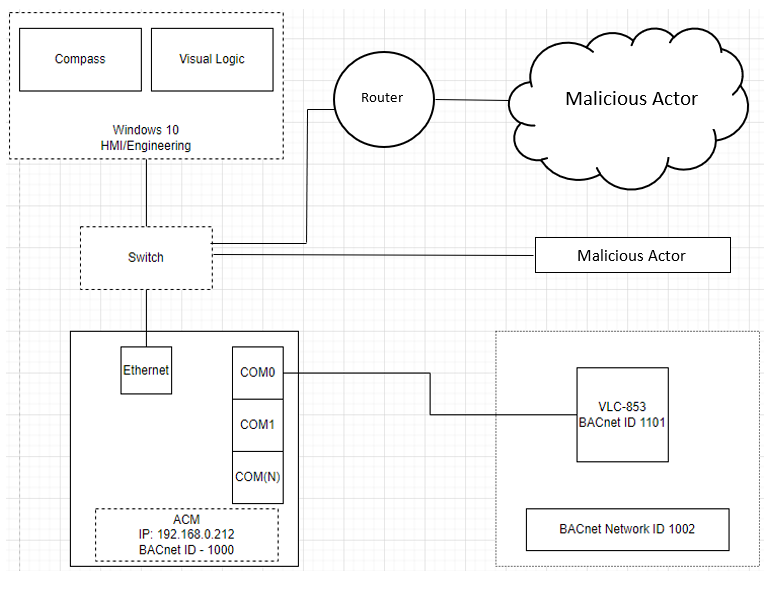
The Alerton Suite is made up of many different components. For example, in the research we conducted the Alerton Ascent network comprised:

  1. Alerton Ascent Control Module (ACM) – Main controller
  2. VLC-853 – Field controller
  3. Alerton Compass – Management and Control Tool
  4. Visual Logic – Programming ToolAlerton Ascent Suite Topology Map

As seen in the topology map, an ACM is connected to a VLC-853 device over a serial port. The Compass software and Visual Logic software have access to the ACM over ethernet via a network switch. 

Any user, innocent or malicious, can access the various Alerton devices and software either locally or remotely via the network switch, assuming that there are no extra security tools providing network protection (such as an FW or switch port security).

The resulting effect of a malicious user gaining access to the Ascent Suite can result in a degradation of credibility, integrity, and availability of the BMS as a whole. 

Configuration Change for Alerton ACM

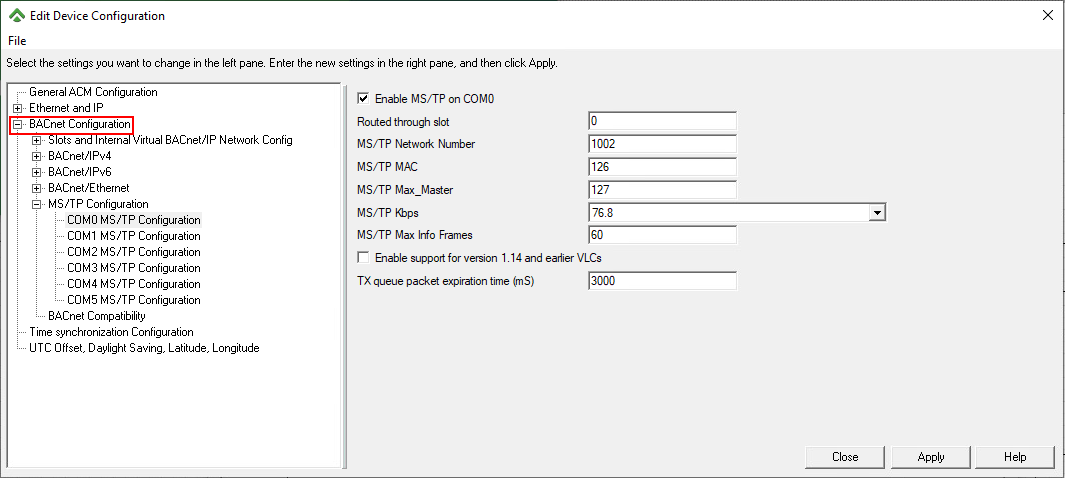
The Compass software provides the ability to configure the ACM. This configuration includes setting IP values, enabling or disabling specific ports, defining which networking protocols are active and more. In general, the configuration is set when the system is installed and is rarely changed thereafter. 

Alerton Config Interface

The Attack – CVE-2022-30242 and CVE-2022-30245

Two of the CVEs that were disclosed, CVE-2022-30242 (cvss 3.x score of 6.8) and CVE-2022-30245 (cvss 3.x score of 6.5), are vulnerabilities discovered which allow for configuration changes to be made outside of the Compass Software without any authorization or authentication. In addition, the configuration changes that were performed are relayed to the Compass Software, leaving the system operator unaware that a change to the configuration occurred. 

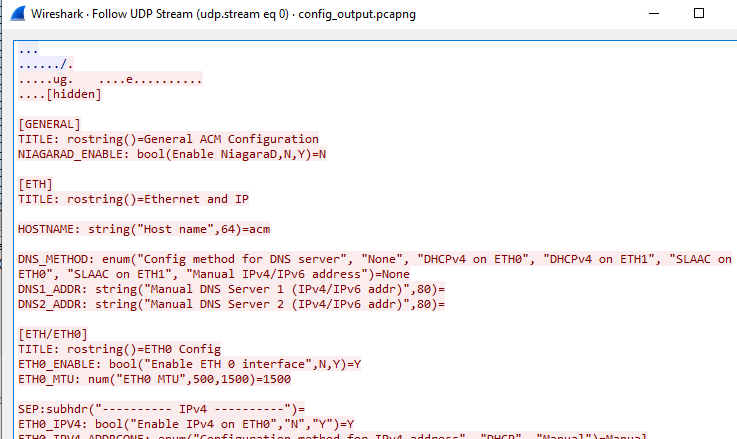
The following is a Wireshark partial capture showing how the configuration data is sent over the network from the Compass Software to the ACM: 

Wireshark capture showing config data sent over the network

As seen in the traffic snippet above from Wireshark, the configuration is sent to the ACM in ASCII characters and in cleartext with no obfuscation and minor difficulty in understanding or changing the configuration data. 

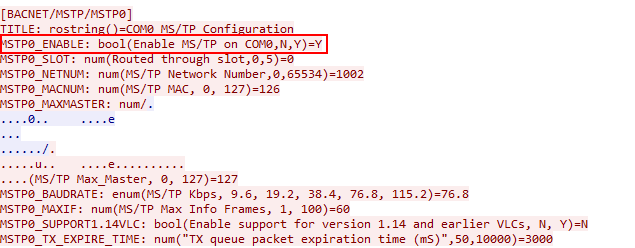
By extracting the whole configuration from the network traffic, and setting the MSTP0 ENABLE field to N, we can simply disable the COM0 port from any computer with access to the ACM. 

Change sent over the network 

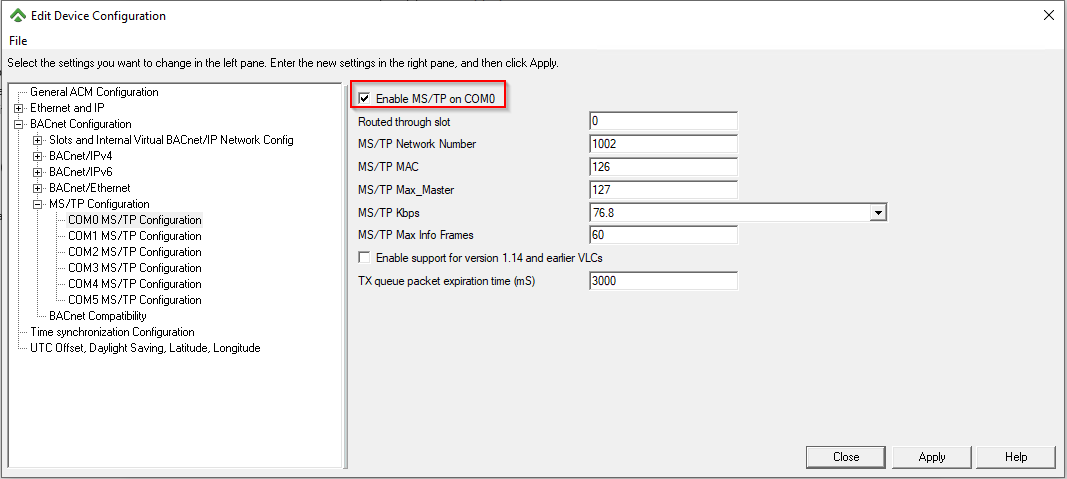
As a result of sending a specially crafted packet with the above change, the configuration of the ACM changed, and COM0 was set to disabled, disconnecting the VLC-853 controller from the ACM: 


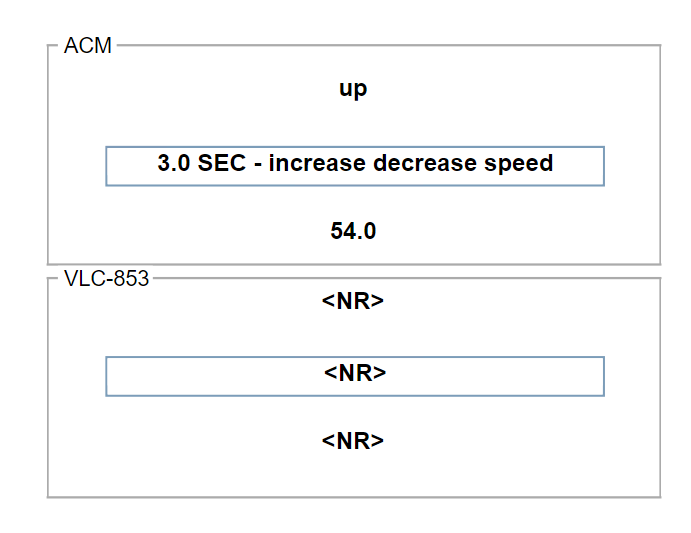
While successful changes in the configuration occurred, the Device Configuration window still indicates to the operator that COM0 is enabled: 


While successful changes in the configuration occurred, the Device Configuration window still indicates to the operator that COM0 is enabled:

In a real life scenario, this can have significant and/or tragic effects. 

Having this vulnerability leveraged in a real life setting can cause connectivity issues or undefined behavior of the entire network. In the example above, COM0 was disabled, which resulted in the VLC-853 to be cut out of the network. 

If the VLC-853 was responsible for ensuring that a cloud storage server room was properly cooled, operators who notice that VLC-853 is not communicating with the ACM and also are unaware that a configuration change occurred, may be compelled to shutdown the server farm out of fear of the servers overheating causing major disruptions for numerous services worldwide. 

This is obviously a single example for a single change in configuration. Any number of other changes can have similar, troubling effects. 

Programming Changes for Alerton Controllers

Programming management for Alerton Controllers is done using an Alerton proprietary plug-in for Microsoft Visio called Visual Logic. Programs written in using Visual Logic use diagrams to display the program in a visual manner as seen below:Visual Logic Program sent to Alerton Controller

Programs are written, pushed to controllers and run by engineers whose task it is to define the programmatic logic of the controller necessary for it to perform its specific role in the network.

Programs are written and edited on an as-needed basis and are not accessed frequently so long as the target device is fulfilling its intended purpose. 

The Attack – CVE-2022-30243 and CVE-2022-30244

In our research, we successfully wrote a program to an Alerton ACM device without authorization or authentication. In addition, the Visual Logic software did not provide an indication that a programming change occurred or that there is a difference in the program saved in the engineering software to that actually running on the ACM. This leaves an operator clueless as to why a controller has malfunctioned, changed its activity or stopped processing altogether.

This resulted in the disclosure of two CVEs, CVE-2022-30243 (cvss 3.x score of 8.8) and CVE-2022-30244 (cvss 3.x score of 8.0)

The packet sequence for writing a program to the ACM is a set sequence of Bacnet commands and is listed, in order as follows: 

With the exclusion of ADD_CODE_BLOCK_PACKET, all of the commands above are static, constant BACnet packets with a dynamic parameter of invoke ID. Being a BACnet system, there are no authorization checks to ensure that the commands being sent are from a reliable and authorized source. 

An attacker who has network access to any of the Alerton controllers can send a maliciously crafted program, using the above sequence of commands, to change a program on the target controller. This is done without the knowledge of an operator, as there is no indication of a program change in the Compass software or the Visual Logic Programming Visio plug-in. 

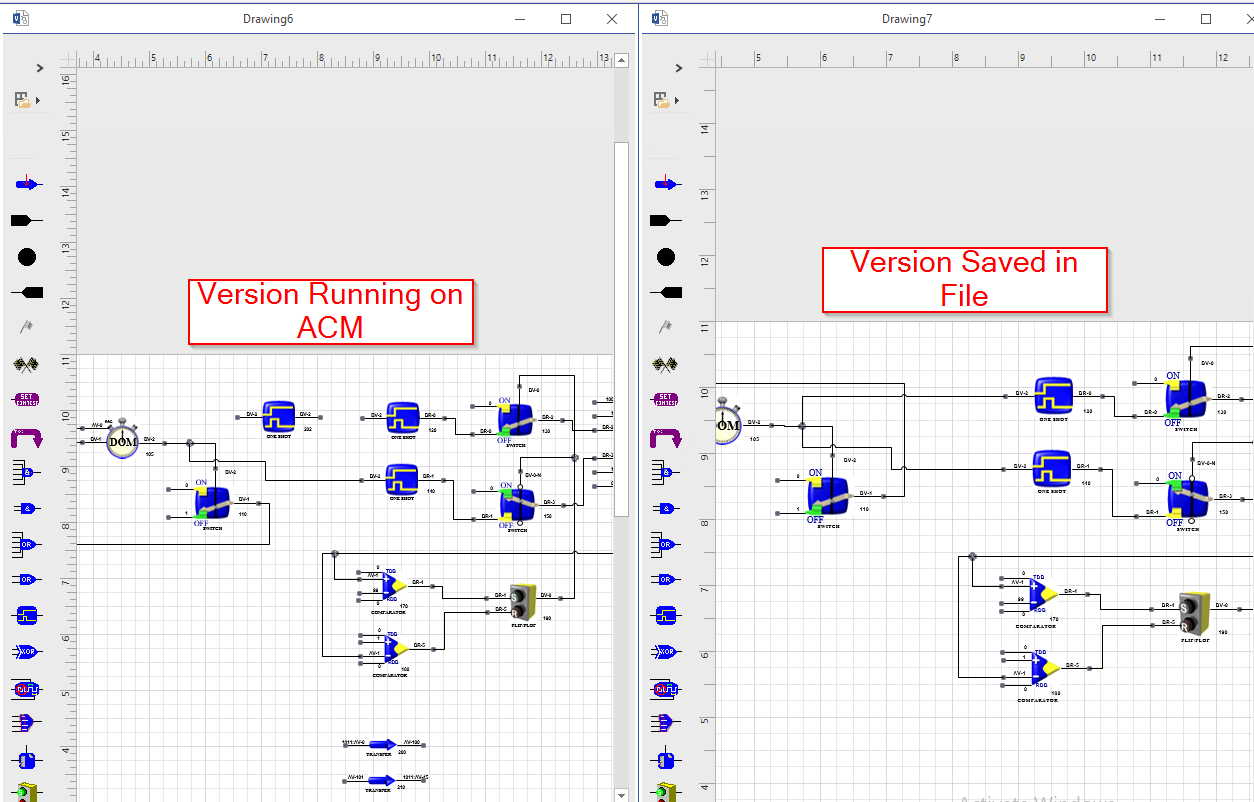
The following image is a diagram of the program that we pushed to the controller in the previous section; however, an additional component was added and pushed to the controller from a third-party computer with no access to the Visual Logic software:  

VIsual Logic Image of Program Pushed to Alerton Controler

The only indication that a programming change occurred is by clicking the Read from Device button as seen in the image below, and comparing the downloaded program to that which is stored on the engineering station:


Program Stored On Engineering Station

As with the configuration change vulnerabilities, if these vulnerabilities are leveraged on an Alerton controller in a real-life, production network the effects can be catastrophic. 

If a controller is managing the air flow in a chemical lab, and a program is written to the controller that essentially renders it useless for its current purpose (either by sending a stub program, or sending a program that does not fulfill the air flow requirement), anyone in the lab could potentially be in life threatening situation. 

The potential scenarios that can occur by taking advantage of these vulnerabilities are endless, and can be very serious and even lethal. 

Full details on the CVEs can be found on the official NIST website:
https://nvd.nist.gov/vuln/detail/CVE-2022-30242

https://nvd.nist.gov/vuln/detail/CVE-2022-30243

https://nvd.nist.gov/vuln/detail/CVE-2022-30244

https://nvd.nist.gov/vuln/detail/CVE-2022-30245

In response to SCADAfence’s findings, Honeywell issued a Product Security Bulletin informing Alerton ACM Controller users of the vulnerabilities. 

To learn more about how the SCADAfence Platform can protect your OT network, visit our website or request a demo.

About Version 2 Digital

Version 2 Digital is one of the most dynamic IT companies in Asia. The company distributes a wide range of IT products across various areas including cyber security, cloud, data protection, end points, infrastructures, system monitoring, storage, networking, business productivity and communication products.

Through an extensive network of channels, point of sales, resellers, and partnership companies, Version 2 offers quality products and services which are highly acclaimed in the market. Its customers cover a wide spectrum which include Global 1000 enterprises, regional listed companies, different vertical industries, public utilities, Government, a vast number of successful SMEs, and consumers in various Asian cities.

About SCADAfence
SCADAfence helps companies with large-scale operational technology (OT) networks embrace the benefits of industrial IoT by reducing cyber risks and mitigating operational threats. Our non-intrusive platform provides full coverage of large-scale networks, offering best-in-class detection accuracy, asset discovery and user experience. The platform seamlessly integrates OT security within existing security operations, bridging the IT/OT convergence gap. SCADAfence secures OT networks in manufacturing, building management and critical infrastructure industries. We deliver security and visibility for some of world’s most complex OT networks, including Europe’s largest manufacturing facility. With SCADAfence, companies can operate securely, reliably and efficiently as they go through the digital transformation journey.