Skip to content

SaaS 的 HIPAA 合規性:醫療保健提供者指南

As healthcare providers increasingly rely on Software-as-a-Service (SaaS) applications to manage patient data, it is crucial for them to understand the importance of HIPAA compliance.

This article will discuss what healthcare organizations need to know about HIPAA compliance for SaaS and how to ensure that their SaaS applications follow industry-specific regulations.

What does HIPAA compliance mean for SaaS?

When it comes to HIPAA compliance, SaaS providers fall into two broad categories: developers and app providers and SaaS hosting services. The two groups have different compliance needs, so it’s helpful to discuss them separately.


SaaS developers and providers

SaaS developers and providers that serve the healthcare sector must ensure their products are HIPAA compliant.

HIPAA compliance means that SaaS developers and service providers adhere to HIPAA’s Security, Privacy, and Breach Notification rules. The most important section here is the HIPAA Security Rule, which has three sub-sections: technical, administrative, and physical.

Under the HIPAA Security Rule, Covered Entities (CEs) and Business Associates (BAs) must put in place protective measures to secure Protected Health Information (PHI). SaaS companies tend to fall under the Business Associate header.

SaaS providers must sign Business Associate Agreements (BAAs) with clients. These agreements set out areas of responsibility and liability. Both healthcare companies and cloud providers should be clear about sharing compliance duties and protecting patient data.

SaaS hosting services

The situation is less clear about SaaS hosting services. HIPAA security rule does not set clear guidelines for cloud computing companies hosting healthcare services. Yet, it has become increasingly important to brand cloud infrastructure as HIPAA-eligible.

HIPAA-eligible hosts offer products that clients can adapt to meet HIPAA standards. This reassures clients that shared cloud computing architecture is properly secured. The major cloud platforms offer HIPAA-eligible services, including Amazon Web Services, Microsoft Azure, and Google Cloud.

Important HIPAA compliance areas for companies and SaaS providers

Not all SaaS companies working in the healthcare sector need to worry about HIPAA compliance. For example, many health app developers won’t handle patient records if their involvement ends when the app is delivered to clients.

But this changes if DevOps teams maintain and update cloud apps for health companies. If you handle Protected Health Information or could access PHI during development tasks, you must be HIPAA compliant.

Generally speaking, HIPAA compliance is critical for providers of SaaS-based healthcare services such as monitoring apps, payment portals, or insurance management tools. And compliance is also a concern for services that host PHI on cloud infrastructure.

Specifically, healthcare organizations need to protect patient data:

  • When creating patient records

  • When information is received

  • When PHI is at rest on cloud resources

  • During transmission (if this involves SaaS infrastructure or apps).

HIPAA requirements for SaaS providers

What does the process of becoming HIPAA-compliant look like? Under the HIPAA Privacy rule, there are three main areas of focus.

Firstly, achieving SaaS data security involves creating robust technical controls. This could include encryption of data in transit and at rest. It also includes access controls to prevent unauthorized access to confidential data. Multi-factor authentication, firewall protection, and password management systems all contribute.

On the administrative side, SaaS companies must train workers to use SaaS tools safely. They must also have robust data handling policies and device usage rules to prevent the unsafe movement of patient data.

Finally, physical security measures include securing data centers via locks, authorization systems, and cameras. There should be measures to protect physical devices on and off-site and plans to guard data against natural disasters and sabotage.

Business Associate Agreements cover all three of these areas. The Covered Entity and Business Associate sign BAAs before commencing their business partnership.

The BAA describes the areas of responsibility of clients and SaaS providers. It includes details on how to achieve compliance. And it explains how partners will be liable when security breaches occur.

Sharing compliance responsibilities

Under the Privacy Rule. SaaS partners and Covered Entities have shared responsibility for protecting patient data.

Cloud Service Providers guard infrastructure and data at rest on their servers. Service users manage access control, data in transit, and how users interact with their apps. This situation applies in healthcare as well. But controls on data access are much tighter.

HIPAA-compliant SaaS hosts and providers must apply the strongest possible encryption to all confidential data. They are responsible for ensuring data is available when requested. Servers must also remain online when healthcare organizations need them.

SaaS hosts manage the physical safety of hosting infrastructure. SaaS providers handle the integrity of application code. They must guard against emerging threats like Zero Day Exploits and ensure healthcare apps are as secure as possible.

Healthcare organizations (Covered Entities) have different responsibilities. Healthcare organizations must train staff to use SaaS services safely. Every covered entity needs to educate users about safe remote access, using encryption, managing passwords, and avoiding phishing attacks.

Healthcare organizations also deal with access controls. They must ensure PHI is only available to authorized professionals or patients themselves.

Most cloud-based cyber attacks have their roots in unsafe user behavior or loose access controls. Provider-side security is critical. Yet, it’s also important for SaaS providers and hosts to tighten their HIPAA compliance.

Healthcare organizations and SaaS partners should know exactly how to share responsibility and take appropriate action to ensure watertight compliance.

Implementing HIPAA compliance measures

A robust HIPAA compliance plan ensures that SaaS companies follow HIPAA’s Security, Privacy, and Breach Notification rules. Dividing your compliance plan between the three HIPAA regulations is good practice.

Compliance plans cover many areas, and the exact make-up varies between organizations. But common elements include:

Risk management

Create risk management plans for all critical data protection risks. Risk assessment processes should include risk severity and actions required to mitigate each risk.

Project ownership

Appoint individuals with responsibility for HIPAA privacy and security management.

Security controls

This includes physical safeguards such as cameras and locks. Data protection controls are also crucial. Use encryption, access management, endpoint protection, and monitoring tools to track user activity,

Administrative safeguards

This could include training plans to educate workers and communicate HIPAA responsibilities.

Auditing

Regular compliance audits ensure controls function properly and that staff training achieves the desired results.

Systems to receive and act on HIPAA complaints

Create a secure email or phone line to report PHI violations. Organizations must make data available to patients and have streamlined processes to report data breaches to regulators.

Documentation

Create and store clear documentation outlining HIPAA compliance policies. Make documents available to staff members and regulators if needed.

Handling third parties and associates

HIPAA-compliant organizations must have solid procedures to onboard business associates. SaaS partners should be able to provide clear evidence of compliance and HIPAA eligibility (if needed).

Clients should immediately know that the SaaS provider is a dependable and secure partner. If you have not done so, plan to achieve recognized security standards such as NIST 800-53, ISO 27001, or ISO 20000-1.

How can NordLayer help?

Becoming HIPAA compliant can be challenging for SaaS developers and service providers. But if you want to thrive in the healthcare sector, a strong compliance plan is essential. Nordlayer’s HIPAA-compliant solution can help you make the changes needed when building a reputation in SaaS health provision.

Our network security solutions include the following:

  • Streamlined network access controls to ensure only authorized users can access PHI.

  • Secure Remote Access from all endpoints ensures equally secure and protected network access for remote and hybrid work environments without putting health data at risk.

  • 256-bit AES encrypts data that is being sent between networks and reduces data breach risks.

  • Compatibility with major cloud platforms such as Azure and AWS. Integrate Secure Remote Access with cloud-native controls to create a solid HIPAA security setup.

All SaaS companies operating in the health sector need rock-solid data protection that complies with HIPAA regulations. Explore your options and ensure safe access to PHI with Nordlayer’s assistance.


About NordLayer
NordLayer is an adaptive network access security solution for modern businesses – from the world’s most trusted cybersecurity brand, Nord Security.

The web has become a chaotic space where safety and trust have been compromised by cybercrime and data protection issues. Therefore, our team has a global mission to shape a more trusted and peaceful online future for people everywhere.

About Nord Security
The web has become a chaotic space where safety and trust have been compromised by cybercrime and data protection issues. Therefore, our team has a global mission to shape a more trusted and peaceful online future for people everywhere.

About Version 2 Digital

Version 2 Digital is one of the most dynamic IT companies in Asia. The company distributes a wide range of IT products across various areas including cyber security, cloud, data protection, end points, infrastructures, system monitoring, storage, networking, business productivity and communication products.

Through an extensive network of channels, point of sales, resellers, and partnership companies, Version 2 offers quality products and services which are highly acclaimed in the market. Its customers cover a wide spectrum which include Global 1000 enterprises, regional listed companies, different vertical industries, public utilities, Government, a vast number of successful SMEs, and consumers in various Asian cities.

為什麼中小型公司的安全心態對業務成功至關重要:與 Cutec 交談

A discussion with Mark Rowland, Co-Founder & Managing Director at Cutec, about how they solved client problems using NordLayer and what to expect for next cybersecurity’s major challenges and possibilities.

Cutec is a Managed Service Provider (MSP) and IT support company from England. Operating in the industry for 25 years, a 20-employee expert team supports a range of small and medium clients across the UK. Whether an organization has a staff of just a few or hundreds of people, Cutec’s role is to consult companies with technical focus and accuracy to fill in the vacancy of an internal IT person for the client.


The consultancy firm fills in the IT management and knowledge gap, which is a recurring issue for many businesses, especially smaller organizations Cutec gets to consult. However, conversing with different clients revealed another concern — there’s no cybersecurity mindset. Mark Rowland, a Co-founder and Managing Director at Cutec, shares his insight on how crucial security awareness is for business continuity. 

Business case: decentralizing single-site infrastructure

The client has been with Cutec for about 6 years — during this time, the company of 30 people expanded to an almost 300-employee organization. And as this financial services provider grew into a country-wide company, it started facing security challenges.

“As for a managed IT service provider, it is important to be there for your client when they need you. It’s our responsibility to support branches dotted around different parts of the UK — online presence becomes a necessity over physical.”

Click to tweet

Being contained in one place and managing 20 people is relatively easy. However, the client business model involved advisors spread all over the country. Combine it with rapid growth during a short time and data sensitivity due to the nature of financial services — the need to protect databases, CRM, and phone systems was critical.

The foundational elements for security were there: the client had two-factor authentication, password management, and fixed IP in place. It’s secure enough for 20 people sitting in one office, but not if numbers jump to hundred users in dozen cities — circumstances urged for an extra layer of security.

An increasing number of VPN connections to internal applications started causing connectivity issues and quickly bogged the network. This was the turning point for Cutec to find a better solution for a VPN route that would ensure security.

Close-up on the solution

One of the available options for the client was to get much more powerful broadband for the HQ office, install hardware firewalls, and achieve the wanted level of security for an outrageous expense bill.

Moreover, the solution would bind everything to one location. From a disaster management perspective, it’s not sustainable for business continuity — if the power is cut off, the internet goes down, and all employees get disconnected despite their location.

The alternative was getting a NordLayer subscription. Although it meant paying per user license, it offered what the company needed — a fixed IP address that provided much-needed flexibility and stability.

Choosing NordLayer allowed upgrading and downgrading the number of member accounts as the staff comes and leaves and, most importantly, eliminating the dependence on the HQ office — if the power got cut off, server design allowed carry-on working.

Sorting out the inconvenience of in-house security


Deployment and maintenance of the on-premise solution meant a lot of man-hours. It included a remote connection to a client’s PC and setting up their VPN connection. 

NordLayer, on the other hand, provided a simple solution. The MSP had to connect to the Partner Portal and add the user, so they could complete the setup themselves — click the welcome link to install the VPN.

“The solution setup was fantastic as we looked at a massive project and a big headache. Rolling out NordLayer VPN connection to 300 people was achieved in four days. And out of 300 members, we had only five people calling for help, but that’s because they were cautious, not because they didn’t know what to do.”

Click to tweet

It’s worth mentioning that the client has no one in-house with the knowledge and expertise on cybersecurity. In this case, Cutec is an advisor and a guide for organizations’ cybersecurity strategy, closely collaborating with a single point of contact on-premise, the Technology Director, to help steer the business away from cyber threats.

Expert insights: take on SMBs security

The client scope Cutec works with is usually small-medium sized businesses without internally dedicated IT staff. Better to say SMBs have little understanding of cybersecurity. There’s a persistent tendency for a slow but inevitable change in the business mindset:

  • A now-outdated perspective of ‘antivirus solves all our security problems’ was effective 10–20 years ago — today you have to think outside the box.

  • Small-medium enterprises tend to give on-premise servers and migrate to the cloud more often. Core IT support is going to change. It will be more about picking the right cloud solution for people driving the migration to the cloud. Over the next three years, people will drop on-premise stuff and go to the cloud completely, and we’ll be there to help them with that.

  • Cloud-edge solutions like NordLayer are going to get more popular over time. Teams work from coffee shops and McDonald’s — they connect to public Wi-Fi and hot spots and must protect their traffic with tools that work well.

A future notion on SMBs from sensitive industries


The cybersecurity landscape changed— now it’s about protecting yourself online. At our company, we notice clients are transitioning to online cloud services. The number of adopted vendors and service providers can be three, five, or a dozen online solutions and tools.

Previously, having a server in the office under lock and key with a firewall allowed us to assume that that was enough to keep the company secure. However, small businesses struggle to comprehend the gravity of cybersecurity.

“Using Office365, therefore, thinking my data is secure is a mistaken approach. Company data might be secure in the Microsoft Data Center, but is it safe where you are accessing it from?”

Click to tweet

After Covid, once people started connecting from their home PCs and smartphones, companies without proper security measures risked having their business data on employees’ personal devices.

Larger enterprises and governmental institutions already have an awareness – sometimes forced by insurance companies and bank regulations – of owning some security accreditations to filter down the risks. Meanwhile, small-medium enterprises don’t have this perception, and MSPs like Cutec help them drive in the right direction.

Our biggest challenge is overcoming the big issue of clients thinking that security is finite. Threats are layered and complex — getting an antivirus or a firewall might solve only a small part of the potential risks and gaps for threat actors to exploit. Instead, business owners and their teams must keep up-to-date with a cybersecurity mindset to guarantee business continuity.

Pro cybersecurity tips

Education on cybersecurity is increasing, and it is becoming a common topic of conversation. More and more employees and decision-makers now acknowledge a serious lack of digital security knowledge. To make the learning process easier, it’s better to ask questions and have some starting points. Here’re some pro tips you can begin with:


Explore cybersecurity to broaden your knowledge about threats and solutions for managing them. NordLayer offers layered-by-design network access solutions for all kinds of businesses and their team setups to rise to the challenges of a modern company. And at NordLayer, we care about guidance. Thus, explore our Cybersecurity Learning Center and Decision Maker’s Kit for in-depth support for building your own cybersecurity strategy.

Want to join forces to build a more resilient and aware cybersecurity landscape for businesses and organizations? NordLayer invites Managed Service Providers to seize the opportunity to join our Partner Program — reach out to learn more about it.


About NordLayer
NordLayer is an adaptive network access security solution for modern businesses – from the world’s most trusted cybersecurity brand, Nord Security.

The web has become a chaotic space where safety and trust have been compromised by cybercrime and data protection issues. Therefore, our team has a global mission to shape a more trusted and peaceful online future for people everywhere.

About Nord Security
The web has become a chaotic space where safety and trust have been compromised by cybercrime and data protection issues. Therefore, our team has a global mission to shape a more trusted and peaceful online future for people everywhere.

About Version 2 Digital

Version 2 Digital is one of the most dynamic IT companies in Asia. The company distributes a wide range of IT products across various areas including cyber security, cloud, data protection, end points, infrastructures, system monitoring, storage, networking, business productivity and communication products.

Through an extensive network of channels, point of sales, resellers, and partnership companies, Version 2 offers quality products and services which are highly acclaimed in the market. Its customers cover a wide spectrum which include Global 1000 enterprises, regional listed companies, different vertical industries, public utilities, Government, a vast number of successful SMEs, and consumers in various Asian cities.

查找 PaperCut MF 和 NG 服務器

PaperCut recently revealed that two products in its popular line of print server software contain severe vulnerabilities currently being exploited in the wild. Reported via the Trend Micro Zero Day Initiative, these vulnerabilities can be exploited by unauthenticated attackers to achieve remote code execution as the SYSTEM user (CVE-2023-27350/ZDI-CAN-18987) or information disclosure, including user information and password hashes (CVE-2023-27351/ZDI-CAN-19226).

What is the impact?

With a CVSS score of 9.8 (“critical”), CVE-2023-27350/ZDI-CAN-18987 exists in the SetupCompleted class and can be leveraged for unauthenticated remote code execution due to improper access control. The Application Server and Site Server components of PaperCut MF and NG product versions 8.0 and later contain this flaw.

CVE-2023-27351/ZDI-CAN-19226 has been assigned a CVSS score of 8.2 (“high”) and exists in the SecurityRequestFilter class as a flaw in the authentication algorithm, allowing for unauthenticated information disclosure. The Application Server component of PaperCut MF and NG product versions 15.0 and later contain this flaw.

PaperCut’s website claims over 130 million users of their products across almost 90,000 organizations in almost 200 countries, including government, commercial, and educational users. Coupled with the substantial list of affected product versions and exploitation of these vulnerabilities already observed happening in the wild, the impact could be quite broad. Trend Micro will defer disclosing more details on these vulnerabilities until next month in order to give PaperCut customers time to patch.

While a definitive indicator of compromise doesn’t exist in detecting exploitation of these vulnerabilities on a target, PaperCut does offer some clues one can look for.

Are updates available?

Last month, PaperCut released patched versions 20.1.7, 21.2.11, and 22.0.9 which fix these vulnerabilities. Older unsupported/end-of-life versions will not be receiving a patched update.

For admins who cannot patch immediately, PaperCut does provide a mitigation for CVE-2023-27351/ZDI-CAN-19226, but none is available currently for CVE-2023-27350/ZDI-CAN-18987.

How do I find potentially vulnerable PaperCut services with runZero?

From the Services inventory, use the following prebuilt query to locate all PaperCut MF and NG servers in your network:

_asset.protocol:http and protocol:http and (http.body:"PaperCut MF is a print management system" OR last.http.body:"PaperCut MF is a print management system" OR http.body:"PaperCut NG is a print management system" OR last.http.body:"PaperCut NG is a print management system")

As always, any prebuilt queries are available from your runZero console. Check out the documentation for other useful inventory queries.

About runZero
runZero, a network discovery and asset inventory solution, was founded in 2018 by HD Moore, the creator of Metasploit. HD envisioned a modern active discovery solution that could find and identify everything on a network–without credentials. As a security researcher and penetration tester, he often employed benign ways to get information leaks and piece them together to build device profiles. Eventually, this work led him to leverage applied research and the discovery techniques developed for security and penetration testing to create runZero.

About Version 2 Digital

Version 2 Digital is one of the most dynamic IT companies in Asia. The company distributes a wide range of IT products across various areas including cyber security, cloud, data protection, end points, infrastructures, system monitoring, storage, networking, business productivity and communication products.

Through an extensive network of channels, point of sales, resellers, and partnership companies, Version 2 offers quality products and services which are highly acclaimed in the market. Its customers cover a wide spectrum which include Global 1000 enterprises, regional listed companies, different vertical industries, public utilities, Government, a vast number of successful SMEs, and consumers in various Asian cities.

醫療保健網絡安全:如何保護患者數據

Cybersecurity for healthcare organizations involves protecting sensitive patient data from unauthorized access, use, and disclosure. It’s a strategic imperative for every healthcare business, but with the digitization of medical records, sharing sensitive information has become simple and, at the same time, much more exposed to cyber threats.

Cyberattacks often cause serious disruptions to patient care and lead to misdiagnosis and medical errors. Many studies have shown that ransomware attacks affected hospital mortality rates due to the lack of access to patient information. Also, as HIPAA Breach Notification Rule states, sensitive information violations can have serious financial consequences.

What other cybersecurity risks are healthcare organizations facing? And how can you mitigate them? Read on to discover the best practices for healthcare cybersecurity.

Over 93% of covered entities and business associates faced a breach in the last two years. According to IBM Data Breach Report, in 2022, the healthcare sector suffered the highest costs of data breaches. And although the number of breached records fell from 54.09 million in 2021 to 51 million in 2022, healthcare still remains one of the industries most affected by hackers. The commercial and public health sector is clearly under fire.

A new trend is a growing number of attacks through third-party vendors. Nearly 26 million records were exposed from business associates, and almost 25 million were on healthcare organizations.

Cyber attacks will continue to plague the US health sector, the Healthcare Cybersecurity Report for 2022 states. The criminal ecosystem keeps evolving and adjusting to new security measures. Threat actors will increasingly look for and exploit vulnerabilities in the systems. Also, third-party vendors are more at risk now.

Other long-term trends are seemingly unrelated geopolitical events directly impacting the healthcare industry. Since the beginning of the war, the Russian government has regularly leveraged wipers and DDoS attacks. And the same applies to Russia’s allies, such as China, North Korea, and Iran. 

Cybersecurity challenges for healthcare organizations

Let us examine why the healthcare industry is an attractive target for threat actors. There are 3 main reasons for that trend: 

  • Poor risk management

Healthcare organizations deal with connected medical devices (Internet of Medical Things), employees’ devices that don’t have adequate security measures, and several third parties that access Protected Health Information (PHI) and other critical assets. Ensuring adequate cybersecurity solutions that mitigate risk and address vulnerabilities in a legacy system is critical.

  • A huge value of PHI on the Dark Web

Stolen patient data can be used for malicious activities like identity theft or healthcare insurance fraud. A single medical record is valued at up to $250 on the black market, and this information is worth about 50 times more than credit card details on the Dark Web.  All this means that patient privacy is at risk of being violated.

  • Financial reasons 

It’s a major security risk for the industry. Suffering a ransomware attack, for example, means paying a large amount to the attackers. 

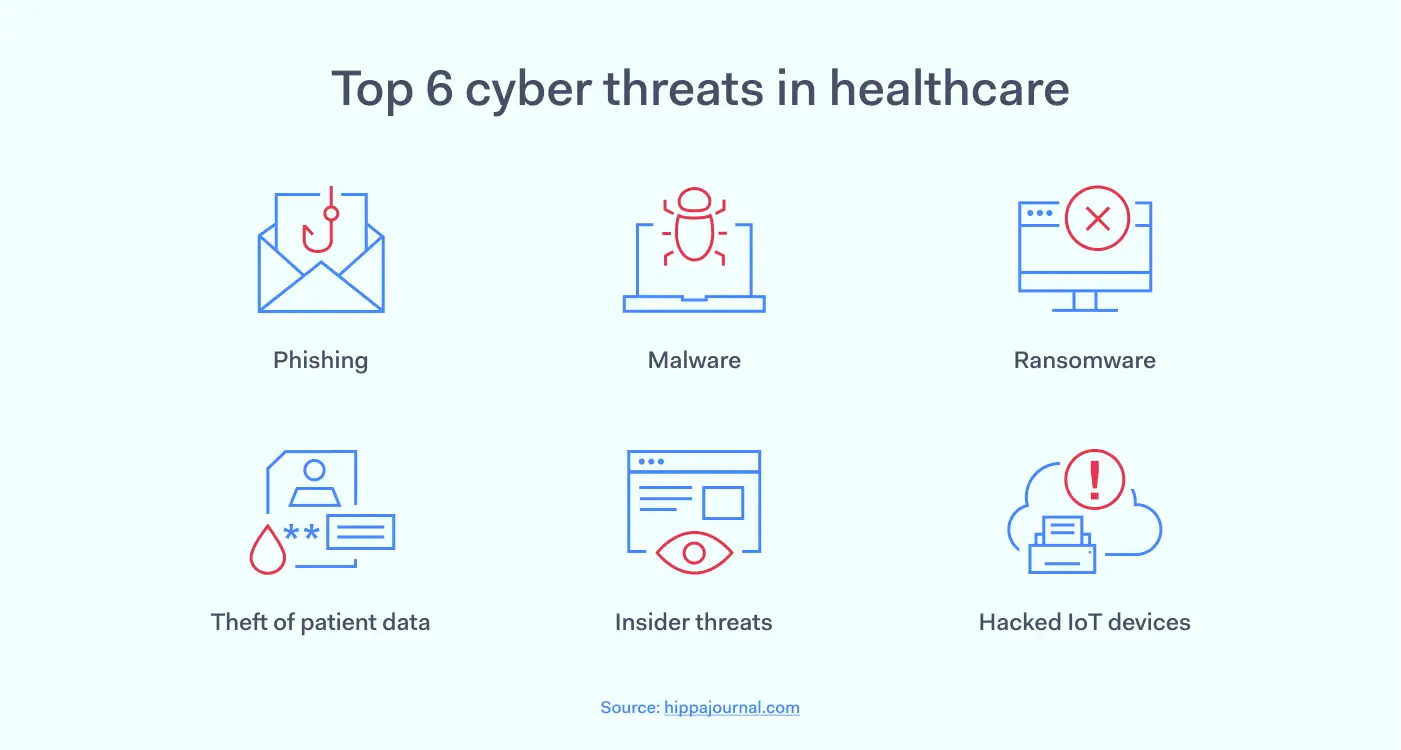
Top 6 cyber threats for healthcare organizations

Threats for the healthcare industry come in many forms, from ransomware to theft of personal information. In 2022, the biggest security breaches in healthcare came from phishing and malware attacks.

  • Phishing

Phishing targets individuals by tricking them into disclosing sensitive information, clicking a malicious link, or opening a malicious attachment. The most common telltale sign of a phishing email is that it conveys a sense of urgency or preys on fear or greed. Scammers can also use social media, text messages, and voice calls for phishing. 

  • Malware

It’s malicious software installed on a computer without a user’s consent. It can steal passwords or money or perform other malicious actions. Examples of malware include a Trojan horse, spyware, adware, or a virus.

  • Ransomware

Ransomware is a form of malware that encrypts files on a user’s device and locks them out until they pay the hacker money to release them. 

  • Theft of patient data

Stolen patient medical records may be sold on the dark web and used for insurance fraud or identity theft. Often, data recovery is not possible.

  • Insi
    der threats

These risks can come from current or former staff members or contractors and happen intentionally or by negligence. For example, an employee may accidentally click a malicious link in a phishing email or skip security protocols to make their job easier. 

  • Hacked IoT devices

Hackers take advantage of vulnerabilities in devices connected by IoT, such as handheld devices, camera sensors, or CT scanners.

Top 6 cyber risks in healthcare

All the facts and statistics mentioned earlier mean one thing: cybersecurity in healthcare is a burning issue. Criminals can disrupt health businesses with malware, ransomware, or phishing. And damage the organization’s reputation and endanger patients’ lives. But apart from that, healthcare organizations are exposed to various cyber risks, such as unprotected access to PHI, human error, vulnerabilities of legacy systems, third-party vendors, and a lack of regular cyber risk audits. 

Risk 1: Unsecured access to PHI

According to new HIPAA encryption requirements, ensuring all sensitive patient data is unreadable, undecipherable, and unusable to any person or software program without access rights is mandatory. For your organization, it means implementing robust security controls that help store Protected Health Information (PHI) safely and protect it from unauthorized access.

Risk 2: Human error

82% of data breaches involved a human element, including social attacks, errors, and misuse.  according to Verizon’s 2022 Data Breach Investigations Report. Understanding how human error affects your organization can help you mitigate risks for the future. Almost one-third of such incidents involved a person abusing their use of internal resources. For example, a doctor shares access to their work-issued device with children, who click on a malicious link and download malware. 

Risk 3: Vulnerabilities of legacy systems 

Outdated technology opens doors for cybercriminals. Legacy devices and operating systems are vulnerable because they can’t update properly. This means inadequate security control and weaknesses in the system can’t be patched. 

However, some healthcare organizations delay transitioning to up-to-date security solutions because of tight budgets or complacency. They choose to fix a problem only after a system failure or a cyber attack. Deploying technology that encrypts data, monitors authorized users, and blocks unauthorized user access can help minimize cyber risks. 

Risk 4: Third-party vendors

The number of business associates that handle sensitive data has grown with the volume of electronic medical records. According to an analysis by Fortified Health Security, third-party vendors accounted for 16% of data breaches in the first half of 2022. 

In 2022, the largest third-party vendor data breach, which affected almost 4 million individuals, happened through a ransomware attack at Eye Care Leaders. The breach impacted at least 39 covered entities, as well. 

Risk 5: Compliance 

Healthcare organizations also face regulatory challenges. Protecting patient privacy according to the latest HIPAA and GDPR rules can be complex. Besides following compliance guidelines, your organization should implement the best cyber security practices. Failure to keep patient records private may result in substantial penalties and harm your reputation. 

Risk 6: The absence of risk assessments

Every healthcare organization should conduct a regular risk assessment to identify vulnerabilities and risks to the confidentiality and integrity of PHI.  The evaluation should determine your organization’s capabilities for detecting, preventing, and responding to cyberattacks. It’s also crucial to know where your sensitive information is, what threats your organization faces, and your system’s vulnerabilities and security holes. And what your action plan in case of an attack is. 

Best practices for healthcare cybersecurity challenges 

This year’s IBM Data Breach Report demonstrates no system is impenetrable. But healthcare cybersecurity is all about basic security measures that stop criminals and make them look for an easier target. What are the best practices for minimizing cyber risks? Here is a list of the strategies worth adopting: 

  • Deploy verified cybersecurity software

Install cybersecurity software on every connected device and secure your network. 

  • Update your software regularly

Prompt, regular updates will address patches and vulnerabilities.

  • Train your staff on cybersecurity

Your employees should be aware of cyber threats and how to detect them. 

  • Strengthen your system access controls 

Restrict access to your most sensitive data and monitor who accesses it.

  • Conduct regular risk assessments 

Identify weaknesses in your system and mitigate risks. Determine where your sensitive information is and protect access to it.

  • Ensure your business associates have strict security policies 

Some business associates have lax policies that can create problems for the healthcare organization they cooperate with. Don’t let stolen vendor credentials or data will compromise your organization. 

Cybersecurity solutions for healthcare organizations

Securing your organization from cyber threats can be overwhelming. Protecting your valuable data and critical equipment is complicated but doesn’t have to be complex. That’s why we have prepared a guide on security solutions tailored to the health industry.  

  • Network security

The key to combating any external threats is network visibility and responsive protection. A solution that quickly isolates risks will prevent your network from being exposed. Setting permissions and policies for secure users and apps across multiple devices is also good. This way, you will ensure that only authorized staff will access your confidential data. 

  • Application security 

The best way to secure access to your applications is to verify and authenticate every user, device, and connection. This Zero-trust approach enforces mandatory checks at every step and minimizes security gaps. It also enables your staff to work remotely and on multiple devices. 

  • Endpoint security

If your devices are left unsecured, they can be a gateway for breaches, and an infected endpoint will affect your organization’s functioning ability. A comprehensive solution for endpoint protection uses data encryption and enforces unified security policies on all servers, networks, and endpoints. It also monitors 24/7 access to your resources, alerting you if there is suspicious activity. 

  • Data security

Encrypting sensitive healthcare data can help conceal it from outsiders. MFA will add strength to authentication processes. Permission sets enable managing data access, meaning only authorized users can access it.  Everyone else will be blocked by default until granted the necessary privileges. Before you apply access controls, you need to classify your data accordion to its value and vulnerability. 

  • Cloud data security

As healthcare organizations move their as
sets and data to the cloud, cloud services need robust protection. Cloud providers and businesses should share responsibilities to ensure data security, but this doesn’t mean you will always have a full view of your infrastructure. The provider may move data without you even knowing it. That’s why having a clear division of responsibilities is crucial. Also, you should encrypt everything in the cloud and set strict access permissions. You add IP allowlists to only connect specific IP ranges to your network. 

How NordLayer can help 

You can protect access to your sensitive data and transition your organization towards the SSE framework by implementing our solutions for Zero Trust Network Access.

NordLayer also provides an adaptive network security solution that easily integrates with your existing infrastructure and provides secure access to sensitive resources.

Contact our sales team and discover how to protect your patient data from cyber threats.

Disclaimer: This article has been prepared for general informational purposes and is not legal advice. We hope that you will find the information informative and helpful. However, you should use the information in this article at your own risk and consider seeking advice from a professional counsel licensed in your state or country. The materials presented on this site may not reflect the most current legal developments or the law of the jurisdiction in which you reside. This article may be changed, improved, or updated without notice.


About NordLayer
NordLayer is an adaptive network access security solution for modern businesses – from the world’s most trusted cybersecurity brand, Nord Security.

The web has become a chaotic space where safety and trust have been compromised by cybercrime and data protection issues. Therefore, our team has a global mission to shape a more trusted and peaceful online future for people everywhere.

About Nord Security
The web has become a chaotic space where safety and trust have been compromised by cybercrime and data protection issues. Therefore, our team has a global mission to shape a more trusted and peaceful online future for people everywhere.

About Version 2 Digital

Version 2 Digital is one of the most dynamic IT companies in Asia. The company distributes a wide range of IT products across various areas including cyber security, cloud, data protection, end points, infrastructures, system monitoring, storage, networking, business productivity and communication products.

Through an extensive network of channels, point of sales, resellers, and partnership companies, Version 2 offers quality products and services which are highly acclaimed in the market. Its customers cover a wide spectrum which include Global 1000 enterprises, regional listed companies, different vertical industries, public utilities, Government, a vast number of successful SMEs, and consumers in various Asian cities.

HIPAA 違規後果:法律、財務和聲譽風險

The Health Insurance Portability and Accountability Act (HIPAA) is the most important data protection regulation for healthcare providers in the USA. It covers health insurers, clinics, hospitals, private practices, and developers of health apps, care settings, and pharmacies.

If you handle patient records, you need to be HIPAA-compliant. For your convenience, we have created a handy HIPAA compliance checklist for covered organizations. However, this blog looks at another critical HIPAA-related issue: the different types of violations and the penalties for breaching HIPAA rules.

Violations matter. Poor compliance causes customers to lose trust in your data protection policies. It’s only a matter of time before patients move their business elsewhere. Regulators can also issue significant financial penalties or even jail offenders in the most extreme cases.

This makes protecting sensitive data a critical task for health companies and their partners. So let’s explore the issue in-depth and explain everything you need to know about HIPAA violations.

What qualifies as a HIPAA Violation?

Before talking about HIPAA penalties, we need a clear understanding of what exactly constitutes a HIPAA violation. Fortunately, the legal definition of a violation is extremely clear.

HIPAA violations take place when either a covered entity (CE) or a business associate (BA) of a covered entity breach HIPAA Security, Private, or Breach Notification Rules.

HIPAA has three main rules. Here is a quick summary of what you need to know about them:

  • The HIPAA Privacy Rule sets out protections for private health data. CEs must keep data confidential and prevent unauthorized disclosure. They must also make health records available if patients desire.

  • The HIPAA Security Rule states that healthcare organizations must keep patient records secure. This includes physical, administrative, and electronic safeguards. You could see this rule as putting the privacy rule into practice.

  • The HIPAA Breach Notification Rule requires CEs to inform patients about any actual or potential data breaches. Notification must occur within 60 days of the breach.

Covered entities must become familiar with these rules when creating a compliance strategy. If you suffer a penalty, ignorance of HIPAA guidelines is not a valid defense. Covered entities must be aware of their responsibilities under the law.

Business associates, third parties your company uses also need to be part of compliance strategies. If partners can access your network assets, they could potentially cause a data breach.

Deliberate versus accidental violations

The first thing to note is that violating HIPAA can be deliberate or accidental. Covered entities need policies to cover both types of violations.

Deliberate breaches could include nurses passing the health records of a celebrity to media contacts or selling records on the Dark Web. But they also extend to simply sharing patient data without the consent of the individual concerned. In these cases, penalties tend to be severe.

Deliberate breaches also include offenses where organizations fail to act when they should do so. For instance, companies may refuse to issue breach notifications to customers within the required 60-day limit.

Company policies that clash with HIPAA rules are often deemed deliberate breaches if regulators decide that the covered entity knew about the issue and was able to remove the conflict.

Accidental breaches of HIPAA rules carry less severe penalties. They could include the absence of encryption on mobile devices or failure to train staff in cybersecurity practices.

For example, physicians could click on phishing links disguised as communications from pharmaceutical partners. There is probably no deliberate or malicious breach here. But the covered entity would be liable due to poor security training and policies.

Broadly speaking, if companies fail to take action to conform to HIPAA rules, this will qualify as a breach. That’s why having a comprehensive HIPAA compliance strategy is essential.

Criminal versus civil violations

It’s also important to understand the difference between criminal and civil HIPAA breaches.

Criminal cases are mounted by the Department of Justice and are much less common than civil penalties. They deal with deliberate violations and can lead to prison sentences for individuals at the organizations involved. Offenses leading to criminal charges include:

  • Wrongful disclosure of Protected Health Information (PHI)

  • Wrongful disclosure of PHI under false pretenses (e.g. seeking access to medical records of patients not under the care of a physician)

  • Wrongful disclosure of PHI under false pretenses with malicious intent (to sell or otherwise benefit from stealing PHI)

Most of the time, you or your staff won’t risk criminal charges. Instead, the challenge is to minimize the risk of civil cases.

Civil cases may involve behavior that is deliberate, but not malicious. Instead, civil offenses tend to involve poor risk assessment processes or simply ignorance of what HIPAA requires.

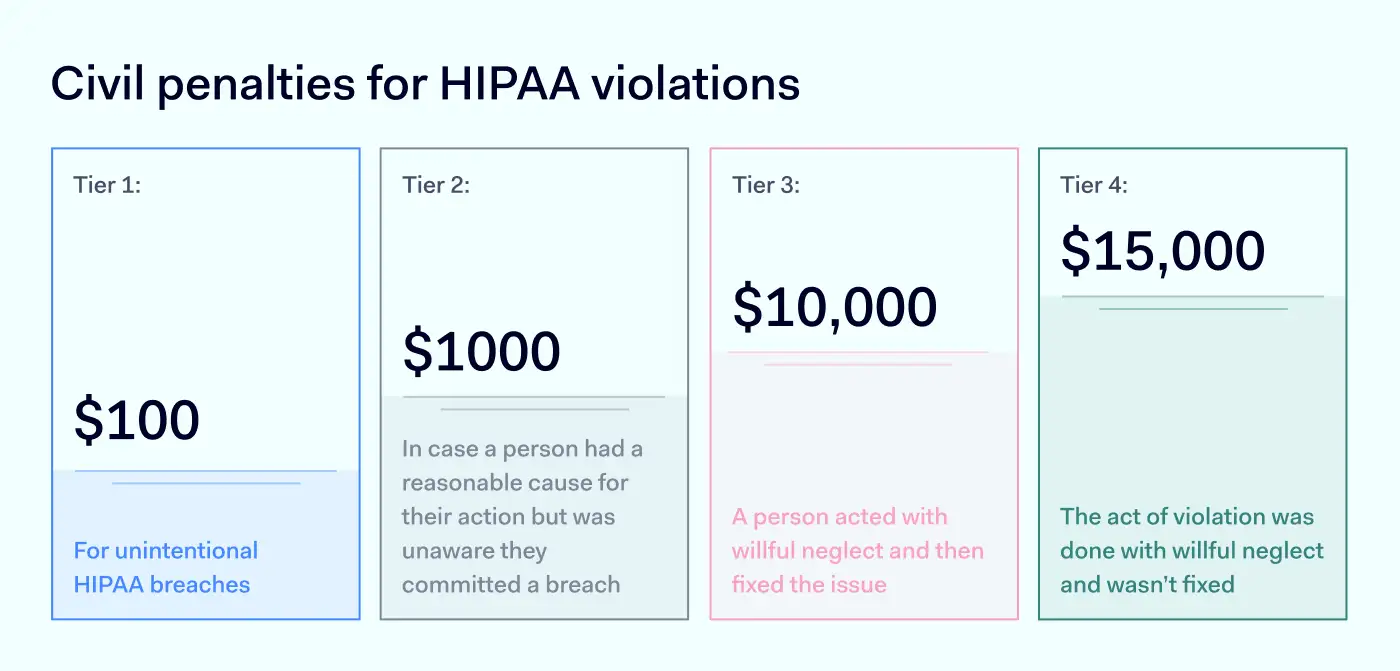
In these cases, the OCR or Attorneys General will seek a financial penalty under the HIPAA enforcement rule. Civil violations are covered by four tiers, which we will look at in more detail below.

4 types of HIPAA violations

In most instances, the Office for Civil Rights (OCR) receives complaints and decides whether organizations have violated HIPAA regulations. When the OCR deliberates, its regulators use a four-tier system to categorize potential violations.

The four tiers differ in terms of severity, with rising financial penalties. They also differ in terms of culpability. In some cases, organizations are not aware of HIPAA violations. In others, breaches are wilful and systematic.

The size of the financial penalty is related to various factors. Regulators consider:

  • How long the violation has existed

  • How many individuals are affected

  • The value and amount of the data at risk

  • Whether the organization willingly collaborates with OCR

  • Whether the organization has a clean regulatory history

Tier 1 – Accidental violation

At this tier, organizations are not aware of HIPAA breaches. The organization also had no way to avoid the violation, even with complete adherence to HIPAA regulations. At this level, covered entities must show evidence of compliance. This proves that the breach could not be avoided.

Highest penalty: $100 per incident, with a limit of $50,000

Tier 2 – Aware of violation, but no remediation possible

At tier 2, organizations know about HIPAA violations before OCR is informed. In this category, staff should have been aware of the fault. But the organization could not avoid violating HIPAA rules, even while administering adequate levels of care. This level falls short of the definition of “wilful neglect.”

Highest penalty: $1,000 per incident, with a limit of $100,000</ p>

Tier 3 – Wilful neglect with remediation

At tier 3, organizations commit “wilful neglect”. This means they were aware of the violation. the covered entity could have taken action to remedy the breach but failed to do so. However, there is a caveat here. Tier 3 penalties are lower because the organization involved has taken action to remediate the issue.

Highest penalty: $10,000 per incident, with a limit of $250,000

Tier 4 – Wilful neglect without remediation

At tier 4, organizations are also guilty of “wilful neglect”. The violation was known and the organization failed to take remedial action. Breaches in this category could continue for months or years, with serious consequences for patient welfare and data protection. For these reasons, Tier 4 penalties are far higher than other categories.

Highest penalty: $50,000 per incident, with a limit of $1.5 million

The consequences of a HIPAA violation

According to US law, if a covered entity breaks the HIPAA regulations, it may face a penalty of up to $50,000 and up to one-year imprisonment. The actual consequences depend on the type and severity of the HIPAA violation, and whether they were committed by a healthcare employee or an employer, i.e., covered entities.

There are two types of violations: civil and criminal. Each category has tiers to determine penalties for a specific breach.

Civil HIPAA penalties

HIPAA violations committed without malicious intent fall into the category of civil penalties. What’s the most common reason for these violations? Most of the time, it’s because healthcare employees or covered entities don’t know the HIPAA Privacy Rule. Yet, unawareness or negligence of HIPAA standards is not an excuse for escaping a penalty.

Criminal HIPAA penalties

Intentional HIPAA violations, such as disclosing or selling personal health information, are a crime. The criminal penalties for these violations can be severe and restitution may be also paid to the victims. A covered entity that committed a HIPAA violation must settle it with OCR and state attorneys general.

The height of the criminal penalties depends on the following factors:

  • the seriousness of HIPAA violations

  • the length of time that the violation has been taking place

  • the number of violations identified.

Who issues penalties?

HIPAA is a Federal regulation. So you might assume that penalties are issued exclusively by the Federal Government. However, the actual situation is more complex. Covered entities should be familiar with all regulatory bodies in their specific business sector.

The Office for Civil Rights (OCR)

To start with, the Office for Civil Rights processes most HIPAA violations and issues penalties. OCR is part of the Department of Health and Human Services (HHS), and it has a general bias towards negotiation instead of penalizing organizations.

As a rule, before mandating penalties, OCR will issue technical assistance and monitor voluntary compliance agreements with covered entities. However, if breaches persist, OCR will launch civil cases to demand HIPAA violation penalties. This is particularly likely if covered entities have a previous history of repeat violations.

OCR has the power to launch civil proceedings. But it can also pass HIPAA cases to the Department of Justice (DOJ) to handle criminal violations. So a violation at the federal level can lead to jail time alongside large financial penalties.

State-level Attorneys General

HIPAA penalties may also be issued at a state level by Attorneys General. Attorneys General can use powers granted by the 2009 HITECH Act to launch lawsuits against organizations breaching HIPAA rules. These suits are civil cases, so they do not lead to prison sentences. But they can result in large financial penalties.

Additionally, HIPAA violations can stretch across state boundaries. In these situations, covered entities may face lawsuits from numerous Attorneys General. This multiplies the financial cost of non-compliance.

Internal penalties

Proactive organizations may also create policies to penalize staff members when they violate HIPAA regulations. This could be developed autonomously, or in collaboration with the Office for Civil Rights as part of compliance strategies.

Internal penalties tend to range in severity and seek to deter unsafe behavior when handling patient data. They are an important data security measure, especially when deployed with mandatory security training.

How can NordLayer solutions mitigate HIPAA risks?

Violating HIPAA suggests that your data protection measures are below the standard needed in today’s digital marketplace. That’s why organizations need modern security solutions that easily adapt to the complexities of today’s hybrid working environments and HIPAA rules. All locations, users, devices, apps, and data must have the same advanced level of protection. 

With Nordlayer’s solutions, you can secure access to sensitive information, prevents reputational, legal, and financial damage, and helps achieve HIPAA compliance.  Whatever area of healthcare you work in, Nordlayer is ready to help you succeed. Get in touch and discuss your options today.


About NordLayer
NordLayer is an adaptive network access security solution for modern businesses – from the world’s most trusted cybersecurity brand, Nord Security.

The web has become a chaotic space where safety and trust have been compromised by cybercrime and data protection issues. Therefore, our team has a global mission to shape a more trusted and peaceful online future for people everywhere.

About Nord Security
The web has become a chaotic space where safety and trust have been compromised by cybercrime and data protection issues. Therefore, our team has a global mission to shape a more trusted and peaceful online future for people everywhere.

About Version 2 Digital

Version 2 Digital is one of the most dynamic IT companies in Asia. The company distributes a wide range of IT products across various areas including cyber security, cloud, data protection, end points, infrastructures, system monitoring, storage, networking, business productivity and communication products.

Through an extensive network of channels, point of sales, resellers, and partnership companies, Version 2 offers quality products and services which are highly acclaimed in the market. Its customers cover a wide spectrum which include Global 1000 enterprises, regional listed companies, different vertical industries, public utilities, Government, a vast number of successful SMEs, and consumers in various Asian cities.

駭客藉著含有惡意模組的WhatsApp 和 Telegram 應用程式,來竊取加密貨幣

國際資安大廠ESET發現假藉提供即時通訊軟體Telegram、WhatsApp的名義,透過YouTube頻道及冒牌網站來散布竊資軟體的攻擊行動,其主要目標是中國的Windows、安卓使用者,竊取他們的加密貨幣,部分甚至能將加密貨幣錢包洗劫一空。 

攻擊者先是在Google搜尋引擎服務當中,投放詐騙廣告,引導使用者瀏覽YouTube頻道,接著讓他們存取冒牌網站,並下載駭客提供的Telegram、WhatsApp安裝程式,導致電腦或手機被植入含有惡意模組的即時通訊軟體。

這些即時通訊軟體會攔截剪貼簿內容,竄改用戶複製的加密貨幣網址,或是通關密語(Seed Words)。比較特別的是,其中一種安卓惡意程式具備光學文字辨識(OCR)的能力,可從使用者設備留存的圖檔相簿解析通關密語。

#若有任何資安需求,歡迎洽詢台灣二版資安專業團隊,服務電話:(02)7722-6899,或上官網查詢:https://version-2.com.tw/

原文出處:https://www.welivesecurity.com/2023/03/16/not-so-private-messaging-trojanized-whatsapp-telegram-cryptocurrency-wallets/

關於ESET
ESET成立於1992年,是一家面向企業與個人用戶的全球性的電腦安全軟體提供商,其 獲獎產品——NOD32防病毒軟體系統,能夠針對各種已知或未知病毒、間諜軟體 (spyware)、rootkits和其他惡意軟體為電腦系統提供實時保護。ESET NOD32佔用 系統資源最少,偵測速度最快,可以提供最有效的保護,並且比其他任何防病毒產品獲 得了更多的Virus Bulletin 100%獎項。ESET連續五年被評為“德勤高科技快速成長500 強”(Deloitte’s Technology Fast 500)公司,擁有廣泛的合作夥伴網絡,包括佳 能、戴爾、微軟等國際知名公司,在布拉迪斯拉發(斯洛伐克)、布里斯托爾(英國 )、布宜諾斯艾利斯(阿根廷)、布拉格(捷克)、聖地亞哥(美國)等地均設有辦事 處,代理機構覆蓋全球超過100個國家。

關於 Version 2 Digital
資安解決方案 專業代理商與領導者
台灣二版 ( Version 2 ) 是亞洲其中一間最有活力的 IT 公司,多年來深耕資訊科技領域,致力於提供與時俱進的資安解決方案 ( 如EDR、NDR、漏洞管理 ),工具型產品 ( 如遠端控制、網頁過濾 ) 及資安威脅偵測應 變服務服務 ( MDR ) 等,透過龐大銷售點、經銷商及合作伙伴,提供廣被市場讚賞的產品及客製化、在地化的專業服務。

台灣二版 ( Version 2 ) 的銷售範圍包括台灣、香港、中國內地、新加坡、澳門等地區,客戶涵 蓋各產業,包括全球 1000 大跨國企業、上市公司、公用機構、政府部門、無數成功的中小企業及來自亞 洲各城市的消費市場客戶。

資產清單是安全計劃的基礎

Think of the technological ecosystem an organization relies on to operate efficiently and effectively: desktop workstations, mobile devices, IT/IoT/OT devices, virtual systems, web apps, data, cloud infrastructure–just to name a few. Keeping track of every single one of these devices feels impossible.

As the number and types of assets continue to grow exponentially, organizations need help staying on top of these devices. Left unmanaged, these devices can act as potential footholds for malicious actors. Security teams need to be able to discover and identify unmanaged assets if they ever want to secure or protect them. How could they effectively secure and protect their organization if there are assets they don’t know about–what they do, where they are, or what their status is?

Cybersecurity frameworks and regulations start with a comprehensive asset inventory

Asset inventory is the foundation of a strong cybersecurity posture. It is often considered the first step in identifying potential risks to your organization’s security. This is why it is a key recommendation in many cybersecurity frameworks, including the NIST Cybersecurity Framework (CSF) and CIS Controls. By maintaining an up-to-date inventory of all hardware, software, users, and digital assets across your organization, you can better understand your attack surface and take proactive measures to protect against potential threats.

Let’s take a look at some of the major frameworks and regulations that require an asset inventory.

CIS Controls

The Center for Internet Security (CIS) provides a list of recognized standards for defending your systems and data against modern cyber threats. Cybersecurity professionals and subject matter experts use a consensus-based process to establish these controls. Organizations such as ISC2 and the SANS Institute contribute to the process.

You can consider the CIS Controls an essential safety check that ensures you have your house in order by following security best practices. It speaks volumes that the first control on the list, seen as foundational for good cyber hygiene, is “Inventory and Control of Enterprise Assets.” The rationale is that you need an up-to-date inventory to know what to monitor and protect within the enterprise. An asset inventory also helps you identify unauthorized and unmanaged assets to remove or remediate.

NIST CSF

The NIST Cybersecurity Framework (NIST CSF) is a set of cybersecurity guidelines developed by a non-regulatory agency of the United States government. The NIST CSF is about guidance and best practices with a framework centered around five core functions: Identify, Protect, Detect, Respond, and Recover.

It’s in the Identify function of this framework that asset inventories get flagged as vital for modern cybersecurity programs. According to the framework, the Identify function is all about “risk to systems, people, assets, data, and capabilities.” A big part of this is knowing what assets you actually have.

SOC2

SOC2 is a voluntary compliance standard, but it’s often required to land vendor contracts, particularly with SaaS and B2B companies. Compliance with SOC2 shows clients and partners that your company maintains the highest standards of information security. Meeting SOC2 requirements can make all the difference in whether you succeed in various industries and types of services.

Effective IT asset management is pivotal for obtaining SOC2 certification. In particular, the certification looks for your ability to safeguard assets against unauthorized access and reliably assign owners and users to assets.

HIPAA

Compliance with the Health Insurance Portability and Accountability Act (HIPAA) is essential in the healthcare industry. High standards of security must protect sensitive patient healthcare information. Violations of HIPAA are costly from a financial standpoint, and the penalty involved depends on the level of negligence.

Healthcare providers and business associates need IT asset inventories in order to track the location of electronic health information (ePHI). This reliable, up-to-date asset inventory helps comply with the regulation’s Security Rule.

PCI DSS

The Payment Card Industry Data Security Standard (PCI DSS) is a mandatory regulation aimed at protecting cardholder data. Companies that store, process, or transmit cardholder data must comply with PCI DSS. In requirement 2.4 of PCI DSS, the regulation requires companies to maintain an inventory of physical devices, software, user accounts, and more.

The elusive single-source-of-truth for assets

An asset inventory is like the blueprint of a house–without it, there isn’t a clear understanding of what needs protecting. But just like how blueprints can change over time with additions and renovations, an inventory can also become outdated as assets get added or removed from the network.

Networks change constantly, with users logging into enterprise platforms from personal devices or rapidly spinning up new cloud infrastructure that often gets forgotten about. Unsanctioned shadow applications get stood up or accessed by different departments. Add remote work and the continued proliferation of IoT devices to the mix, and you have a more complex IT ecosystem that’s harder to track than ever.

A couple of statistics that drive home the challenges include:

  • Shadow IT cloud usage is estimated to be 10x the size of known cloud usage.
  • One survey found just 28 percent of companies thought their asset inventories were more than 75 percent complete.

Why do asset inventories pose such a challenge for so many organizations? Part of the challenge is that many companies use outdated processes, like spreadsheets, for tracking and managing their cyber assets. As a result, gaps in visibility emerge regularly in today’s dynamic IT ecosystems and risky security scenarios are commonplace. For these reasons, it’s crucial to have a system in place that allows for continuous discovery and monitoring of assets.

The risks of not having an accurate asset inventory

If you’re not proactively maintaining and analyzing your asset inventory, you’re putting your organization at risk. An up-to-date and comprehensive asset inventory is essential for you to make informed business decisions and ensure operational efficiency. Let’s take a look at some of the common issues you’ll encounter when your asset inventory is lacking.

Issue 1: Misalignment between IT and security teams

IT and security teams end up counting different numbers of assets, depending on how they track and update their inventories. This makes it hard to discern the truth of what your IT ecosystem looks like and reduce risks.

Issue 2: Weak security controls coverage

Given the lack of a single source of truth, gaps are more likely to arise in security control coverage. Different teams take responsibility for various areas of security. If these teams lack alignment you’ll end up with a lack of visibility into security controls coverage, leaving you unaware of:

  • Endpoints not covered by an endpoint detection and response solution (EDR), such as CrowdStrike.
  • Missing hosts from the SIEM tools used by security operations teams to correlate events and proactively respond to more advanced threats.

Issue 3: Failure to manage risky assets

An asset inventory is crucial for identifying and responding to security risks. Not all assets pose the same level of risk, and a comprehensive inventory helps to identify those that do. For example, an isolated device with encrypted traffic may be less risky than an internet-facing asset with insecure configurations. By keeping track of all assets, organizations can respond quickly to zero-day vulnerabilities that require immediate attention. For example, the Log4 vulnerability affected up to 3 billion devices, highlighting the importance of maintaining an up-to-date inventory for efficient vulnerability response.

Issue 4: Lack of asset ownership

Asset ownership is a critical component of asset inventory, as it defines who is responsible for managing and securing each asset. The Equifax breach serves as a prime example of the consequences of not having proper asset ownership in place–without clear ownership over a legacy internet-facing system, no one took responsibility for ensuring that it was scanned and patched regularly. To avoid similar incidents, organizations must prioritize establishing clear lines of asset ownership and incorporating them into their overall security program.

Build the foundation for your security program

Given the modern threat landscape and the fluid nature of IT environments, organizations must regard an accurate and up-to-date asset inventory as a basic tenet of an effective security program. Given the challenges and risks involved, it’s time to move on from manual processes that provide point-in-time static snapshots that often don’t resemble the true state of your network.

Take the first step towards improving your security posture by moving to cyber asset management solutions that can keep pace with the assets connected to your network. A truly effective cyber asset management solution offers advanced fingerprinting techniques and leverages asset data from multiple sources to provide a comprehensive view of your asset inventory–from IT to OT devices, on-premise to cloud to remote environments.

How runZero can help

runZero can help you to gain visibility into all the assets connected to your network, so you can proactively defend against cyber threats. First, you can identify all the assets connected to your network, including those that may have been forgotten or overlooked. Second, you can track changes made to these assets over time. Third, you can assess the risk associated with each asset and prioritize remediation efforts accordingly. As a result, you can improve your organization’s overall security posture by having a complete understanding of your asset inventory.

Ready to take the next step? runZero is the fastest and easiest way to get to full asset inventory across IT, OT, on-premise, cloud, and remote environments.

Build your asset inventory in minutes

runZero is a cyber asset management solution that delivers full cyber asset inventory–quickly, easily, and safely. The solution enriches existing IT & security infrastructure data–from vuln scanners, EDRs, and cloud service providers–with detailed asset and network data from a purpose-built unauthenticated active scanner. No credentials required. Just deploy an Explorer and start scanning.


About runZero
runZero, a network discovery and asset inventory solution, was founded in 2018 by HD Moore, the creator of Metasploit. HD envisioned a modern active discovery solution that could find and identify everything on a network–without credentials. As a security researcher and penetration tester, he often employed benign ways to get information leaks and piece them together to build device profiles. Eventually, this work led him to leverage applied research and the discovery techniques developed for security and penetration testing to create runZero.

About Version 2 Digital

Version 2 Digital is one of the most dynamic IT companies in Asia. The company distributes a wide range of IT products across various areas including cyber security, cloud, data protection, end points, infrastructures, system monitoring, storage, networking, business productivity and communication products.

Through an extensive network of channels, point of sales, resellers, and partnership companies, Version 2 offers quality products and services which are highly acclaimed in the market. Its customers cover a wide spectrum which include Global 1000 enterprises, regional listed companies, different vertical industries, public utilities, Government, a vast number of successful SMEs, and consumers in various Asian cities.

runZero 與 Abira Security 合作

runZero partners with Abira Security, a full service cybersecurity advisor 
and managed services provider.

runZero is excited to announce our partnership with Abira Security, a market-leading provider of comprehensive cybersecurity solutions. As part of this partnership, Abira will be offering runZero as a solution to solve the challenges of cyber asset management. runZero’s asset inventory and discovery capabilities are the key to delivering a complete security package.

At runZero, we believe network visibility and asset inventory is a foundational part of maintaining a strong security posture. Abira offers a complete portfolio of cybersecurity solutions, paired with exceptional strategy expertise and real-world experience. Partnering with Abira Security allows runZero to expand and reach more organizations that are searching for a complete security strategy that includes deep network visibility and comprehensive asset inventory.

Eric Goldstein, Director of Channel at runZero, says, “We’re thrilled to be partnering with Abira Security to deliver cyber asset management to our joint customers. A comprehensive asset inventory is essential for any security program and is often the very first step in a security assessment. Together with runZero, Abira will help customers achieve their security goals and maximize their security tech stack value.”

“Abira is a pure play cybersecurity services firm and a true VAR. Our quality, flexibility, and cost structure is hard to beat,” says Ray Harrison, Sales Director at Abira Security.

Organizations today face ever-increasing cyber threats that can compromise their sensitive data and operations. The first step in securing any network is developing a complete asset inventory that accounts for all devices: managed or unmanaged; IT, OT, or IoT; cloud, on-prem, or remote. Combining runZero’s asset inventory capabilities and Abira’s cybersecurity expertise, customers have the benefit of an end-to-end solution that helps them identify, secure, and manage all of their assets, no matter where they exist, safely and effectively.

For more information, visit https://abirasecurity.com/.

Strengthen your security posture with cyber asset management

runZero is a cyber asset management solution that delivers full cyber asset inventory–quickly, easily, and safely. The solution enriches existing IT & security infrastructure data–from vuln scanners, EDRs, and cloud service providers–with detailed asset and network data from a purpose-built unauthenticated active scanner. No credentials required. Just deploy an Explorer and start scanning.

Get runZero for free 

About runZero
runZero, a network discovery and asset inventory solution, was founded in 2018 by HD Moore, the creator of Metasploit. HD envisioned a modern active discovery solution that could find and identify everything on a network–without credentials. As a security researcher and penetration tester, he often employed benign ways to get information leaks and piece them together to build device profiles. Eventually, this work led him to leverage applied research and the discovery techniques developed for security and penetration testing to create runZero.

About Version 2 Digital

Version 2 Digital is one of the most dynamic IT companies in Asia. The company distributes a wide range of IT products across various areas including cyber security, cloud, data protection, end points, infrastructures, system monitoring, storage, networking, business productivity and communication products.

Through an extensive network of channels, point of sales, resellers, and partnership companies, Version 2 offers quality products and services which are highly acclaimed in the market. Its customers cover a wide spectrum which include Global 1000 enterprises, regional listed companies, different vertical industries, public utilities, Government, a vast number of successful SMEs, and consumers in various Asian cities.