醫療保健網絡安全:如何保護患者數據

Cybersecurity for healthcare organizations involves protecting sensitive patient data from unauthorized access, use, and disclosure. It’s a strategic imperative for every healthcare business, but with the digitization of medical records, sharing sensitive information has become simple and, at the same time, much more exposed to cyber threats.

Cyberattacks often cause serious disruptions to patient care and lead to misdiagnosis and medical errors. Many studies have shown that ransomware attacks affected hospital mortality rates due to the lack of access to patient information. Also, as HIPAA Breach Notification Rule states, sensitive information violations can have serious financial consequences.

What other cybersecurity risks are healthcare organizations facing? And how can you mitigate them? Read on to discover the best practices for healthcare cybersecurity.

Over 93% of covered entities and business associates faced a breach in the last two years. According to IBM Data Breach Report, in 2022, the healthcare sector suffered the highest costs of data breaches. And although the number of breached records fell from 54.09 million in 2021 to 51 million in 2022, healthcare still remains one of the industries most affected by hackers. The commercial and public health sector is clearly under fire.

A new trend is a growing number of attacks through third-party vendors. Nearly 26 million records were exposed from business associates, and almost 25 million were on healthcare organizations.

Cyber attacks will continue to plague the US health sector, the Healthcare Cybersecurity Report for 2022 states. The criminal ecosystem keeps evolving and adjusting to new security measures. Threat actors will increasingly look for and exploit vulnerabilities in the systems. Also, third-party vendors are more at risk now.

Other long-term trends are seemingly unrelated geopolitical events directly impacting the healthcare industry. Since the beginning of the war, the Russian government has regularly leveraged wipers and DDoS attacks. And the same applies to Russia’s allies, such as China, North Korea, and Iran. 

Cybersecurity challenges for healthcare organizations

Let us examine why the healthcare industry is an attractive target for threat actors. There are 3 main reasons for that trend: 

  • Poor risk management

Healthcare organizations deal with connected medical devices (Internet of Medical Things), employees’ devices that don’t have adequate security measures, and several third parties that access Protected Health Information (PHI) and other critical assets. Ensuring adequate cybersecurity solutions that mitigate risk and address vulnerabilities in a legacy system is critical.

  • A huge value of PHI on the Dark Web

Stolen patient data can be used for malicious activities like identity theft or healthcare insurance fraud. A single medical record is valued at up to $250 on the black market, and this information is worth about 50 times more than credit card details on the Dark Web.  All this means that patient privacy is at risk of being violated.

  • Financial reasons 

It’s a major security risk for the industry. Suffering a ransomware attack, for example, means paying a large amount to the attackers. 

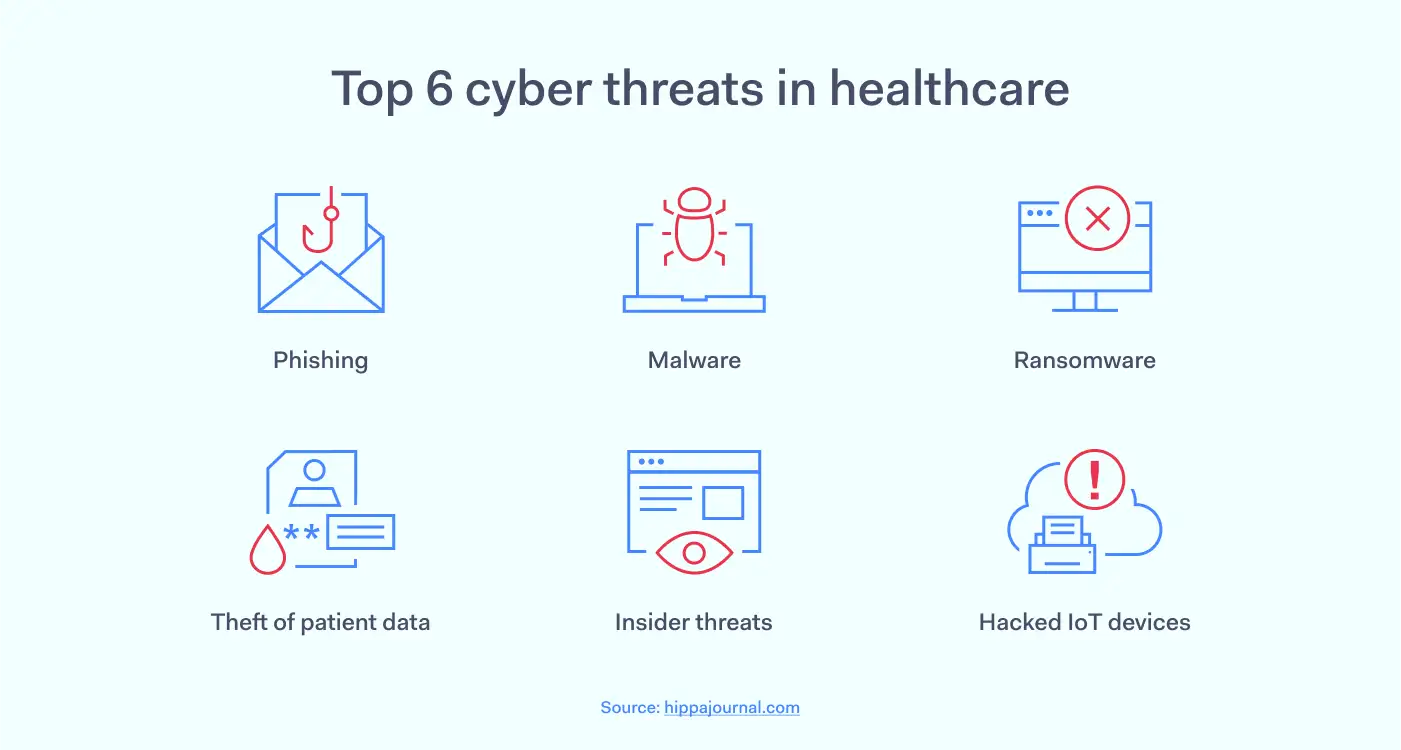
Top 6 cyber threats for healthcare organizations

Threats for the healthcare industry come in many forms, from ransomware to theft of personal information. In 2022, the biggest security breaches in healthcare came from phishing and malware attacks.

  • Phishing

Phishing targets individuals by tricking them into disclosing sensitive information, clicking a malicious link, or opening a malicious attachment. The most common telltale sign of a phishing email is that it conveys a sense of urgency or preys on fear or greed. Scammers can also use social media, text messages, and voice calls for phishing. 

  • Malware

It’s malicious software installed on a computer without a user’s consent. It can steal passwords or money or perform other malicious actions. Examples of malware include a Trojan horse, spyware, adware, or a virus.

  • Ransomware

Ransomware is a form of malware that encrypts files on a user’s device and locks them out until they pay the hacker money to release them. 

  • Theft of patient data

Stolen patient medical records may be sold on the dark web and used for insurance fraud or identity theft. Often, data recovery is not possible.

  • Insi
    der threats

These risks can come from current or former staff members or contractors and happen intentionally or by negligence. For example, an employee may accidentally click a malicious link in a phishing email or skip security protocols to make their job easier. 

  • Hacked IoT devices

Hackers take advantage of vulnerabilities in devices connected by IoT, such as handheld devices, camera sensors, or CT scanners.

Top 6 cyber risks in healthcare

All the facts and statistics mentioned earlier mean one thing: cybersecurity in healthcare is a burning issue. Criminals can disrupt health businesses with malware, ransomware, or phishing. And damage the organization’s reputation and endanger patients’ lives. But apart from that, healthcare organizations are exposed to various cyber risks, such as unprotected access to PHI, human error, vulnerabilities of legacy systems, third-party vendors, and a lack of regular cyber risk audits. 

Risk 1: Unsecured access to PHI

According to new HIPAA encryption requirements, ensuring all sensitive patient data is unreadable, undecipherable, and unusable to any person or software program without access rights is mandatory. For your organization, it means implementing robust security controls that help store Protected Health Information (PHI) safely and protect it from unauthorized access.

Risk 2: Human error

82% of data breaches involved a human element, including social attacks, errors, and misuse.  according to Verizon’s 2022 Data Breach Investigations Report. Understanding how human error affects your organization can help you mitigate risks for the future. Almost one-third of such incidents involved a person abusing their use of internal resources. For example, a doctor shares access to their work-issued device with children, who click on a malicious link and download malware. 

Risk 3: Vulnerabilities of legacy systems 

Outdated technology opens doors for cybercriminals. Legacy devices and operating systems are vulnerable because they can’t update properly. This means inadequate security control and weaknesses in the system can’t be patched. 

However, some healthcare organizations delay transitioning to up-to-date security solutions because of tight budgets or complacency. They choose to fix a problem only after a system failure or a cyber attack. Deploying technology that encrypts data, monitors authorized users, and blocks unauthorized user access can help minimize cyber risks. 

Risk 4: Third-party vendors

The number of business associates that handle sensitive data has grown with the volume of electronic medical records. According to an analysis by Fortified Health Security, third-party vendors accounted for 16% of data breaches in the first half of 2022. 

In 2022, the largest third-party vendor data breach, which affected almost 4 million individuals, happened through a ransomware attack at Eye Care Leaders. The breach impacted at least 39 covered entities, as well. 

Risk 5: Compliance 

Healthcare organizations also face regulatory challenges. Protecting patient privacy according to the latest HIPAA and GDPR rules can be complex. Besides following compliance guidelines, your organization should implement the best cyber security practices. Failure to keep patient records private may result in substantial penalties and harm your reputation. 

Risk 6: The absence of risk assessments

Every healthcare organization should conduct a regular risk assessment to identify vulnerabilities and risks to the confidentiality and integrity of PHI.  The evaluation should determine your organization’s capabilities for detecting, preventing, and responding to cyberattacks. It’s also crucial to know where your sensitive information is, what threats your organization faces, and your system’s vulnerabilities and security holes. And what your action plan in case of an attack is. 

Best practices for healthcare cybersecurity challenges 

This year’s IBM Data Breach Report demonstrates no system is impenetrable. But healthcare cybersecurity is all about basic security measures that stop criminals and make them look for an easier target. What are the best practices for minimizing cyber risks? Here is a list of the strategies worth adopting: 

  • Deploy verified cybersecurity software

Install cybersecurity software on every connected device and secure your network. 

  • Update your software regularly

Prompt, regular updates will address patches and vulnerabilities.

  • Train your staff on cybersecurity

Your employees should be aware of cyber threats and how to detect them. 

  • Strengthen your system access controls 

Restrict access to your most sensitive data and monitor who accesses it.

  • Conduct regular risk assessments 

Identify weaknesses in your system and mitigate risks. Determine where your sensitive information is and protect access to it.

  • Ensure your business associates have strict security policies 

Some business associates have lax policies that can create problems for the healthcare organization they cooperate with. Don’t let stolen vendor credentials or data will compromise your organization. 

Cybersecurity solutions for healthcare organizations

Securing your organization from cyber threats can be overwhelming. Protecting your valuable data and critical equipment is complicated but doesn’t have to be complex. That’s why we have prepared a guide on security solutions tailored to the health industry.  

  • Network security

The key to combating any external threats is network visibility and responsive protection. A solution that quickly isolates risks will prevent your network from being exposed. Setting permissions and policies for secure users and apps across multiple devices is also good. This way, you will ensure that only authorized staff will access your confidential data. 

  • Application security 

The best way to secure access to your applications is to verify and authenticate every user, device, and connection. This Zero-trust approach enforces mandatory checks at every step and minimizes security gaps. It also enables your staff to work remotely and on multiple devices. 

  • Endpoint security

If your devices are left unsecured, they can be a gateway for breaches, and an infected endpoint will affect your organization’s functioning ability. A comprehensive solution for endpoint protection uses data encryption and enforces unified security policies on all servers, networks, and endpoints. It also monitors 24/7 access to your resources, alerting you if there is suspicious activity. 

  • Data security

Encrypting sensitive healthcare data can help conceal it from outsiders. MFA will add strength to authentication processes. Permission sets enable managing data access, meaning only authorized users can access it.  Everyone else will be blocked by default until granted the necessary privileges. Before you apply access controls, you need to classify your data accordion to its value and vulnerability. 

  • Cloud data security

As healthcare organizations move their as
sets and data to the cloud, cloud services need robust protection. Cloud providers and businesses should share responsibilities to ensure data security, but this doesn’t mean you will always have a full view of your infrastructure. The provider may move data without you even knowing it. That’s why having a clear division of responsibilities is crucial. Also, you should encrypt everything in the cloud and set strict access permissions. You add IP allowlists to only connect specific IP ranges to your network. 

How NordLayer can help 

You can protect access to your sensitive data and transition your organization towards the SSE framework by implementing our solutions for Zero Trust Network Access.

NordLayer also provides an adaptive network security solution that easily integrates with your existing infrastructure and provides secure access to sensitive resources.

Contact our sales team and discover how to protect your patient data from cyber threats.

Disclaimer: This article has been prepared for general informational purposes and is not legal advice. We hope that you will find the information informative and helpful. However, you should use the information in this article at your own risk and consider seeking advice from a professional counsel licensed in your state or country. The materials presented on this site may not reflect the most current legal developments or the law of the jurisdiction in which you reside. This article may be changed, improved, or updated without notice.


About NordLayer
NordLayer is an adaptive network access security solution for modern businesses – from the world’s most trusted cybersecurity brand, Nord Security.

The web has become a chaotic space where safety and trust have been compromised by cybercrime and data protection issues. Therefore, our team has a global mission to shape a more trusted and peaceful online future for people everywhere.

About Nord Security
The web has become a chaotic space where safety and trust have been compromised by cybercrime and data protection issues. Therefore, our team has a global mission to shape a more trusted and peaceful online future for people everywhere.

About Version 2 Digital

Version 2 Digital is one of the most dynamic IT companies in Asia. The company distributes a wide range of IT products across various areas including cyber security, cloud, data protection, end points, infrastructures, system monitoring, storage, networking, business productivity and communication products.

Through an extensive network of channels, point of sales, resellers, and partnership companies, Version 2 offers quality products and services which are highly acclaimed in the market. Its customers cover a wide spectrum which include Global 1000 enterprises, regional listed companies, different vertical industries, public utilities, Government, a vast number of successful SMEs, and consumers in various Asian cities.

HIPAA 違規後果:法律、財務和聲譽風險

The Health Insurance Portability and Accountability Act (HIPAA) is the most important data protection regulation for healthcare providers in the USA. It covers health insurers, clinics, hospitals, private practices, and developers of health apps, care settings, and pharmacies.

If you handle patient records, you need to be HIPAA-compliant. For your convenience, we have created a handy HIPAA compliance checklist for covered organizations. However, this blog looks at another critical HIPAA-related issue: the different types of violations and the penalties for breaching HIPAA rules.

Violations matter. Poor compliance causes customers to lose trust in your data protection policies. It’s only a matter of time before patients move their business elsewhere. Regulators can also issue significant financial penalties or even jail offenders in the most extreme cases.

This makes protecting sensitive data a critical task for health companies and their partners. So let’s explore the issue in-depth and explain everything you need to know about HIPAA violations.

What qualifies as a HIPAA Violation?

Before talking about HIPAA penalties, we need a clear understanding of what exactly constitutes a HIPAA violation. Fortunately, the legal definition of a violation is extremely clear.

HIPAA violations take place when either a covered entity (CE) or a business associate (BA) of a covered entity breach HIPAA Security, Private, or Breach Notification Rules.

HIPAA has three main rules. Here is a quick summary of what you need to know about them:

  • The HIPAA Privacy Rule sets out protections for private health data. CEs must keep data confidential and prevent unauthorized disclosure. They must also make health records available if patients desire.

  • The HIPAA Security Rule states that healthcare organizations must keep patient records secure. This includes physical, administrative, and electronic safeguards. You could see this rule as putting the privacy rule into practice.

  • The HIPAA Breach Notification Rule requires CEs to inform patients about any actual or potential data breaches. Notification must occur within 60 days of the breach.

Covered entities must become familiar with these rules when creating a compliance strategy. If you suffer a penalty, ignorance of HIPAA guidelines is not a valid defense. Covered entities must be aware of their responsibilities under the law.

Business associates, third parties your company uses also need to be part of compliance strategies. If partners can access your network assets, they could potentially cause a data breach.

Deliberate versus accidental violations

The first thing to note is that violating HIPAA can be deliberate or accidental. Covered entities need policies to cover both types of violations.

Deliberate breaches could include nurses passing the health records of a celebrity to media contacts or selling records on the Dark Web. But they also extend to simply sharing patient data without the consent of the individual concerned. In these cases, penalties tend to be severe.

Deliberate breaches also include offenses where organizations fail to act when they should do so. For instance, companies may refuse to issue breach notifications to customers within the required 60-day limit.

Company policies that clash with HIPAA rules are often deemed deliberate breaches if regulators decide that the covered entity knew about the issue and was able to remove the conflict.

Accidental breaches of HIPAA rules carry less severe penalties. They could include the absence of encryption on mobile devices or failure to train staff in cybersecurity practices.

For example, physicians could click on phishing links disguised as communications from pharmaceutical partners. There is probably no deliberate or malicious breach here. But the covered entity would be liable due to poor security training and policies.

Broadly speaking, if companies fail to take action to conform to HIPAA rules, this will qualify as a breach. That’s why having a comprehensive HIPAA compliance strategy is essential.

Criminal versus civil violations

It’s also important to understand the difference between criminal and civil HIPAA breaches.

Criminal cases are mounted by the Department of Justice and are much less common than civil penalties. They deal with deliberate violations and can lead to prison sentences for individuals at the organizations involved. Offenses leading to criminal charges include:

  • Wrongful disclosure of Protected Health Information (PHI)

  • Wrongful disclosure of PHI under false pretenses (e.g. seeking access to medical records of patients not under the care of a physician)

  • Wrongful disclosure of PHI under false pretenses with malicious intent (to sell or otherwise benefit from stealing PHI)

Most of the time, you or your staff won’t risk criminal charges. Instead, the challenge is to minimize the risk of civil cases.

Civil cases may involve behavior that is deliberate, but not malicious. Instead, civil offenses tend to involve poor risk assessment processes or simply ignorance of what HIPAA requires.

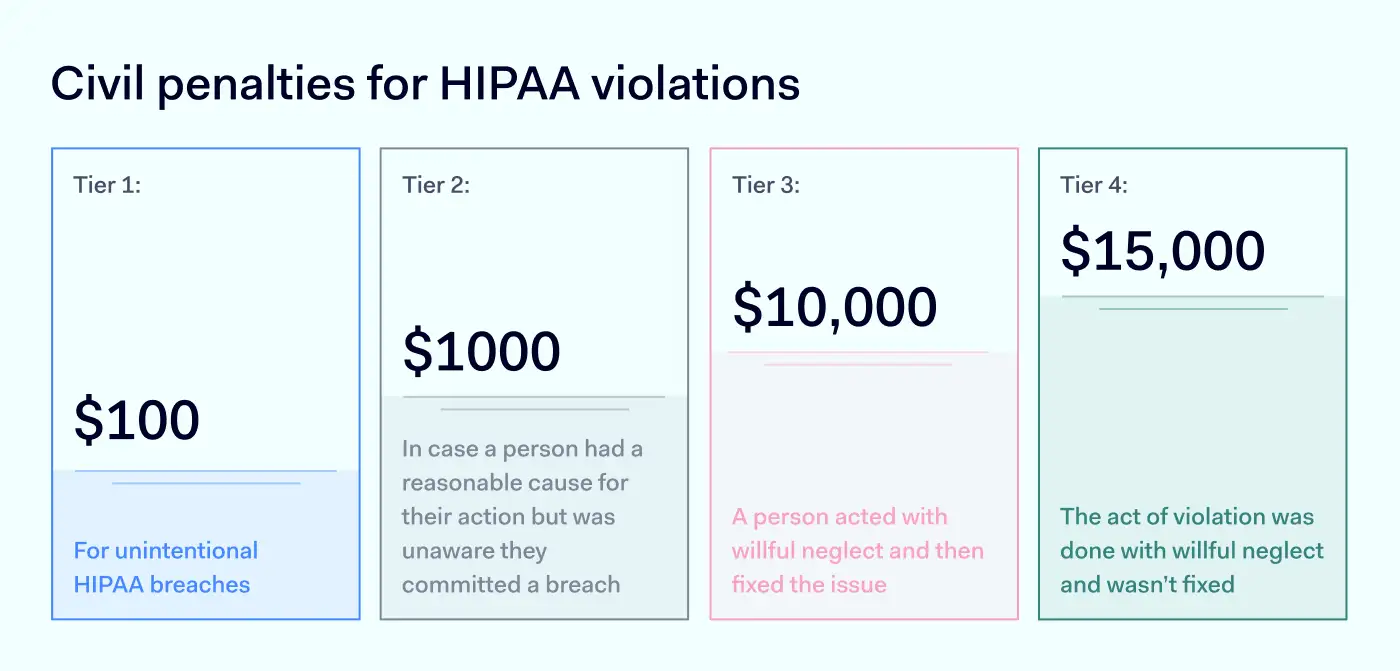
In these cases, the OCR or Attorneys General will seek a financial penalty under the HIPAA enforcement rule. Civil violations are covered by four tiers, which we will look at in more detail below.

4 types of HIPAA violations

In most instances, the Office for Civil Rights (OCR) receives complaints and decides whether organizations have violated HIPAA regulations. When the OCR deliberates, its regulators use a four-tier system to categorize potential violations.

The four tiers differ in terms of severity, with rising financial penalties. They also differ in terms of culpability. In some cases, organizations are not aware of HIPAA violations. In others, breaches are wilful and systematic.

The size of the financial penalty is related to various factors. Regulators consider:

  • How long the violation has existed

  • How many individuals are affected

  • The value and amount of the data at risk

  • Whether the organization willingly collaborates with OCR

  • Whether the organization has a clean regulatory history

Tier 1 – Accidental violation

At this tier, organizations are not aware of HIPAA breaches. The organization also had no way to avoid the violation, even with complete adherence to HIPAA regulations. At this level, covered entities must show evidence of compliance. This proves that the breach could not be avoided.

Highest penalty: $100 per incident, with a limit of $50,000

Tier 2 – Aware of violation, but no remediation possible

At tier 2, organizations know about HIPAA violations before OCR is informed. In this category, staff should have been aware of the fault. But the organization could not avoid violating HIPAA rules, even while administering adequate levels of care. This level falls short of the definition of “wilful neglect.”

Highest penalty: $1,000 per incident, with a limit of $100,000</ p>

Tier 3 – Wilful neglect with remediation

At tier 3, organizations commit “wilful neglect”. This means they were aware of the violation. the covered entity could have taken action to remedy the breach but failed to do so. However, there is a caveat here. Tier 3 penalties are lower because the organization involved has taken action to remediate the issue.

Highest penalty: $10,000 per incident, with a limit of $250,000

Tier 4 – Wilful neglect without remediation

At tier 4, organizations are also guilty of “wilful neglect”. The violation was known and the organization failed to take remedial action. Breaches in this category could continue for months or years, with serious consequences for patient welfare and data protection. For these reasons, Tier 4 penalties are far higher than other categories.

Highest penalty: $50,000 per incident, with a limit of $1.5 million

The consequences of a HIPAA violation

According to US law, if a covered entity breaks the HIPAA regulations, it may face a penalty of up to $50,000 and up to one-year imprisonment. The actual consequences depend on the type and severity of the HIPAA violation, and whether they were committed by a healthcare employee or an employer, i.e., covered entities.

There are two types of violations: civil and criminal. Each category has tiers to determine penalties for a specific breach.

Civil HIPAA penalties

HIPAA violations committed without malicious intent fall into the category of civil penalties. What’s the most common reason for these violations? Most of the time, it’s because healthcare employees or covered entities don’t know the HIPAA Privacy Rule. Yet, unawareness or negligence of HIPAA standards is not an excuse for escaping a penalty.

Criminal HIPAA penalties

Intentional HIPAA violations, such as disclosing or selling personal health information, are a crime. The criminal penalties for these violations can be severe and restitution may be also paid to the victims. A covered entity that committed a HIPAA violation must settle it with OCR and state attorneys general.

The height of the criminal penalties depends on the following factors:

  • the seriousness of HIPAA violations

  • the length of time that the violation has been taking place

  • the number of violations identified.

Who issues penalties?

HIPAA is a Federal regulation. So you might assume that penalties are issued exclusively by the Federal Government. However, the actual situation is more complex. Covered entities should be familiar with all regulatory bodies in their specific business sector.

The Office for Civil Rights (OCR)

To start with, the Office for Civil Rights processes most HIPAA violations and issues penalties. OCR is part of the Department of Health and Human Services (HHS), and it has a general bias towards negotiation instead of penalizing organizations.

As a rule, before mandating penalties, OCR will issue technical assistance and monitor voluntary compliance agreements with covered entities. However, if breaches persist, OCR will launch civil cases to demand HIPAA violation penalties. This is particularly likely if covered entities have a previous history of repeat violations.

OCR has the power to launch civil proceedings. But it can also pass HIPAA cases to the Department of Justice (DOJ) to handle criminal violations. So a violation at the federal level can lead to jail time alongside large financial penalties.

State-level Attorneys General

HIPAA penalties may also be issued at a state level by Attorneys General. Attorneys General can use powers granted by the 2009 HITECH Act to launch lawsuits against organizations breaching HIPAA rules. These suits are civil cases, so they do not lead to prison sentences. But they can result in large financial penalties.

Additionally, HIPAA violations can stretch across state boundaries. In these situations, covered entities may face lawsuits from numerous Attorneys General. This multiplies the financial cost of non-compliance.

Internal penalties

Proactive organizations may also create policies to penalize staff members when they violate HIPAA regulations. This could be developed autonomously, or in collaboration with the Office for Civil Rights as part of compliance strategies.

Internal penalties tend to range in severity and seek to deter unsafe behavior when handling patient data. They are an important data security measure, especially when deployed with mandatory security training.

How can NordLayer solutions mitigate HIPAA risks?

Violating HIPAA suggests that your data protection measures are below the standard needed in today’s digital marketplace. That’s why organizations need modern security solutions that easily adapt to the complexities of today’s hybrid working environments and HIPAA rules. All locations, users, devices, apps, and data must have the same advanced level of protection. 

With Nordlayer’s solutions, you can secure access to sensitive information, prevents reputational, legal, and financial damage, and helps achieve HIPAA compliance.  Whatever area of healthcare you work in, Nordlayer is ready to help you succeed. Get in touch and discuss your options today.


About NordLayer
NordLayer is an adaptive network access security solution for modern businesses – from the world’s most trusted cybersecurity brand, Nord Security.

The web has become a chaotic space where safety and trust have been compromised by cybercrime and data protection issues. Therefore, our team has a global mission to shape a more trusted and peaceful online future for people everywhere.

About Nord Security
The web has become a chaotic space where safety and trust have been compromised by cybercrime and data protection issues. Therefore, our team has a global mission to shape a more trusted and peaceful online future for people everywhere.

About Version 2 Digital

Version 2 Digital is one of the most dynamic IT companies in Asia. The company distributes a wide range of IT products across various areas including cyber security, cloud, data protection, end points, infrastructures, system monitoring, storage, networking, business productivity and communication products.

Through an extensive network of channels, point of sales, resellers, and partnership companies, Version 2 offers quality products and services which are highly acclaimed in the market. Its customers cover a wide spectrum which include Global 1000 enterprises, regional listed companies, different vertical industries, public utilities, Government, a vast number of successful SMEs, and consumers in various Asian cities.