BRATISLAVA – May 27, 2020 – The enterprise version of ESET’s Android mobile security app, ESET Endpoint Security for Android, reached the best score in the first edition of the Android Security Apps for Corporate Users test by AV-TEST, a respected independent testing organization.
“Requirements of businesses differ from those of consumers, so it’s a step in the right direction by AV-TEST to design the Android test specifically for corporate use cases,” says Jiří Kropáč, Head of Threat Detection Labs at ESET.
In the first edition of the new test, three security solutions were tested, including ESET Endpoint Security for Android. In two of the three key parts of the test – Usability and Performance – all three solutions reached the best possible score. In the Protection part of the test, arguably the crucial one, ESET Endpoint Security for Android was the only app to detect 100% of the 3,100-strong sample set.
“This test shows ESET Endpoint security for Android is the right security solution for mobile devices allowed in corporate networks,” comments Kropáč.
The test of corporate Android security apps differs from the test for consumer apps in two main areas.
First, the set of samples for detection reflects the specifics of the business use of Android devices. For example, instead of infected game apps, the testing set contains threats known to target corporate users. Apps for the corporate version of the test were taken exclusively from the official Android app store, Google Play. This eliminates the need for tuning up the protection to also cover obscure types of threats that a corporate user will rarely encounter.
Second, the manageability of the security solution is also considered.
Besides that, the design of the performance test has been slightly adjusted so the new test evaluates the impact on website loading, document reading, or network traffic.
The testing of corporate Android apps was long overdue, according to Kropáč. “Nowadays, corporate internal systems tend to be accessible from mobile devices. Additionally, those devices are often also used for personal purposes. This combined means that the need for reliable corporate mobile security solutions is imminent. And where there is a need for reliability, there is also a need for independent tests.”
The results of the first edition of the test of Android security apps for corporate users can be found on AV-TEST’s website.
Version 2 Digital is one of the most dynamic IT companies in Asia. The company distributes a wide range of IT products across various areas including cyber security, cloud, data protection, end points, infrastructures, system monitoring, storage, networking, business productivity and communication products.
Through an extensive network of channels, point of sales, resellers, and partnership companies, Version 2 offers quality products and services which are highly acclaimed in the market. Its customers cover a wide spectrum which include Global 1000 enterprises, regional listed companies, different vertical industries, public utilities, Government, a vast number of successful SMEs, and consumers in various Asian cities.
About ESET For 30 years, ESET® has been developing industry-leading IT security software and services for businesses and consumers worldwide. With solutions ranging from endpoint security to encryption and two-factor authentication, ESET’s high-performing, easy-to-use products give individuals and businesses the peace of mind to enjoy the full potential of their technology. ESET unobtrusively protects and monitors 24/7, updating defenses in real time to keep users safe and businesses running without interruption. Evolving threats require an evolving IT security company. Backed by R&D facilities worldwide, ESET became the first IT security company to earn 100 Virus Bulletin VB100 awards, identifying every single “in-the-wild” malware without interruption since 2003.
Bratislava, Montreal – ESET researchers have uncovered a new version of one of the oldest malware families run by the Turla group, the ComRAT backdoor. Turla, also known as Snake, is an infamous cyber-espionage group that has been active for more than ten years. The most interesting feature of the updated backdoor is its use of the Gmail web UI to receive commands and exfiltrate data. ComRAT steals sensitive documents, and since 2017 it has attacked at least three governmental institutions. ESET has found indications that this latest version of ComRAT was still in use at the beginning of 2020, showing that the Turla group is still very active and a major threat for diplomats and militaries.
The main use of ComRAT is stealing confidential documents. In one case, its operators even deployed a .NET executable to interact with the victim’s central MS SQL Server database containing the organization’s documents. The malware operators used public cloud services such as OneDrive and 4shared to exfiltrate data. Turla’s latest backdoor can perform many other actions on compromised computers, such as executing additional programs and exfiltrating files.
The fact that the attackers try to evade security software is concerning. “This shows the level of sophistication of this group and its intention to stay on the same machines for a long time,” explains Matthieu Faou, who has investigated the infamous group for several years. “Additionally, the latest version of the ComRAT malware family, thanks to its use of the Gmail web interface, is able to bypass some security controls because it doesn’t rely on any malicious domain,” says Faou.
The backdoor upgrade was first discovered by ESET in 2017. It uses a completely new code base and is far more complex than its predecessors. The most recent iteration of the backdoor that ESET researchers have seen was compiled in November of last year.“
Based on the victimology and the other malware samples found on the same compromised machines, we believe that ComRAT is used exclusively by Turla,” says Faou.
ComRAT, also known as Agent.BTZ, is a malicious backdoor that became infamous after its use in a breach of the US military in 2008. The first version of this malware, likely released in 2007, exhibited worm capabilities by spreading through removable drives.
For more technical details of ComRAT and a full and comprehensive list of Indicators of Compromise (IoCs), please read the full ESET white paper From Agent.BTZ to ComRAT v4: a ten year journey on WeLiveSecurity. Make sure to follow ESET research on Twitter for the latest news from ESET Research.
About Version 2 Digital
Version 2 Digital is one of the most dynamic IT companies in Asia. The company distributes a wide range of IT products across various areas including cyber security, cloud, data protection, end points, infrastructures, system monitoring, storage, networking, business productivity and communication products.
Through an extensive network of channels, point of sales, resellers, and partnership companies, Version 2 offers quality products and services which are highly acclaimed in the market. Its customers cover a wide spectrum which include Global 1000 enterprises, regional listed companies, different vertical industries, public utilities, Government, a vast number of successful SMEs, and consumers in various Asian cities.
About ESET For 30 years, ESET® has been developing industry-leading IT security software and services for businesses and consumers worldwide. With solutions ranging from endpoint security to encryption and two-factor authentication, ESET’s high-performing, easy-to-use products give individuals and businesses the peace of mind to enjoy the full potential of their technology. ESET unobtrusively protects and monitors 24/7, updating defenses in real time to keep users safe and businesses running without interruption. Evolving threats require an evolving IT security company. Backed by R&D facilities worldwide, ESET became the first IT security company to earn 100 Virus Bulletin VB100 awards, identifying every single “in-the-wild” malware without interruption since 2003.
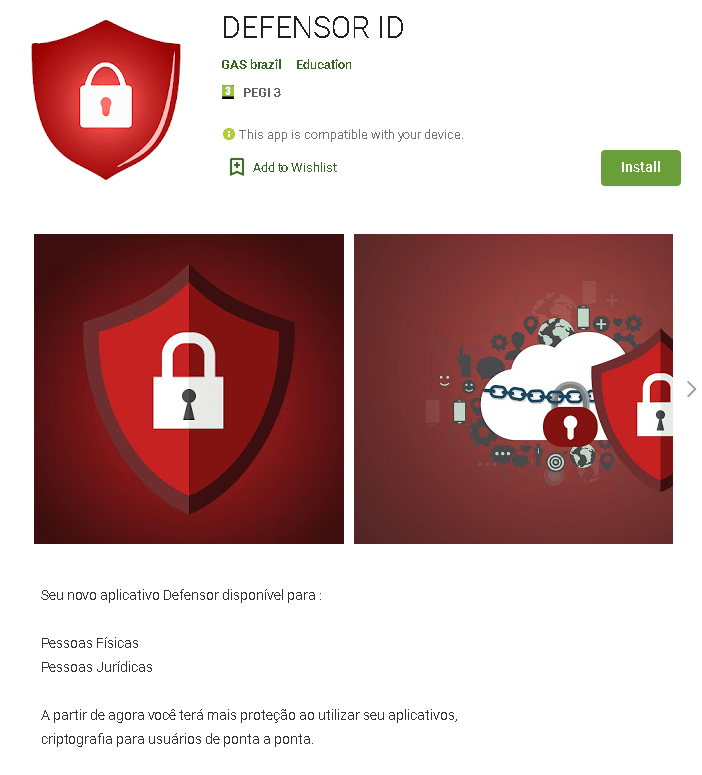
Bratislava – May 22, 2020 – ESET researchers discovered an extremely stealthy – yet surprisingly simple – technique that allowed Android malware to stay under the radar. Analyzing the DEFENSOR ID app that was – at the time – available on the official Android app store, ESET researchers learned the app misused Accessibility Services but required no other suspicious permission nor had any other malicious functionality.
“The Accessibility Services feature is long known to be the Achilles’ heel of the Android operating system, and security solutions have been tuned to detect various combinations of misuse of this weak spot with other indicators of malicious behavior,” explains Lukáš Štefanko, the ESET malware researcher who conducted the analysis into DEFENSOR ID.
Faced with malware that displayed no additional functionality nor suspicious permissions on top of Accessibility Services, all known security mechanisms failed to trigger any alarm. As a result, DEFENSOR ID made it onto the Google Play store, stayed there for a few months and was never detected by any security vendor participating in the VirusTotal program.
“This has been a valuable lesson for us. Based on what we’ve learned about DEFENSOR ID, we’ve fine-tuned our detection technologies to also cover malware with such a uniquely low detection cross-section,” says Štefanko.
Apart from being extremely stealthy, DEFENSOR ID is capable of inflicting serious harm on its victims. It belongs to the banking trojans malware category and is exceptionally insidious: once installed, it needs its victim to take only one action to fully unleash its power.
“Once the user activates Accessibility Services, DEFENSOR ID can pave the way for the attacker to clean out the victim’s bank account or cryptocurrency wallet and take over their email or social media accounts, among other malicious actions,” comments Štefanko.
Following ESET’s notice, Google removed DEFENSOR ID from the official Android app store.
“We decided to publish the results of our investigation into this malware to help defenders cope with ultra-low cross-section Android malware. The creators of such malware are definitely going to face hardened protections around both Google Play and the users’ devices,” concludes ESET’s Štefanko.
The DEFENSOR ID app on Google Play – Portuguese version (Google Translate: “Your new Defensor app available for: / Physical People / Legal entities / From now on you will have more protection when using your applications, encryption for end-to-end users”)
About Version 2 Digital
Version 2 Digital is one of the most dynamic IT companies in Asia. The company distributes a wide range of IT products across various areas including cyber security, cloud, data protection, end points, infrastructures, system monitoring, storage, networking, business productivity and communication products.
Through an extensive network of channels, point of sales, resellers, and partnership companies, Version 2 offers quality products and services which are highly acclaimed in the market. Its customers cover a wide spectrum which include Global 1000 enterprises, regional listed companies, different vertical industries, public utilities, Government, a vast number of successful SMEs, and consumers in various Asian cities.
About ESET For 30 years, ESET® has been developing industry-leading IT security software and services for businesses and consumers worldwide. With solutions ranging from endpoint security to encryption and two-factor authentication, ESET’s high-performing, easy-to-use products give individuals and businesses the peace of mind to enjoy the full potential of their technology. ESET unobtrusively protects and monitors 24/7, updating defenses in real time to keep users safe and businesses running without interruption. Evolving threats require an evolving IT security company. Backed by R&D facilities worldwide, ESET became the first IT security company to earn 100 Virus Bulletin VB100 awards, identifying every single “in-the-wild” malware without interruption since 2003.
BRATISLAVA, MONTREAL – ESET researchers have discovered a new modular backdoor used by the Winnti Group against several video game companies that develop MMO (massively multiplayer online) games. The malware, named PipeMon by ESET, targeted companies in South Korea and Taiwan. The video games developed by these companies are distributed all around the world, are available on popular gaming platforms, and have thousands of simultaneous players.
In at least one case, the attackers compromised the company’s build orchestration server, allowing them to take control of the victim’s automated build systems. This could have allowed the attackers to trojanize video game executables. “However, we do not have evidence this has occurred,” says Mathieu Tartare, Malware researcher at ESET. In another case, the operators compromised the company’s game servers. With this attack, it would be possible to manipulate in-game currencies for financial gain. ESET contacted the affected companies and provided the necessary information and assistance to remediate the compromise.
“Multiple indicators led us to attribute this campaign to the Winnti Group. Some of the command and control domains used by PipeMon were used by Winnti malware in previous campaigns. Furthermore, in 2019 other Winnti malware was found at some of the same companies that were later discovered to be compromised with PipeMon in 2020,” says Mathieu Tartare, ESET researcher monitoring the Winnti Group. There are other notable similarities that researchers explore in the blogpost.
The new modular backdoor PipeMon is signed with a code-signing certificate likely stolen during a previous campaign and shares similarities with the PortReuse backdoor. “This new implant shows that the attackers are actively developing new tools using multiple open source projects and don’t rely solely on their flagship backdoors, ShadowPad and the Winnti malware,” adds Tartare. ESET was able to trace two different variants of PipeMon.
The Winnti Group, active since at least 2012, is responsible for high-profile supply-chain attacks against the video game and software industries, leading to the distribution of trojanized software (such as CCleaner, ASUS LiveUpdate and multiple video games) that is used to compromise more victims. Recently, ESET researchers also discovered a campaign of the Winnti Group targeting several Hong Kong universities with ShadowPad and the Winnti malware. More details about the group’s arsenal are explored in a white paper published in October 2019.
About Version 2 Digital
Version 2 Digital is one of the most dynamic IT companies in Asia. The company distributes a wide range of IT products across various areas including cyber security, cloud, data protection, end points, infrastructures, system monitoring, storage, networking, business productivity and communication products.
Through an extensive network of channels, point of sales, resellers, and partnership companies, Version 2 offers quality products and services which are highly acclaimed in the market. Its customers cover a wide spectrum which include Global 1000 enterprises, regional listed companies, different vertical industries, public utilities, Government, a vast number of successful SMEs, and consumers in various Asian cities.
About ESET For 30 years, ESET® has been developing industry-leading IT security software and services for businesses and consumers worldwide. With solutions ranging from endpoint security to encryption and two-factor authentication, ESET’s high-performing, easy-to-use products give individuals and businesses the peace of mind to enjoy the full potential of their technology. ESET unobtrusively protects and monitors 24/7, updating defenses in real time to keep users safe and businesses running without interruption. Evolving threats require an evolving IT security company. Backed by R&D facilities worldwide, ESET became the first IT security company to earn 100 Virus Bulletin VB100 awards, identifying every single “in-the-wild” malware without interruption since 2003.
BRATISLAVA – Global cybersecurity leader ESET has been included among 29 vendors in Forrester’s Now Tech: Enterprise Detection and Response Q1 2020 report. The report provides an overview of the technology players in the EDR market and offers insights into understanding their capabilities. Security and risk professionals can use the report to determine the value they can expect from an enterprise detection and response provider and to select one based on size and functionality. Especially in these challenging times, detection & response capabilities are necessary to ensure business continuity.
ESET has been included in the report as an Enterprise Architecture EDR solution, as classified by the architectural decisions behind the product that are designed to provide sub-second behavioral detection and response on the endpoint itself, improving endpoint protection capabilities and offline protection.
Key takeaways from the report include:
A key benefit of EDR products is the ability to hunt for indications that an adversary has eluded your security controls and is lying in the weeds of your infrastructure.
Each provider in this market has a unique industry focus, geographic footprint, and a set of core competencies, leading to different engagement models that suit a variety of customer needs.
Juraj Malcho, chief technology officer at ESET, commented, “We are proud to be included in the Forrester Now Tech report, and to be recognized among players in the EDR market as, in our opinion, protecting our users and their businesses against the latest advanced persistent threats is central to our mission as a business. Ensuring your business is equipped with capable and cutting-edge detection and response tools is an absolute necessity during these unpredicted times, and we hope that security and risk professionals will be able to make the best decision for their business with ESET’s innovative EDR offerings.”
To read more about Forrester Now Tech, please click here, and to read more about ESET’s enterprise solutions, please click here.
About Version 2 Digital
Version 2 Digital is one of the most dynamic IT companies in Asia. The company distributes a wide range of IT products across various areas including cyber security, cloud, data protection, end points, infrastructures, system monitoring, storage, networking, business productivity and communication products.
Through an extensive network of channels, point of sales, resellers, and partnership companies, Version 2 offers quality products and services which are highly acclaimed in the market. Its customers cover a wide spectrum which include Global 1000 enterprises, regional listed companies, different vertical industries, public utilities, Government, a vast number of successful SMEs, and consumers in various Asian cities.
About ESET For 30 years, ESET® has been developing industry-leading IT security software and services for businesses and consumers worldwide. With solutions ranging from endpoint security to encryption and two-factor authentication, ESET’s high-performing, easy-to-use products give individuals and businesses the peace of mind to enjoy the full potential of their technology. ESET unobtrusively protects and monitors 24/7, updating defenses in real time to keep users safe and businesses running without interruption. Evolving threats require an evolving IT security company. Backed by R&D facilities worldwide, ESET became the first IT security company to earn 100 Virus Bulletin VB100 awards, identifying every single “in-the-wild” malware without interruption since 2003.
A new COVID-19 diagnostic kit developed by Slovak scientists is registered by Slovakia’s State Institute for Drug Control (ŠUKL). The first 100,000 tests, donated to the Slovak Republic by the ESET Foundation, are ready to be handed over to state diagnostic laboratories.
BRATISLAVA – Slovak scientists from MultiplexDX, the Biomedical Research Center of the Slovak Academy of Sciences (BMC SAS), the Comenius University Science Park in Bratislava, Lambda Life and ProScience Tech joined forces to develop and register the first Slovak-made diagnostic kit for COVID-19. The ESET Foundation supported the development and production of the kit and donated the first 100,000 tests to the government of the Slovak Republic.
On May 14, the State Institute for Drug Control (ŠUKL) approved the kit, which is called vDetect COVID-19 RT-qPCR.The first 100,000 tests will be delivered to state diagnostic laboratories. “The State Institute for Drug Control dealt with the application for registration of the test as a matter of priority, and the final decision was issued within four working days of receiving the application. With the technical dossier and validation tests meeting the necessary criteria, the registration went smoothly. This is the first registration of an IVD test by the State Institute for Drug Control that was designed, manufactured, and registered in Slovakia,” says the director of ŠUKL, PharmDr. Zuzana Baťová, PhD.
During the process of test validation, Slovak researchers from MultiplexDX came up with a way to increase the test’s sensitivity, which slightly delayed the regulatory submission. “When we performed a forensic analysis, we found that the primers used to confirm the test results according to the Charité protocol were not designed optimally. Therefore, we prepared a new version of primers that increased the sensitivity and, consequently, the accuracy of the test. Then it was necessary to repeat testing and, due to this, the original date of the test’s registration was postponed,” explains Pavol Čekan, PhD, founder of MultiplexDX. The tests underwent validation showing a 100% match with the samples already evaluated.”
Blind validation tests, performed at two independent laboratories on 92 clinical samples, showed identical results in comparison with the reference method, as well as with each other. This demonstrates the high reliability of the test directly on clinical samples,” says RNDr. Boris Klempa, DrSc., from BMC SAV.
The ESET Foundation supported the development of the tests, donating the first 100,000 tests to the state. ESET also covered the financing and coordination of activities related to the test’s production and registration.
“The development of the new diagnostic kit confirms that science in the Slovak Republic is being pursued at a high level and, at the same time, demonstrates the ability for science to bring solutions to societal problems. That’s why we have been supporting science for a long time. ESET’s involvement in the development of the coronavirus diagnostic tests has also been an interesting challenge for us because we have been detecting virtual viruses since our founding as a company,” comments Richard Marko, CEO of ESET.
Throughout the test’s development and validation, the team of RNDr. Tomáš Szemes, PhD from the Charles University Science Park in Prague, also participated: “We worked with the team on optimization and validation, and I was surprised at how quickly and smoothly the process went, including registration.” The final documentation for registration at ŠUKL was prepared by Roman Oravec from the non-profit organization CCCT SK.
The Slovak companies Lambda Life and ProScience Tech were also involved during the entire preparation of the diagnostic kit. “With the cooperation of numerous talented scientists and domestic companies, we not only received approval for the first Slovak-made PCR test for COVID-19, but also developed a top product in difficult conditions, one that will help the country when it needs it most. It was by no means an easy task, and I am happy that it succeeded in the end,” concludes Róbert Mistrík from the Slovak government’s permanent crisis team.
About Version 2 Digital
Version 2 Digital is one of the most dynamic IT companies in Asia. The company distributes a wide range of IT products across various areas including cyber security, cloud, data protection, end points, infrastructures, system monitoring, storage, networking, business productivity and communication products.
Through an extensive network of channels, point of sales, resellers, and partnership companies, Version 2 offers quality products and services which are highly acclaimed in the market. Its customers cover a wide spectrum which include Global 1000 enterprises, regional listed companies, different vertical industries, public utilities, Government, a vast number of successful SMEs, and consumers in various Asian cities.
About ESET For 30 years, ESET® has been developing industry-leading IT security software and services for businesses and consumers worldwide. With solutions ranging from endpoint security to encryption and two-factor authentication, ESET’s high-performing, easy-to-use products give individuals and businesses the peace of mind to enjoy the full potential of their technology. ESET unobtrusively protects and monitors 24/7, updating defenses in real time to keep users safe and businesses running without interruption. Evolving threats require an evolving IT security company. Backed by R&D facilities worldwide, ESET became the first IT security company to earn 100 Virus Bulletin VB100 awards, identifying every single “in-the-wild” malware without interruption since 2003.
Ransomware – a term that we were already aware of a few years ago but most of us rather took it as a “not-our-problem” kind of thing. However, cybercriminals didn’t see it the same way and it was just a matter of time before that kind of extortionate vermin came to do harm in our land, too. And even though the attacks on Benešov Hospital and OKD were not among the first ones, their coverage definitely raised awareness of the topic. Then, the emergence of coronavirus has actually created new opportunities of phishing and ransomware campaigns for cybercriminals; hugely supported by the massive transition of office workers to home office.
Now that the topic of cybercriminals and the possibilities of protection against them gets more publicity, it could come in useful to refresh a few rules which may significantly minimize the risk of an attack on your infrastructure. I’m going to try to summarize them in this article without getting too technical and complex so that anybody can understand. Hopefully, successfully 🙂
Rule number 1 Don’t try to find a single solution to the whole area of cyber security – there’s nothing like a “Silver Bullet” or “Holy Grail” (i.e. a single “cover-it-all” or “save-it-all”) solution. Simply not. Just as in cars, with a lot of various features that increase the safety (the sole car construction ensures passive safety, then there are the safety belts, airbags, ABS and other electronic systems), it’s their combination that will make you more likely to survive an accident, or get away without getting injured. The same applies to cyber security – it takes various “layers” of security and their correct combination to ensure the maximum degree of protection.
Rule number 2 Use up-to-date versions of operating systems and update them regularly – those “once-in-a-blue-moon” updates leave enough space for an attacker to use unpatched flaws to penetrate your infrastructure. If, for some serious reason, you really have to use operating systems after they expire (i.e. their developer doesn’t issue updates anymore), at least reserve a separate segment in the network for such devices and take special care of them; however, it’s definitely better not to have such devices in the infrastructure at all. Don’t forget to regularly update any other software you use – as well as an out-of-date operating system this can also lead to the infection of your infrastructure.
Rule number 3 Use good-quality antivirus solution. Current antivirus software includes a lot of security mechanisms and their scope is rather vast so they will help you prevent plenty of problems. Nevertheless, the same rule as with operating systems applies here – update, update, update!
Rule number 4 Don’t trust the “experts” who claim that it’s enough to use common sense, not to open suspicious attachments and to behave sensibly “on the web” to prevent the infection – that’s not true anymore. Modern malware can exploit unpatched flaws not only in operating systems, but also in applications, etc., and it can use them to get into your infrastructure without you performing an action knowingly (such as opening an email attachment).
Rule number 5 Even your firewall and network elements deserve your attention and regular updates. After all, firewall or routers are also computers, i.e. hardware, which run some specialized software. And as it’s generally known and the experience has confirmed that there’s a flaw in every kind of software, it’s vital to update such devices regularly, too. If you don’t do so, you open yet another route into your infrastructure for attackers, just as we showed in practice at our conference GREYCORTEX DAY, where we demonstrated an attack on a typical network infrastructure live.
Rule number 6 Unless necessary, don’t work within the administrator account. It’s not really needed for regular work and if an attacker breaks through the security of the device you’re logged on as an admin (most probably unnecessarily), you’ll make their efforts much easier as well as their way to your data (and possibly money).
Rule number 7 If you use any kind of remote desktop at work, don’t leave it on, nor permanently open to the Internet, as it’s often the target of initial stages of an attack and you practically leave the door to your infrastructure open. In general, be careful how your colleagues or suppliers working remotely connect and which permissions they have, which parts of the infrastructure they can access and how their connection to internal tools is secured. All this is linked to the following rule:
Rule number 8 Use VPN only (Virtual Private Network) for external connection to the internal network. If you allow direct connection from the outside without using VPN, sooner or later, some attacker will abuse it. Don’t forget to cancel disused VPN accounts as there’s always the danger of abuse of a long-forgotten access. This applies in general – if you grant anyone access to anywhere and they don’t need it for work anymore, cancel it.
Rule number 9 Divide the visitor (i.e. publicly accessible) and internal / production parts of infrastructure thoroughly and consistently. This doesn’t only apply on guest Wi-Fi, but any part of the infrastructure which can be freely accessed by unknown persons. A lot of attacks on internal infrastructure start by a “visit” of an unwelcome guest from the publicly accessible part of the network.
Rule number 10 Cybercriminals keep improving and coming up with new ways how to convey harmful code to you and your colleagues, so it’s useful to get informed regularly on new ways how someone might try to trick you (or make you do something that will spread the infection) and on new dangers. It’s definitely not a waste of time or money to take part in an interesting conference on such a topic or get regular training from companies that focus on prevention. You’d have to invest a lot more time and money in removing the consequences of actions of unknowing employees. Unfortunately, the human factor will always be the weakest link in the chain of cyber security, so it pays to regularly raise awareness of what may happen.
Rule number 11 If your colleagues work within your infrastructure on their own devices (so called BYOD, Bring Your Own Device), it’s necessary to count on the fact that you’ll have to apply all the mentioned rules on such devices, which is rather a big problem. One of the possible solutions is granting these devices access only to a certain segment of the infrastructure, secure it properly and monitor, which may obviously be quite strenuous.
Rule number 12 If I don’t understand something, I can’t deal with it. If you don’t have sufficient insight into the whole infrastructure and you don’t have the possibility to monitor what’s going on in it, the attacker is invisible to you and you’re practically blind (until the attack shows in its full extent, i.e. in case of ransomware data encryption). That’s why it’s convenient to use the NTA solution (Network Traffic Analysis), such as our solution GREYCORTEX MENDEL. These tools will not only allow you to see (to the tiniest detail) which devices there are in your network and what’s going on in them, but they will also enable you to get timely notifications in case there’s a suspicious and dishonest activity in the infrastructure thanks to the automatic analysis of the entire network performance and running event correlation (if you’re interested in more information, you’ll find it here). Obviously, it’s necessary to process such notifications and secure a remedy to the flaws found, but that’s well beyond this article. If there isn’t an internal department dealing with cyber security, you can get the SOC services (Security Operations Centre) at some of our partners and leave this burden with them. You’ll appreciate the NTA solution especially in case the attacker manages to disable your antivirus solution or to get through your firewall (e.g. by hiding illegitimate, harmful traffic inside the legitimate traffic and thus trick the firewall), as they can’t hide the signs of harmful behaviour from permanent analysis of network traffic. What’s more – the NTA solution will help you with forensic analysis, i.e. subsequent investigation, of where the attack came from or how the infection got inside your infrastructure, which will help you detect and remove weak spots in security.
IN SHORT – WHAT ARE THE MAIN BENEFITS OF OUR NTA PRODUCT GREYCORTEX MENDEL IN YOUR FIGHT WITH CYBER CRIMINALS?
It’s fully passive and it analyses the mirror of all your network traffic – it can basically monitor everything but at the same time it’s invisible to cybercriminals, they don’t know that you know about them and their activities.
It doesn’t send any data “home” for analysis (manual analysis by an army of analysts), but analyses everything using machine learning and other advanced methods.
Unlike us, people, it works 24/7/365 (plus one extra day in leap years) and it never gets tired.
Rule number 13 Back up, back up and back up again! Ideally, make backups on exchangeable media and take them physically away from your company’s premises (you’ll ensure continuity of work in case of fire, flood or mobilisation by doing so :), but mainly, you’ll make sure that in case of ransomware attack the backups in the same infrastructure won’t be encrypted. If, for some reason, it’s not possible or convenient to take away backups physically, make sure the servers with back-up copies aren’t connected to your infrastructure permanently and thus inaccessible to the attackers in time of an ongoing attack – otherwise they’ll encrypt even these backups and there won’t be anywhere to recover the data from.
And finally, the last rule: Even following all the above-mentioned rules may not ensure 100 % protection against an attack of your infrastructure as present cybercriminals are no “greasy teenagers” who want to prove themselves anymore, but professional groups with huge budgets and possibilities.
But if you stick to all of the above-mentioned, you’ll at least make their attempt to launch an attack immensely difficult, and because they know that the effort must be smaller than the possible profit (for their “business” to make sense), it’s highly probable they’ll attack somebody else instead, someone who’s an easier target not having followed the rules.