Skip to content

How to Utilize Cloudbric Managed Rules to Its Maximum Potential

AWS WAF, according to AWS, is a web application firewall (WAF) that helps protect web applications from attacks by allowing you to configure rules that allow, block, or monitor (count) web requests based on conditions that you define, such as IP addresses, HTTP headers, HTTP body, URI strings, SQL injection, and cross-site scripting. While it is undoubtedly a powerful tool to establish security for your websites and web applications, it requires users to have a certain level of security expertise to utilize the service to its fullest potential.

When the user first adopts AWS WAF, the user is responsible for implementing the security rules¹ for AWS WAF. AWS WAF provides the user with options to either create their own rules or adopt managed rule groups².

How to Utilize Cloudbric Managed Rules to Its Maximum Potential

Without the proper security rule configurations, AWS WAF cannot function or operate properly. Consequently, the users would have to have some level of understanding of how security rules work and what kind of security rules they need.

  1. Security Rules : Statements that define the conditions on how to inspect the HTTP/HTTPS web traffic, or requests, made to the web applications. If the request matches the conditions, it is met with the rule action, such as Allow, Block, and Count, that is configured for the security rule.
  2. Managed Rule Groups : A preset of security rules created by AWS and the Independent Software Vendors (ISV) for the users.

What are Cloudbric Managed Rules?

One such example of managed rule groups that the users can implement for AWS WAF is “Cloudbric Managed Rules.” Cloudbric Managed Rules (CMR) is a managed rule group product provided by Penta Security. 

CMR was created based on the security technologies and expertise of Penta Security’s WAF product, WAPPLES, which has protected web services for various organizations and enterprises since 2005. CMR utilizes Penta Security’s own Cyber Threat Intelligence (CTI), Cloudbric Labs, to provide a safer online environment for AWS WAF users.

Penta Security is not only one of the seven ISVs worldwide that offers managed rule groups for AWS WAF but also the only ISV to enable the Web Application and API Protection (WAAP) model by integrating managed rule groups with AWS WAF. There are a total of 6 different CMR rule groups currently provided in AWS Marketplace, which are able to be implemented on the AWS WAF simply by subscribing to the product.

Cloudbric Managed Rules for AWS WAF Product List

OWASP Top 10 Rule Set
Provides security against threats from OWASP Top 10 Web Application Security Risks, such as SQL Injection and Cross-Site Scripting (XSS) utilizing the logic-based detection engine recognized by world-renowned research organizations such as Gartner and Frost & Sullivan.

API Protection
Provides security against the OWASP API Security Top 10 Risk by establishing a defense system against known API attacks and providing validation and protection for XML, JSON, and YAML data.

Anonymous IP Protection
Provides integrated security against Anonymous IPs originating from various sources including VPNs, Data Centers, DNS Proxies, Tor Networks, Relays, and P2P Networks, responding to threats such as geo-location frauds, DDoS, and license and copyright infringement.

Malicious IP Protection
Provides security against malicious IP traffic based on the Malicious IP Reputation list created using ThreatDB, which is collected and analyzed from 700,000 websites in 148 countries worldwide by Cloudbric Labs, Penta Security’s own Cyber Threat Intelligence (CTI).

Bot Protection
Provides security against malicious bots, such as scrapers, scanners, and crawlers, which negatively impact and damage websites and web applications through repetitive behavior, based on the malicious bot patterns collected and analyzed by Penta Security.

Tor IP Protection
Provides security against Anonymous IP traffic, specifically originating from the Tor network, which can be difficult to detect using an ordinary IP Risk Index, utilizing the Tor IP list managed and updated by Cloudbric Labs.

CMR is continuously updated and managed by the security experts of Penta Security to respond to the latest security threats and maintain a stable security level, boosting the AWS WAF experience for the users.

CMR has also recently been validated to have the highest detection rate through a comparative test conducted by a 3rd party IT testing, validation, and analysis company, The Tolly Group.

OWASP Top 10 Category Test

[Comparative Test Results for OWASP Top 10 Rule Set]

[Comparative Test Results for API Protection]

Optimizing Cloudbric Managed Rules to your environment

Managed rule groups for AWS WAF are designed to provide the users with a basic setup for security and allow the users to add conditions, such as IPs, specific headers, or regions, by creating additional rules when a new threat is identified. This is known as the Blocklist method (also known as Blacklist method). Blocklist method is widely preferred for managed rule groups as it can reduce false positives, but ultimately, the users would have to continue to add more and more rules as they progress, only after the threat or attack has occurred. CMR also utilizes the Blocklist method, but to minimize the burden of adding the rules for the users, CMR provides managed rule groups with maximum security configurations. CMR is continuously updated with the most recent Cyber Threat Intelligence to respond to new threats and vulnerabilities. In doing so, CMR can detect and block more potential threats and attacks compared to any managed rule groups provided in AWS Marketplace, and if a false positive occurs, the users would simply need to override the rule that responded to the legitimate request, instead of having to create a new rule to respond to the new malicious request. Overriding a rule can simply be achieved by clicking a few buttons, and this method can provide more stable security.

Optimizing Cloudbric Managed Rules to your environment

To determine whether a request should be overridden or remain blocked, it is important to analyze your detection logs. Each rule within the managed rule group is defined with a rule action that responds to the request when it matches the condition of the rule. These rule actions include “Allow,” “Block,” and “Count.” Also, the users can adjust the priority of the rule, and the request will pass through the rules in the order of highest priority to the lowest.

If the rule action defined for the rule is Allow, the request will pass through the rule, even if the request matches the conditions defined in the statement of the rule. The request will also not be logged. Allowing a rule will have all the subsequent rules to allow the request as well, so if you want a certain rule to allow the request, it is recommended that the rule is configured to have the lowest priority, as it will minimize the effect it has on the other rules. If the rule action defined for the rule is Block, the request will not pass through the rule, if the request matches the conditions defined in the statement of the rule. The request will then be logged as having been blocked. If the rule action defined for the rule is Count, the request will pass through the rule without being blocked, even if the request matches the conditions defined in the statement of the rule. However, the request will be logged.

When you decide to change the default rule actions defined for the rules, it is recommended that the rule action for the rule is first changed to Count to evaluate the impact. You must analyze your detection logs carefully while keeping your rule action to Count before deciding whether to override the rule. It is also a good idea to run your rules while having the rule action as Count when you are creating your own security rules.

From time to time, CMR will be updated with a newer version. When it is updated with a newer version, you will be notified by AWS Marketplace, and you will be given the option to update the managed rule groups to a newer version or to use the previous version. When a new version of the managed rule group is updated, the updates to the managed rule group will not be automatically applied to the product you are currently subscribed to, as updating to a newer version of managed rule groups may cause the configurations you made to the rules to revert to default state. If you wish to use the newer version of the managed rule group, you can access the AWS WAF management console to change the version of the managed rule group.

AWS WAF Management service, “Cloudbric WMS.”

While CMR was developed to facilitate the process of implementing security rules for AWS WAF, it can still be challenging if you do not have in-house personnel with security expertise. It can be quite unclear as to what threats you must watch out for or which origin IP must be blocked. Analyzing and optimizing the security rules can also be quite difficult if you do not fully understand your infrastructure and environment.

Cloudbric WMS, AWS WAF Managed service, Penta Security, Cloudbric

Cloudbric WMS for AWS WAF

Cloudbric WMS for AWS WAF is a management service developed by Penta Security for AWS WAF users. When Cloudbric WMS is adopted, the security experts of Penta Security analyze your infrastructure and environment to adjust the conditions of the statement and optimize the rules for you. After the optimization of the security rules is completed, you are given access to Cloudbric WMS console, which provides you with an overview of your environment and security status. Cloudbric WMS enables the users to add countries or origin IPs to block through an easy-to-use GUI and provides detailed reports with all the information you need to reinforce your security.

Cloudbric WMS also offers customer support in English, Japanese, and Korean, to respond to any issues or inquiries you may have in operating your WAF.

Penta Security is an official launch partner for AWS WAF Ready, a provider partner of AWS Activate, and an AWS Public Sector Partner. 

All Cloudbric Products provided in AWS Marketplace have been validated by AWS through the Foundational Technical Review.

AWS Partner

For more information on Cloudbric WMS, please visit: 👉Cloudbric  

You may also refer to the “Cloudbric Managed Rules for AWS WAF Setting Guide” for more details on how to subscribe, implement, and optimize CMR for your AWS WAF.


About Penta Security
Penta Security takes a holistic approach to cover all the bases for information security. The company has worked and is constantly working to ensure the safety of its customers behind the scenes through the wide range of IT-security offerings. As a result, with its headquarters in Korea, the company has expanded globally as a market share leader in the Asia-Pacific region.

As one of the first to make headway into information security in Korea, Penta Security has developed a wide range of fundamental technologies. Linking science, engineering, and management together to expand our technological capacity, we then make our critical decisions from a technological standpoint.

About Version 2 Digital

Version 2 Digital is one of the most dynamic IT companies in Asia. The company distributes a wide range of IT products across various areas including cyber security, cloud, data protection, end points, infrastructures, system monitoring, storage, networking, business productivity and communication products.

Through an extensive network of channels, point of sales, resellers, and partnership companies, Version 2 offers quality products and services which are highly acclaimed in the market. Its customers cover a wide spectrum which include Global 1000 enterprises, regional listed companies, different vertical industries, public utilities, Government, a vast number of successful SMEs, and consumers in various Asian cities.

How Cloudbric VPN Protects Your Privacy and Data on Public Wi-Fi

Do you want to surf the internet anonymously and protect your data and identity at all times? If yes, you need a VPN service that provides end-to-end encryption and anonymous usage. In this article, we will understand what a VPN is, how Cloudbric protects your privacy, and why you should use Cloudbric VPN.


What is a VPN?

A virtual private network, which is often referred to as a VPN, is a network connection where you use an encrypted connection to connect to the public internet. This encrypted connection protects your IP addresses from being tracked on websites and safeguards your data during transit. Moreover, VPNs also help you protect from hackers as the encrypted connections cannot be intruded easily. 


Cloudbric VPN

If you are in the market to find the best VPN that lets you browse the internet without any tracking or data collection, you need the Cloudbric VPN for your devices. We offer personalized applications for different web and mobile operating systems to ensure the best user experience when you use our VPN service. 

Cloudbric VPN is created by encryption experts who have built highly secure services for customers in the past. We leverage our expertise from Penta Security and encryption experts to create VPN systems that are safe for usage and provide complete anonymity to our users. You can download our apps from Google Play or the Apple App Store to start today. 


Cloudbric VPN Product Page: https://www.cloudbric.com/cloudbric-vpn

Store link

google play

apple app store


Before we explore the features of Cloudbric VPN, let’s look at who should use a VPN.


Who Should Use A VPN?

Privacy-Conscious Users

VPNs help you protect your data and keep your internet activity private. If you are privacy-conscious or you live in places with heavy surveillance, it is better to use a VPN service. 


Remote Workers

Remote workers work from different places, and this can quickly become a remote work challenge when accessing the internal networks of a company. Hence, it is always a better choice to use a VPN when accessing sensitive corporate data while working remotely. 


Frequent Travelers

If you are traveling regularly, you may access public Wi-Fi networks at airports or train stations. Such public networks are very easy targets for hackers, and if you connect them without a VPN, your device may get compromised. So, if you are a frequent traveler, always use a VPN. 


Users from Censored Regions

Governments across the world censor many websites and restrict access for general users. If you live in any such censored regions, it makes sense to use VPN services so you can access censored websites and surf the internet freely. 


People Avoiding Bandwidth Throttling

Many internet service providers can block or throttle internet usage based on IP addresses. When you want to have unthrottled internet usage and bypass ISP throttling limits, you should use VPNs.


People Sharing Networks Or Devices

If you share your devices or networks with multiple people but still want to keep your internet footprint anonymous, you can rely on a VPN service. This way, your activity on the device or network will remain private. 


Knowing who should use a VPN, you should also know how Cloudbric VPN protects your privacy.


How Cloudbric VPN Protects Your Privacy and Data on Public Wi-Fi

Using public Wi-Fi is always a risky thing, but if you have a Cloudbric VPN connection, you are safe. Let’s understand how we protect your privacy and data on such networks. 


Encrypted Internet Traffic

Cloudbric VPN relies on the latest encryption technologies and uses them to encrypt internet traffic that goes from your devices to the internet. This is an important feature that protects your traffic even if your network gets compromised anyhow. 


Masks IP Address

Our VPN service will route your internet traffic through various internal servers and hide your real IP so no one can trace the request back to you. We also keep your IP address safe when forwarding responses back to your original device.


Enhances Security On Unsecured Networks

If you are on an unsecured network, we take all necessary steps to keep your data secured. We create a secure tunnel for your data and connections so that your security is never compromised. 


Safeguards Data

Through our strong encryption and data security standards, we safeguard your data. Our VPNs will help you safely log in to websites and access restricted content and financial data.


As you know, we protect your data and privacy, so let’s seal the deal by looking at more reasons why you should choose Cloudbric VPN service for your Android and iOS devices. 


Why choose Cloudbric VPN?

While there are many more VPN service providers in the world, there are a few that match our standards. With so many choices, it often confuses customers, but don’t worry. In this section, we will explore why you should choose Cloudbric VPN. 


Easy to use

Cloudbric VPN apps are designed with a customer-centric mindset. This ensures that our apps are easy to use forever. Using our apps, with just a single click, you can access the internet securely by connecting through our VPN servers. We always encrypt all your online activity with just one click. 


Strict privacy protection

Having strict privacy protection is a must for VPNs. We have a no-logs policy, which is enforced strictly. Through this policy, we ensure that no user information is logged, collected, or shared with anyone. No matter what your internet traffic is, it is always protected because of our strict security stance. To make things much more secure, we also use a private DNS service so that your DNS queries never go to public DNS providers. 


Fast speed with high-performance protocol

Many VPN service providers provide very little speed to customers, but we don’t do that. We believe in giving our consumers the best speed so that they don’t feel they are accessing the internet through an intermediary service. Our blazing-fast WireGuard protocol provides a secure and fast internet connection to all connected users with minimal latency. Moreover, our connection protocols are highly available, and there’s little downtime to ensure you are always safe. 


Advanced security technology

At Cloudbric VPN, everything we do is aimed at increasing the security technology for our services. We focus on security and providing the safest online experience to our customers across the globe. We are utilizing the expertise of our specialists to research new security protocols and approaches to make the internet safer for everyone. 


Reasonable price

We believe in providing quality products at a reasonable price to reach more customers and make internet browsing safer for everyone. If you are in the market for a safe yet affordable VPN provider, download our apps and subscribe to Cloudbric VPN services today. 


Before we come to an end, let’s look at some common misconceptions about VPN usage.


Common Misconceptions about VPNs

Free VPN is as Good as a Paid One

Many people think that all VPNs are the same, and there is no need to get a paid VPN service. But this is quite wrong. A free VPN will lack encryption and privacy, moreover it may log user data which can be used to trace requests back to you. 


VPNs Slow Down Internet Speeds Drastically

Yes, VPNs slow down internet speeds, but they don’t make a big difference. If you use a paid VPN service like Cloudbric provides highly optimized servers for customers, so there is a minimal speed reduction.


Conclusion

In today’s interconnected world, protecting your online privacy and data is essential, especially on public Wi-Fi networks. Cloudbric VPN offers a reliable, secure, and user-friendly solution to safeguard your internet activity. With advanced encryption, IP masking, and a no-logs policy, Cloudbric VPN ensures your data remains private and inaccessible to hackers or surveillance. 

Unlike free VPNs, Cloudbric VPN delivers unmatched protection without compromising speed or performance. Whether you’re browsing, accessing sensitive corporate data, or bypassing geo-restrictions, Cloudbric VPN empowers you to surf the web securely and anonymously. 


About Penta Security
Penta Security takes a holistic approach to cover all the bases for information security. The company has worked and is constantly working to ensure the safety of its customers behind the scenes through the wide range of IT-security offerings. As a result, with its headquarters in Korea, the company has expanded globally as a market share leader in the Asia-Pacific region.

As one of the first to make headway into information security in Korea, Penta Security has developed a wide range of fundamental technologies. Linking science, engineering, and management together to expand our technological capacity, we then make our critical decisions from a technological standpoint.

About Version 2 Digital

Version 2 Digital is one of the most dynamic IT companies in Asia. The company distributes a wide range of IT products across various areas including cyber security, cloud, data protection, end points, infrastructures, system monitoring, storage, networking, business productivity and communication products.

Through an extensive network of channels, point of sales, resellers, and partnership companies, Version 2 offers quality products and services which are highly acclaimed in the market. Its customers cover a wide spectrum which include Global 1000 enterprises, regional listed companies, different vertical industries, public utilities, Government, a vast number of successful SMEs, and consumers in various Asian cities.

Next-Level Protection against Malicious IPs with Cloudbric Managed Rules

In the rapidly evolving digital landscape driven by the rise of digital transformation (DX), companies are increasingly shifting their business and operations to be more software-centric. This shift has brought application development to the forefront, making robust cybersecurity—especially web security—a critical requirement. At the core of web security, IP-based rules have long been a foundational method for controlling access and mitigating threats. However, as cyber threats grow in complexity, traditional IP-based rules face significant limitations. Cloudbric Managed Rules (CMR) offers an advanced solution to overcome these challenges and provide comprehensive protection, including support for X-Forwarded-For (XFF) header validation.

What Are IP-Based Rules? 

IP-based rules are a foundational security mechanism that allows or blocks access based on IP addresses. These rules are widely used in network and web security systems for the following purposes:

    • Regulatory Compliance: Certain industries require restricted access to ensure regulatory adherence by permitting only specified IP ranges.
    • Threat Protection: Proactively block malicious IP addresses, such as those used by hackers or bots.


Key Use Cases for IP-Based Rules 

Network Load Management

IP-based rules can help mitigate server overload caused by distributed denial of service (DDoS) attacks by proactively blocking suspicious IPs.

Geo-Restricted Services

Organizations can control service accessibility by allowing only specific IP ranges based on geographic regions, addressing regional licensing or compliance requirements.

Integration with Web Application Firewalls (WAFs)

Modern WAFs incorporate databases of known threat IPs to automatically block malicious traffic, creating a secure environment.


The Limitations of IP-Based Rules and How Cloudbric Managed Rules Address Them

Limitations of Traditional IP-Based Rules

IP-based rules are a widely used method for managing web application traffic, offering simplicity and efficiency. However, they come with several limitations that reduce their effectiveness in modern, complex environments:

  1. Source IP Dependency
    Traditional IP-based rules rely heavily on the source IP address of incoming traffic. This dependency poses challenges when proxies, load balancers, or VPNs are involved, as these intermediaries mask or spoof the origin IP. This masking reduces the accuracy of malicious IP detection.
  2. Resource Intensiveness
    Processing a high volume of requests, especially in environments with frequent malicious traffic, can strain system resources such as CPU and memory, impacting overall performance.

How Cloudbric Managed Rules Overcome These Challenges

Traditional IP-based methods detect malicious activity by comparing the source IP of an incoming request against a database of known threat IPs. While effective in straightforward cases, this approach struggles with the limitations mentioned above.

Cloudbric Managed Rules enhance this process by performing additional inspections of X-Forwarded-For (XFF) headers, a common HTTP header that reveals the original client IP address when proxies or load balancers are used. By analyzing the XFF header, Cloudbric can accurately identify the true origin IP and cross-check it against Penta Security’s proprietary database, ThreatDB.

ThreatDB provides a robust, dynamic repository of known malicious IPs, offering higher accuracy and fewer false positives than traditional static databases.


Overcoming These Challenges with Cloudbric Managed Rules

Cloudbric Managed Rules is a next-generation security solution designed to address the limitations of traditional IP-based rules by offering the following features:

Enhanced Accuracy with Flexible IP Detection

Traditional IP-based detection often faces challenges in identifying the true source of traffic, especially in environments involving proxies, VPNs, or other intermediaries. Cloudbric Managed Rules enhances detection by leveraging sophisticated methodologies that account for these complexities.Unlike the default approach of other managed rule groups, which may lack the ability to fully validate traffic originating from such masked sources, Cloudbric’s solution provides a broader perspective, ensuring more comprehensive threat detection.

Key Offerings

  1. Malicious IP Protection
    • Blocks malicious IP traffic based on ThreatDB’s globally curated threat intelligence.
    • Prevents attacks from malicious bots, hackers, and phishing attempts.
  2. Anonymous IP Protection
    • Detects and mitigates threats from anonymous IP sources, such as VPNs, proxies, and Tor networks.
    • Prevents DDoS attacks and unauthorized content usage.


Conclusion

Cloudbric Managed Rules provides a comprehensive solution for modern web security challenges. By combining advanced IP detection with continuous threat intelligence and a robust detection engine, it empowers organizations to:

  • Protect networks and applications from malicious and anonymous IPs.
  • Maintain operational stability.
  • Meet regulatory compliance requirements.


For more information, explore the AWS Marketplace Penta Security Official Page.


About Penta Security
Penta Security takes a holistic approach to cover all the bases for information security. The company has worked and is constantly working to ensure the safety of its customers behind the scenes through the wide range of IT-security offerings. As a result, with its headquarters in Korea, the company has expanded globally as a market share leader in the Asia-Pacific region.

As one of the first to make headway into information security in Korea, Penta Security has developed a wide range of fundamental technologies. Linking science, engineering, and management together to expand our technological capacity, we then make our critical decisions from a technological standpoint.

About Version 2 Digital

Version 2 Digital is one of the most dynamic IT companies in Asia. The company distributes a wide range of IT products across various areas including cyber security, cloud, data protection, end points, infrastructures, system monitoring, storage, networking, business productivity and communication products.

Through an extensive network of channels, point of sales, resellers, and partnership companies, Version 2 offers quality products and services which are highly acclaimed in the market. Its customers cover a wide spectrum which include Global 1000 enterprises, regional listed companies, different vertical industries, public utilities, Government, a vast number of successful SMEs, and consumers in various Asian cities.

Incident Categorization and Priority in IT Incident Management

In the ever-evolving world of IT service management (ITSM), efficient incident management is critical to ensuring smooth business operations. The ability to swiftly and accurately classify and prioritize incidents can be the difference between minimal disruption and prolonged downtime. To address the growing complexity of modern IT environments, features like Intelligent Categorization and Intelligent Priority have emerged, driven by artificial intelligence (AI). These practices enable IT teams to optimize their workflows, reduce resolution times, and ultimately deliver superior service. 

Challenges with Traditional Incident Categorization

Traditionally, incident categorization in ITSM relies heavily on human operators and predefined categories. Support teams manually classify incidents based on the information provided by users, often relying on configuration item (CI) relationships. While CIs are crucial in mapping infrastructure to services, this method has its limitations. For instance, human error can lead to misclassifications, and relying solely on CIs can overlook other factors that contribute to the root cause of incidents. 

It’s important to note that even in traditional methods, CI relationships are not the sole determinant of incident categorization. They serve as a foundational element, but these manual processes do not always capture the full context of an incident. This is where AI can significantly enhance the process by supplementing CI data with historical trends, real-time system behavior, and incident patterns. 

What is Intelligent Categorization?

Intelligent Categorization leverages AI to streamline the process of classifying incidents. Rather than depending solely on static CI relationships, AI incorporates additional contextual information, such as historical data, incident patterns, and real-time data analysis. This holistic approach ensures a more accurate categorization process. 

By learning from past incidents and applying natural language processing (NLP) to the data, AI systems can identify patterns and similarities that may not be immediately apparent to human operators. For example, an incident reported as “application downtime” might be linked to a recurring issue with a particular server, even if this connection isn’t obvious based on the symptoms alone.

AI enhances the categorization process by continuously evolving as it processes more incidents, reducing the number of misclassifications and ensuring that the right teams are assigned to the right problems. 

The Importance of Intelligent Prioritization

Once an incident is categorized, the next crucial step is assigning the appropriate priority level. In traditional ITSM processes, priority is often determined based on the perceived impact and urgency of an incident, which can be subjective and inconsistent. Human operators may unintentionally deprioritize critical issues or elevate less urgent ones. 

Intelligent Priority addresses these challenges by using AI to analyze a broader range of data points, ensuring that incidents are prioritized accurately and consistently. AI-driven prioritization considers both fixed factors, such as the number of affected users, and dynamic factors, like sentiment analysis, business calendars, and service dependencies. 

How AI Enhances Incident Prioritization

Impact and Urgency Assessment

AI calculates the impact and urgency of an incident by evaluating various factors such as the number of users affected, the criticality of the system, and the potential business impact. For instance, an issue affecting a critical application during peak business hours would receive a higher priority than the same issue occurring during non-critical periods.

Sentiment Analysis

AI can also factor in user sentiment to adjust the urgency of an incident. For example, an incident report filled with frustration or indicating severe disruption may be flagged for higher priority. This ensures that incidents causing the most user dissatisfaction are addressed swiftly.

Business Calendar Integration

By integrating with business calendars, AI systems can adjust priority levels based on upcoming business events. An issue with a financial application just before a quarterly financial report might be treated with greater urgency due to its potential business impact.

Service Dependencies

AI evaluates service dependencies to assign priority levels. If a lower-level issue could escalate and affect mission-critical services, the system can proactively assign a higher priority to ensure the incident is resolved before it impacts more critical services. 


Benefits of AI-Driven Incident Management

The combination of Intelligent Categorization and Intelligent Priority delivers several key benefits to organizations: 


AI processes incident data faster than human operators, allowing incidents to be categorized and prioritized in real-time. Research indicates that AI-enhanced incident management can reduce resolution times by as much as 30% in some cases, depending on the organization and the quality of its ITSM infrastructure . 


AI reduces the likelihood of human error in both categorization and prioritization by applying consistent logic based on data. This leads to fewer misclassifications and ensures that critical incidents are addressed promptly, improving overall efficiency. 


By automating repetitive tasks such as incident classification and priority assignment, AI frees up IT staff to focus on higher-value tasks. This allows teams to tackle more complex issues that require human intervention while leaving routine tasks to AI. 


AI systems can predict potential incidents based on historical data and patterns, helping IT teams address problems before they escalate. However, it is important to note that the effectiveness of predictive analytics depends on the quality and volume of historical data available. In well-documented environments, this approach can significantly reduce incident volumes, but results may vary based on the dataset’s comprehensiveness . 


When incidents are resolved quickly and accurately, users experience less downtime, resulting in higher satisfaction levels. AI helps IT teams deliver better service, fostering positive perceptions of IT operations. 


Addressing the Limitations of AI in Incident Management

While AI significantly improves incident categorization and prioritization, it is not without its limitations. AI systems rely heavily on the quality and diversity of the data they are trained on. Poorly structured or incomplete data can lead to incorrect classifications or prioritizations.

Additionally, AI is still evolving, and while it can greatly reduce human error, it is not entirely immune to mistakes. Continuous monitoring, training, and updates to AI systems are necessary to maintain high levels of accuracy and performance. 

Conclusion: EV Pulse AI and Intelligent Incident Management

At EasyVista, EV Pulse AI incorporates both Intelligent Categorization and Intelligent Priority to provide a smarter, more efficient approach to incident management. By combining traditional CI relationships with dynamic data sources, such as historical trends and real-time analysis, EV Pulse AI ensures accurate classification and prioritization of incidents, allowing IT teams to resolve issues faster and with greater precision. 

EV Pulse AI empowers organizations to move beyond reactive incident management, embracing a proactive, intelligent strategy that reduces downtime, increases operational efficiency, and improves user satisfaction. With EV Pulse AI, organizations can harness the full power of AI to optimize their IT operations and deliver superior business outcomes.

About EasyVista  
EasyVista is a leading IT software provider delivering comprehensive IT solutions, including service management, remote support, IT monitoring, and self-healing technologies. We empower companies to embrace a customer-focused, proactive, and predictive approach to IT service, support, and operations. EasyVista is dedicated to understanding and exceeding customer expectations, ensuring seamless and superior IT experiences. Today, EasyVista supports over 3,000 companies worldwide in accelerating digital transformation, enhancing employee productivity, reducing operating costs, and boosting satisfaction for both employees and customers across various industries, including financial services, healthcare, education, and manufacturing.

About Version 2 Digital

Version 2 Digital is one of the most dynamic IT companies in Asia. The company distributes a wide range of IT products across various areas including cyber security, cloud, data protection, end points, infrastructures, system monitoring, storage, networking, business productivity and communication products.

Through an extensive network of channels, point of sales, resellers, and partnership companies, Version 2 offers quality products and services which are highly acclaimed in the market. Its customers cover a wide spectrum which include Global 1000 enterprises, regional listed companies, different vertical industries, public utilities, Government, a vast number of successful SMEs, and consumers in various Asian cities.

What is Telemetry?

Telemetry is a powerful wireless technology used to collect, transmit, and analyze data remotely. It plays a crucial role in making monitoring and control systems more efficient. 


Ensuring optimal network performance in IT infrastructures, enabling real-time monitoring in healthcare, transmitting environmental data such as temperature and humidity to weather stations, providing space agencies with information on the health of satellites, spacecraft, and aircraft: telemetry helps organizations across various sectors make informed, data-driven decisions. But what exactly is telemetry, and how does it work? 

Brief Introduction to Telemetry 

Telemetry is the automatic process of both collecting data from remote sources and transmitting it to a central system, where the data is analyzed and monitored. 

The term telemetry comes from the French word “télémètre,” which is composed of “télé,” meaning “distant,” and “mètre,” meaning “meter” or “measuring device.” It traces its roots to the Greek words “tele” (remote) and “metron” (measure). 

We can trace the origins of early telemetric devices to 1763 with mercury pressure gauges and the Morse telegraph in the 1800s. In 1912, telemetry was used to monitor power plants. After World War II, it became widely available and evolved significantly during the Cold War. 

By the 1960s, advanced systems made it possible to selectively transmit data via mainframe computers. Today, telemetry is driven by advancements in cloud computing, the Internet of Things (IoT), and real-time monitoring. 

How Telemetry Works 

To generate value from telemetry data, it is essential first to identify monitoring requirements and define message formats to ensure smooth communication between all systems involved. 

Next, the instrumentation is set up by integrating and configuring the target system, based on the defined scheme for key events. Proper data validation is crucial: sensitive information must be handled according to company privacy and security policies. 

The telemetry process moves through three key phases: data collection, transmission, and analysis. 

  • Data collection: Sensors or devices embedded in systems, vehicles, or infrastructures gather vital information such as performance metrics, environmental conditions, or system integrity indicators. 

  • Transmission: Collected data is transmitted wirelessly or via a network to a central system. This can be done using various communication technologies like Wi-Fi, cellular networks, or satellite links.  

  • Analysis: Once the data reaches the central system, it is processed and analyzed to provide useful insights. Such analysis can help organizations monitor performance, detect anomalies, and trigger alerts. 

In modern environments, telemetry systems are cloud-based, allowing real-time data access from anywhere. With the integration of IoT devices and real-time monitoring capabilities, telemetry is becoming indispensable in sectors where continuous oversight and immediate responses are necessary. 

Types of Telemetry Systems 

Telemetry systems come in various forms, each designed to meet specific requirements depending on the context and application. 

  • Wireless telemetry: Data is transmitted via radio waves or satellite communications, commonly used in applications where physical wiring is not feasible, such as remote sensors or space missions. 

  • Wired telemetry: Data is transmitted via cables or physical networks, offering reliable connections in environments like factories or data centers, where direct links are possible (and often preferable). 

  • Embedded telemetry: Telemetry systems are directly integrated into devices or machines, such as vehicles, industrial machinery, or IT infrastructures, enabling real-time monitoring and control of critical systems.


Application Sectors 

The global telemetry market, valued at $116.85 billion in 2020, is projected to grow to over $202 billion by 2028, with a growth rate of 7.68% between 2021 and 2028. Its applications are numerous, with three fields in particular offering particularly promising prospects. 

  • Healthcare: Telemetry is essential in patient monitoring systems. Devices like heart rate monitors and wearable medical devices collect real-time data, enabling doctors to monitor patients remotely and respond quickly to emergencies. 

  • Automotive: Telemetry is used to monitor vehicle performance, fuel consumption, GPS data, and autonomous driving systems. With this data, automakers can improve the safety and efficiency of the cars they produce and predict maintenance needs. 

  • IT: In the IT sector, telemetry plays a crucial role in monitoring system performance, network health, and application usage, ensuring smooth and efficient operations. By continuously collecting data from various IT systems, telemetry provides real-time insights into hardware performance, server uptime, network bandwidth, and application behavior. This constant stream of information helps IT teams not only detect and resolve issues quickly but also prevent them from escalating. 

Telemetry in IT and Beyond 

Among telemetry’s application sectors, IT deserves special attention. Here, telemetry is closely tied to observability, an approach that goes beyond monitoring and offers a deeper understanding of system behavior by considering logs, metrics, and traces. 

Observability can be defined not as a specific operation—monitoring—but as a distinctive feature of the system that enables control over complexity. 

Telemetry data powers observability, but on its own, it doesn’t make a system observable. When combined with AI-based analytics, telemetry becomes even more powerful. Once processed by machine learning algorithms, it helps predict potential issues, optimize resource allocation, and provide automated responses to detected anomalies. 

Key Use Cases 

Telemetry plays a vital role in ensuring the efficient operation of IT infrastructure. The three main use cases are: 

  • Network monitoring: Telemetry helps track bandwidth usage, identify network bottlenecks, and optimize performance, ensuring smooth and efficient operations.

  • Cloud infrastructure: Telemetry monitors cloud-based services such as virtual machines, storage systems, and applications, ensuring their optimal, secure operation.
  • Application performance monitoring: By monitoring application behavior, telemetry helps optimize user experience and ensure application security. 

Benefits 

By providing a holistic view of IT infrastructure, telemetry enables IT teams to improve overall performance, ensure reliability, and maintain high levels of security and compliance. 

The benefits are significant and span across multiple sectors: 

  • Real-time monitoring: Telemetry enables systems to be monitored in real-time, allowing for quick problem detection and response, reducing downtime, and improving reliability.  

  • Proactive maintenance: Telemetry data can identify potential issues before they become critical, enabling predictive maintenance and preventing costly failures.  

  • Data-driven decisions: Data collected via telemetry provides organizations with insights to optimize performance, make informed decisions, and drive efficiency improvements. 
     
  • Automation: Telemetry can trigger automated responses to anomalies or predefined conditions, reducing the need for manual intervention and improving operational efficiency.  

  • Security: By monitoring access patterns, telemetry helps identify suspicious activities and provides real-time alerts on potential threats. 

Key Technologies Supporting Telemetry 

Several technologies are essential to supporting modern telemetry systems: 

  • IoT devices: These devices act as sensors, collecting real-time data from machines, environments, or systems and feeding it into central monitoring platforms.  

  • Cloud Computing: Cloud platforms store and analyze vast amounts of data, offering scalability, accessibility, and processing power to handle real-time information.  

  • Machine learning and artificial intelligence: AI-based systems analyze telemetry data to provide predictive insights, automate responses, and optimize performance. 

Challenges and Considerations for Telemetry 

While the growth opportunities are promising, implementing telemetry systems comes with challenges. 

  • Data overload: The vast volume of data collected through telemetry can be overwhelming. To extract valuable insights, organizations will need reliable data analysis and management solutions.  

  • Privacy and security: Ensuring that telemetry data is securely transmitted and stored is crucial, especially when dealing with sensitive or confidential information.  

  • Integration with existing systems: Integrating telemetry into legacy systems can be complex and often requires careful planning to ensure a smooth, uninterrupted transition. 

Why Telemetry is Important Today 

Telemetry is a fundamental technology in today’s hyper-connected world because it allows organizations to monitor systems, predict problems, and make data-driven decisions. 

The future of telemetry will be shaped by trends we are already witnessing. For example, the rise of edge computing: by processing data closer to the source, latency can be reduced, and real-time responses improved. Or advancements in AI and machine learning, which will further enhance the ability to provide predictive insights and automation. 

Our prediction is firmly rooted in the present: the importance of telemetry will only grow as companies seek to improve efficiency, reliability, and performance. 


FAQs
 

What is telemetry?

Telemetry is a technology that collects, transmits, and analyzes data remotely and is used to monitor and control systems in real-time.

How does telemetry work?

Telemetry collects data through sensors, transmits it to a central system, and analyzes it to provide useful insights and detect problems. 

In which sectors is telemetry used?


Telemetry is used in IT, healthcare, automotive, aerospace, and many others to monitor performance, improve safety, and prevent failures.
 

About EasyVista  
EasyVista is a leading IT software provider delivering comprehensive IT solutions, including service management, remote support, IT monitoring, and self-healing technologies. We empower companies to embrace a customer-focused, proactive, and predictive approach to IT service, support, and operations. EasyVista is dedicated to understanding and exceeding customer expectations, ensuring seamless and superior IT experiences. Today, EasyVista supports over 3,000 companies worldwide in accelerating digital transformation, enhancing employee productivity, reducing operating costs, and boosting satisfaction for both employees and customers across various industries, including financial services, healthcare, education, and manufacturing.

About Version 2 Digital

Version 2 Digital is one of the most dynamic IT companies in Asia. The company distributes a wide range of IT products across various areas including cyber security, cloud, data protection, end points, infrastructures, system monitoring, storage, networking, business productivity and communication products.

Through an extensive network of channels, point of sales, resellers, and partnership companies, Version 2 offers quality products and services which are highly acclaimed in the market. Its customers cover a wide spectrum which include Global 1000 enterprises, regional listed companies, different vertical industries, public utilities, Government, a vast number of successful SMEs, and consumers in various Asian cities.

Web filtering software for schools: Keeping students safe online

338,144,752 children. Yes, you read that right, roughly 300 million children have been exposed to harmful content online. It’s more than just some numbers. It’s the collective innocence of our future generations at stake.

According to UNICEF, the global population of children under 18 stands at a staggering 2,415,319,658, and of those aged 9-13—roughly 483,063,932 children—seven out of 10 have encountered inappropriate or dangerous content while browsing the internet.[1][2]

Web filtering software for schools
Content Filtering Software for Schools

The internet, while a way to infinite knowledge, has also become a minefield of risks for children, from explicit material to cyberbullying and scams. With such a massive number of young minds under threat, the pressing question is: are we doing enough to shield them?

How can we unravel the problem and explore the solution?

Understanding web filtering in schools

After reading the numbers you might wonder that you were sending your kids to school every day to learn but they might be the ones distracted by harmful content, cyberbullies, or sites that offer nothing but junk. Sounds like a nightmare, right?

Well, that’s exactly why web content filtering exists. It helps make sure that students stay on track, focused on their education, and away from all the dangerous stuff lurking online.

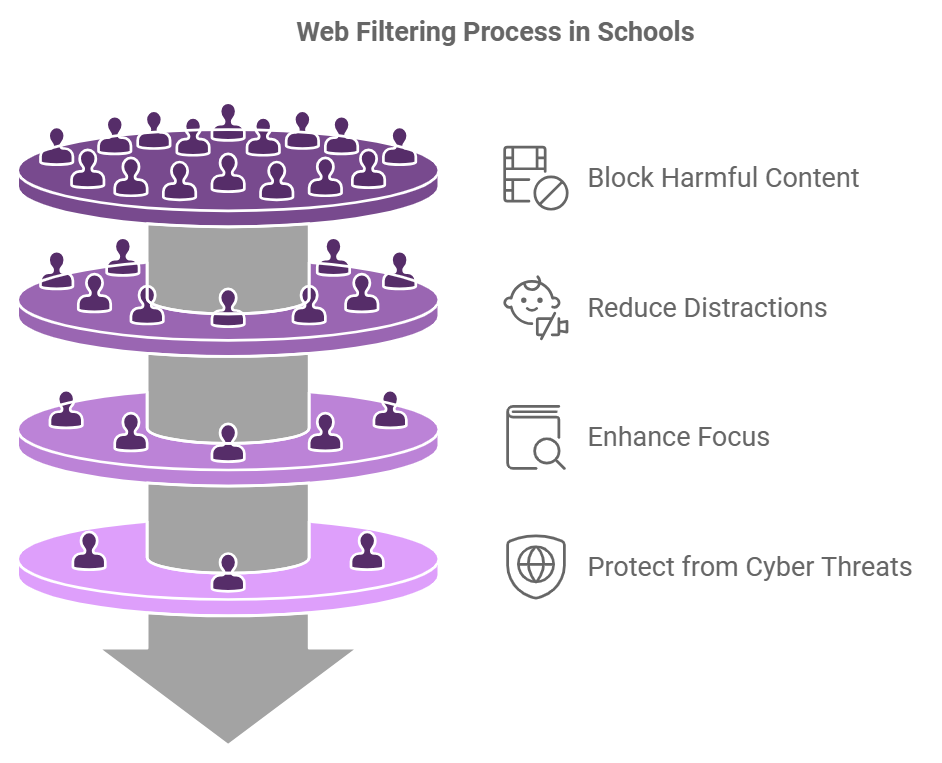
Internet filtering in schools isn’t as complicated as it might sound. In simple terms, it’s a system that blocks access to websites or content that could be harmful—whether that’s explicit material, violent content, or even distractions like social media.

But here’s the thing: web filters don’t just stop at blocking bad content. They also help students stay focused on the right stuff—learning. With the right filters, schools can ensure that students aren’t sidetracked by online games, random videos, or other distractions during study time.

It’s as if setting a study timer on your phone—but for the entire school.

On top of that, web filters act as shields against the growing number of cyber threats. We’re talking about phishing scams, malware, and cyberbullying—risks that can wreak havoc not just on a student’s safety but on their mental health as well. These dangers are kept at bay with web filtering software for schools, creating a safer and more productive environment.

The Problem: The real dangers of an unfiltered internet

The internet, for all its potential, is full of dangers. And without proper web filtering, schools leave students vulnerable to a range of problems.

Here are the top 5 threats that make web filtering a must-have:

1. Exposure to explicit content

We’re talking about graphic images, violence, and explicit material—things that no child should stumble upon while browsing the web. Yet, without web filters, students are just a click away from encountering inappropriate content.

2. Cyberbullying

It’s not just face-to-face bullying that we need to worry about anymore. Cyberbullying is a major concern, and it can have devastating effects on a child’s mental health. With web filters in place, students can be shielded from harmful interactions, ensuring they have a safer space to learn.

3. Scams and phishing attacks

The internet is a goldmine for scammers, and children are prime targets. From fake websites to phishing emails, it’s easy for students to fall for tricks that could steal their personal information. Web filters block these sites, preventing students from becoming victims.

4. Malware and viruses

The internet is full of shady websites and downloads that can infect devices with malware or viruses. These threats can compromise school networks and put personal data at risk. A strong web filter stops these malicious sites in their tracks, ensuring students and their devices stay safe.

5. Distractions that waste time

Think about the number of times you’ve clicked on random videos or games while you should be doing something else. Now imagine students doing the same during class. Without proper web filtering, distractions are everywhere, preventing students from focusing on their studies.

The Solution: web filtering software to the rescue

So, how do we stop these problems from derailing our kids’ education and safety? Solution: Web filtering software for schools.

Here’s how it works:

Blocks harmful content

Web filters prevent access to inappropriate websites by scanning for specific keywords, categories, or URLs. Schools can customize these filters to block everything from explicit material to violent content, making sure students can’t stumble upon harmful websites.

Focuses students’ attention

With distractions like social media, games, and random videos out of the equation, web filtering helps students stay focused on the task at hand—learning. This is particularly important during school hours when students need to stay engaged in their lessons and educational resources.

Protects against cyber threats

A solid web filter does more than block inappropriate sites—it also protects students from cyber threats like phishing scams, malware, and identity theft. By stopping these dangerous sites before they can do harm, web filters keep students safe and secure while they navigate the web.

Protection for schools

One of the best parts of content filtering software for schools is that it can be tailored to meet specific needs. Filters can be set based on the grade level, the subject being studied, or even specific content areas that need to be restricted or encouraged.

Real-time monitoring and reporting

Most web filtering systems offer real-time monitoring and reports, which means educators and administrators can track what students are accessing online. This allows for quick action if anything inappropriate or dangerous is spotted, keeping everyone accountable.

A safer, smarter digital world for students with Veltar

At the end of the day, the internet is an incredible resource, but without the proper safeguards, it can also be a dangerous place. With the alarming statistics highlighting that approximately 338 million children have been exposed to harmful content online, it’s imperative for educational institutions to implement measures to protect their students.

One effective solution is the deployment of web filtering software, such as Veltar.

Veltar is a comprehensive endpoint security solution that helps protect data at rest and in motion. It offers features like web content filtering, VPN tunneling, I/O device access control, and application control, providing a unified approach to endpoint security.

By integrating Veltar into school networks, administrators can prevent access to inappropriate websites by scanning for specific keywords, categories, or URLs. You can select categories of websites to block and enter specific domains to restrict.

Keep students immersed in meaningful learning by cutting out distractions like social media and games.


About Scalefusion
Scalefusion’s company DNA is built on the foundation of providing world-class customer service and making endpoint management simple and effortless for businesses globally. We prioritize the needs and feedback of our customers, making sure that they are at the forefront of all decision-making processes. We are dedicated to providing comprehensive customer support services, and place emphasis on customer-centric thinking throughout the organization.

About Version 2 Digital
Version 2 Digital is one of the most dynamic IT companies in Asia. The company distributes a wide range of IT products across various areas including cyber security, cloud, data protection, end points, infrastructures, system monitoring, storage, networking, business productivity and communication products.

Through an extensive network of channels, point of sales, resellers, and partnership companies, Version 2 offers quality products and services which are highly acclaimed in the market. Its customers cover a wide spectrum which include Global 1000 enterprises, regional listed companies, different vertical industries, public utilities, Government, a vast number of successful SMEs, and consumers in various Asian cities.

How ITSM optimizes vulnerability management

Understanding Vulnerability Management 

Definition and importance of Vulnerability Management in modern IT environments 

Vulnerability management has become a top priority for organizations of all sizes and industries. The reason is simple: cyber threats are increasingly sophisticated, and any unmanaged vulnerability represents an open door for potential attacks. 


But what exactly is Vulnerability Management? 

It is a structured process that enables organizations to identify, assess, and resolve vulnerabilities in their IT systems before they can be exploited by malicious actors. 

Attention! Its role is not limited to security alone: efficient Vulnerability Management also contributes to business continuity and data protection, enhancing customer trust and ensuring compliance with security regulations such as GDPR. 


The main stages of the Vulnerability Management lifecycle
 

The vulnerability management lifecycle consists of several phases that must be carried out methodically to ensure vulnerabilities are properly managed: 

  • Scanning and Identification: Using specific tools, vulnerabilities in IT systems are detected.


  • Evaluation: Vulnerabilities are then analyzed to determine their severity and potential impact on the infrastructure
  • Prioritization: Vulnerabilities are classified based on their criticality, allowing IT teams to focus resources on the most severe threats as quickly as possible
  • Resolution: Corrective actions, such as applying patches or more comprehensive vulnerability mitigation, are implemented.
  • Verification and Continuous Monitoring: After correction, vulnerabilities are monitored to ensure they do not reoccur. Vulnerability Management, in fact, should not be limited to emergency operations but integrated into the normal functioning of business processes.

How ITSM processes improve Vulnerability Management 

IT Service Management (ITSM) processes are crucial in optimizing vulnerability management. 

Why, in concrete terms? 

Because they enable IT operations to be effectively integrated with security practices, automating many repetitive tasks and improving collaboration between security and IT teams. Moreover, they allow for precise tracking of the entire vulnerability lifecycle, from identification to resolution, ultimately improving the effectiveness and efficiency of management. 

How can these processes be enabled and made operational? 

Through versatile, powerful, and easy-to-use tools like EV Service Manager.

Connecting ITSM to security management 

Bridging the gap between ITSM and security is fundamental. 

Integrating these two areas allows for the standardization of processes, reduction of human error risks, and ensuring a faster and more effective response to threats. 

Thanks to tools like EV Reach, vulnerabilities can be managed remotely and automatically, ensuring that even the most distant or hard-to-reach systems are protected in real-time.

Leveraging ITSM processes for Vulnerability Management 

The role of ITSM in identifying, tracking, and managing vulnerabilities 

ITSM provides a well-organized IT service architecture, which, in turn, allows vulnerability management to be integrated into daily operational processes; as we mentioned earlier. 

But where does this role start? And how far does it go? 

It begins with the identification of vulnerabilities, naturally. Then it moves on to management through a ticketing system, which enables prioritization, progress tracking, and documentation of the actions taken to resolve each vulnerability. As a result, the actual resolution of the issue becomes the starting point for continuous process improvement through data analysis.

Aligning ITSM with security risk management 

Let’s get straight to the key point: aligning ITSM with risk management allows vulnerabilities to be addressed with a holistic view, not just an emergency one. 

This approach ensures that security threats are not treated as isolated problems but as part of a broader IT risk management framework with which companies must constantly coexist. 

The most important benefits of this more contemporary approach? Resource optimization and reduced response times, with IT teams staying one step ahead of potential attacks. 

The final outcome? Greater satisfaction for users and customers, along with the competitive advantage this brings. 


Integrating Vulnerability Management into key ITSM processes
 

The integration between ITSM and vulnerability management is something critical and increasingly indispensable; we have emphasized this repeatedly. Now, let’s get even more concrete and operational by isolating the key aspects of this integration: 

  • Incident Management: Vulnerabilities can turn into actual incidents if not managed in time. And when this happens, quick action is required. For example, the Automated Incident Management of EV Reach allows rapid responses to security-related incidents, monitoring resolution and ensuring critical escalations don’t occur. All of this is fully automated.


  • Change Management: Vulnerabilities often require patching or updates. Change Management processes enable these changes to be handled in a structured way, minimizing the impact on business operations and preventing potential interruptions.
  • Problem Management: Some vulnerabilities may recur over time, necessitating an in-depth analysis of their root causes. Problem management helps identify these causes and implement lasting solutions to prevent their reoccurrence
  • Configuration Management: Through the Configuration Management Database (CMDB), vulnerabilities can be mapped to specific IT assets, precisely monitoring the potential impact of each vulnerability on devices, servers, and applications. Products like EV Service Manager enable centralized asset management, improving visibility over systems and their vulnerabilities.

Enhancing vulnerability resolution with ITSM tools 

Finally, it’s time for the actual resolution. 

Solutions and products from EasyVista, such as EV Service Manager and EV Reach, provide tools to automate vulnerability resolution, ensuring that patches are applied quickly and consistently. 

This results in two mirrored benefits: 

  • Resolutions are much faster and more accurate compared to manual efforts. 
  • IT teams can focus on more strategic activities, reducing their workload.

Overcoming challenges in ITSM-based Vulnerability Management 


Addressing organizational and process silos
 

One of the main obstacles to integrating vulnerability management with ITSM is the organizational silos that still characterize the workflows of many companies. 

It’s necessary, therefore, to adopt solutions and tools that facilitate greater collaboration between teams, breaking down barriers that may hinder a coordinated response to threats. 

But even before that, a change in mindset within the company is needed.  


Managing the volume of security threats
 

With the constant increase in the number of threats, managing the volume of vulnerabilities can become complex. And here again, the importance of automation processes within ITSM solutions becomes evident, as they improve the scalability of the process.  


Continuous monitoring and process improvement
 

Continuous monitoring is essential to prevent and mitigate vulnerabilities and to act promptly. 

However, as we have already said, it is not enough to simply solve problems as they arise. 

What is even more crucial is to collect valuable data on all processes related to cybersecurity, turning vulnerability management into a prevention process that makes “cures” increasingly unnecessary. 


Automation and the future of Vulnerability Management


Automating vulnerability detection and resolution
 

We’ve said it and repeated it: Automation is the future of vulnerability management:  It’s about implementing tools that automatically detect vulnerabilities and apply patches with minimal human intervention, reducing the risk of error and speeding up response times. 


Leveraging AI and Machine Learning to improve threat response
 

Artificial intelligence (AI) and machine learning are playing an increasingly important role in all business digital processes, not least in proactive threat detection. 

In practice, these systems can analyze large amounts of data, identify patterns, and suggest corrective actions before vulnerabilities become problematic. 


Future trends in the integration between ITSM and Vulnerability Management
 

While the future can never be predicted with certainty, what we can be sure of is that we will see increasing integration between ITSM and vulnerability management, with the use of advanced technologies like artificial intelligence to anticipate threats and ensure continuous protection of IT infrastructures. 

All of this will be increasingly tailored to the unique needs of individual companies. 


FAQs


What is Vulnerability Management?

It is the process of identifying, evaluating, and resolving vulnerabilities in IT systems to prevent possible attacks. 


What is ITSM’s role in Vulnerability Management?

ITSM provides an organizational structure that allows vulnerabilities to be managed as part of IT operational processes, ensuring traceability, automation, and continuous improvement.


How do EasyVista solutions improve Vulnerability Management?

EV Service Manager and EV Reach help track, monitor, and automate the vulnerability management process, improving threat response, reducing resolution times, and easing the workload on IT teams.

About EasyVista  
EasyVista is a leading IT software provider delivering comprehensive IT solutions, including service management, remote support, IT monitoring, and self-healing technologies. We empower companies to embrace a customer-focused, proactive, and predictive approach to IT service, support, and operations. EasyVista is dedicated to understanding and exceeding customer expectations, ensuring seamless and superior IT experiences. Today, EasyVista supports over 3,000 companies worldwide in accelerating digital transformation, enhancing employee productivity, reducing operating costs, and boosting satisfaction for both employees and customers across various industries, including financial services, healthcare, education, and manufacturing.

About Version 2 Digital

Version 2 Digital is one of the most dynamic IT companies in Asia. The company distributes a wide range of IT products across various areas including cyber security, cloud, data protection, end points, infrastructures, system monitoring, storage, networking, business productivity and communication products.

Through an extensive network of channels, point of sales, resellers, and partnership companies, Version 2 offers quality products and services which are highly acclaimed in the market. Its customers cover a wide spectrum which include Global 1000 enterprises, regional listed companies, different vertical industries, public utilities, Government, a vast number of successful SMEs, and consumers in various Asian cities.

The Role of ITSM in Cybersecurity Incident Response

IT service management (ITSM) plays a crucial role in any business, ensuring IT operations are efficient and well-coordinated, but its impact extends beyond that to everything related to cybersecurity incident response. In concrete terms, it does this by reducing response times, facilitating communication, and improving coordination during an incident. But it’s not just about “curing”; ITSM also allows for prevention, solving problems before they arise.

ITSM and cybersecurity are crucial and delicate topics that we will focus on in the rest of the article.

How ITSM Improves Cybersecurity Incident Management

The role of ITSM in incident detection and response

ITSM systems can support structured management of cybersecurity incidents, starting from the detection processes. A response is then triggered, often in an automated manner.

Solutions like EV Observe offer continuous monitoring, enabling you to detect incidents and initiate corrective actions as quickly as possible.

ITSM workflows with cybersecurity needs

By leveraging ITSM, you can standardize your IT workflows to make them consistent with your IT security practices. These practices are constantly evolving; here’s another key point: good ITSM systems ensure no vulnerabilities are introduced during system changes and updates.

Reducing response time through ITSM frameworks

Here, we touch on another crucial aspect we have mentioned since the introduction.

Adopting an ITSM framework for incident management can significantly reduce response times in the event of incidents or cyberattacks. It can do so through predefined and automated processes of prioritization and escalation.

In this regard, automation tools, such as those offered by EV Reach, manage security tickets in real time, improving the response’s overall effectiveness.

ITSM Features That Strengthen Cybersecurity

Incident tracking and compliance documentation

It’s not just about detecting and fixing errors. One of the most important aspects of ITSM is the ability to track and document each phase of incident management, a key factor when it comes to cybersecurity. Detailed recording of activities allows compliance with regulations (for example, GDPR) and provides valuable information to prevent future incidents, triggering a continuous improvement mechanism.

Root cause analysis and response coordination

Still on the subject of continuous improvement: after an incident, it is essential to conduct a thorough analysis to identify the causes and prevent similar events from happening in the future. ITSM also facilitates this process through workflows structured around this objective.

In this way, the coordination of the response becomes increasingly efficient. It’s a bit like what happens in all immune systems.

Automated workflows and reduction of human errors

Automation is one of the most powerful weapons in the fight against cyberattacks. In this way, efficiency soars and the risk of human errors tends toward zero.

ITSM Metrics and KPIs for Incident Response

KPIs for cybersecurity in ITSM

Measuring the effectiveness of your security incident response is critical to continuously improving your business protection.

There are several relevant KPIs, and they depend on the type of company. Among these, the most important and valid for everyone are as follows:

  • The mean time to detect incidents (MTTD).
  • The mean time to resolution (MTTR).
  • The number of incidents resolved without escalation.

ITSM metrics to optimize incident response strategies

At this point, it is a matter of taking a further step: collecting data from ITSM allows you to continuously optimize response strategies; we have seen it. It is always a question of quantity of information but also of quality and depth.

Last but not least, IT teams must easily read this data.

Solutions like EV Reach and EV Service Manager offer intuitive, customizable dashboards that allow IT managers to visualize incident trends and make informed decisions to prevent future attacks.

Continuous improvement through incident data analysis

We have reiterated in several passages above that the information collected during incident management is fundamental for improving security processes.

Using historical incident data, organizations can implement timely fixes and improve their defenses in the short, medium, and long term. ITSM is at the heart of this process, as it ensures all information is stored and used to optimize response plans.

Best Practices for Implementing ITSM in Cybersecurity Incident Response

ITSM processes with security policies

Processes must be aligned with the company’s security policies for ITSM to effectively support cybersecurity.

This means clearly defining roles and responsibilitiesstandardizing response procedures, and ensuring all teams have access to the same information and tools. All this must occur in a dynamic manner since these policies can (and must) be constantly updated.

ITSM team training for security incident management

Automation is important, but it is of little use if it is not supported by attentive and well-trained staff. In other words, companies must invest in the continuous training of their IT teams to be prepared to face ever-evolving threats through ever-evolving tools.

Leveraging automation in ITSM for faster incident resolution

As we have reiterated, speed is a decisive factor in managing cybersecurity incidents.

Attention must always be at its maximum, 24 hours a day, seven days a week. The human factor alone cannot guarantee this type of attention. By automating many repetitive tasks, you can ensure fast and accurate incident responses.

Collaboration between ITSM and cybersecurity teams

ITSM systems can serve as a hub for communication and coordination during a security incident. Collaboration between ITSM and cybersecurity teams enables a more coordinated response based on relevant information shared in real time.

ITSM is a central hub for communication and coordination

We have discussed collaboration and coordination between teams as the key to timely incident resolution. However, such a response cannot be achieved without efficient centralization of processes.

Tools like EV Service Manager offer an integrated platform that centralizes communications. This ensures that all teams involved have access to the same information and that decisions are made quickly and with full knowledge of the facts.

Challenges and Solutions in Integrating ITSM for Cybersecurity

Breaking down organizational silos for incident management

One of the main obstacles to effectively integrating ITSM into cybersecurity processes is the presence of organizational silos or inefficient barriers between one sector and another. Instead, it is important to foster a culture of collaboration in which various teams share knowledge and resources to ensure a timely and coordinated response.

ITSM flexibility to address evolving threats

Cybersecurity threats are constantly evolving, and ITSM must be flexible enough to adapt. This is another reason to rely on solutions and platforms that allow you to easily update workflows and adapt to new needs, keeping your business security up to date.

Cross-functional incident management with ITSM

Integrating ITSM with other business functions, such as vulnerability management and compliance monitoring, can significantly improve cross-functional incident management. This is a direct consequence of what we highlighted earlier about ITSM’s role as a facilitator of communication and collaboration between departments.

Conclusion: The Future of ITSM in Cybersecurity Incident Response

In an increasingly digital business, it is normal for cyber threats and incidents to multiply. Consequently, we will increasingly need efficient, easy-to-use, continuously updated tools.

ITSM systems will be increasingly crucial in cybersecurity management, especially as advanced technologies such as artificial intelligence and automation are integrated.

FAQs

What are the main benefits of ITSM in cybersecurity incident management?

Improved team coordination, reduced response times, and compliance assurances through incident documentation and tracking.

How can automation improve security incident response?

By enabling you to detect, classify, and respond to incidents faster and more efficiently, reducing human error and improving resolution speed.

What are the main challenges in integrating ITSM with cybersecurity?

Overcoming the inefficiencies of organizational silos and aiming for ever greater flexibility to address emerging threats.

About EasyVista  
EasyVista is a leading IT software provider delivering comprehensive IT solutions, including service management, remote support, IT monitoring, and self-healing technologies. We empower companies to embrace a customer-focused, proactive, and predictive approach to IT service, support, and operations. EasyVista is dedicated to understanding and exceeding customer expectations, ensuring seamless and superior IT experiences. Today, EasyVista supports over 3,000 companies worldwide in accelerating digital transformation, enhancing employee productivity, reducing operating costs, and boosting satisfaction for both employees and customers across various industries, including financial services, healthcare, education, and manufacturing.

About Version 2 Digital

Version 2 Digital is one of the most dynamic IT companies in Asia. The company distributes a wide range of IT products across various areas including cyber security, cloud, data protection, end points, infrastructures, system monitoring, storage, networking, business productivity and communication products.

Through an extensive network of channels, point of sales, resellers, and partnership companies, Version 2 offers quality products and services which are highly acclaimed in the market. Its customers cover a wide spectrum which include Global 1000 enterprises, regional listed companies, different vertical industries, public utilities, Government, a vast number of successful SMEs, and consumers in various Asian cities.

How ESM Transforms IT Departments into Service-Centric Organizations


How ESM Transforms IT Departments into Service-Centric Organizations

With enterprise service management (ESM), you can digitize your internal processes, streamline incoming request management, automate tasks, relieve pressure on your service desk, and perform lengthy, low-value-added processes efficiently while improving the user experience.

In essence, by adopting ESM tools, you apply IT service management (ITSM) best practices to your entire organization, not just the IT department.

On the other hand, any company that wants to remain competitive today can do nothing but commit itself to increasing the quality of its services, both internal (e.g., the activities of employees) and external (the end customer).

This commitment requires a transformation of IT departments, which must emerge from traditional isolation to become integrated and service-oriented organizations.

Enterprise service management is a crucial enabler of this transformation.


How IT Departments Are Changing: From Cost Centers to Strategic Partners

The need to integrate digital tools into every part of the business demonstrates that the isolation we have mentioned is an inefficient and uneconomical strategy.

Today, IT departments can achieve business results and generate value and can no longer be considered mere technical support functions.

Traditional IT departments focus on infrastructure management, system maintenance, and network security. They are reactive—responding to issues as they arise—and have limited interaction with other business units as they operate in silos. Their perception of being cost centers rather than strategic partners limits their ability to influence broader business goals.

Therefore, the traditional approach produces inefficiencies: isolated systems and processes cause delays and prevent the provision of consistent services.

The choice to equip oneself with ESM solutions helps to overcome the role typically assigned to IT departments, moving toward the adoption of a holistic approach that aligns with the broader organizational strategy.


What Does Service-Centric Mean?

By now, we should have realized that an organization’s true digital transformation is not just about expanding ITSM best practices.

For transformation to happen, processes must be standardized and unified, and services provided to users must be interconnected. Old ITSM tools are not suited to such flexible and customer-centric deployments; they are expensive and complex to extend to the rest of the company.

The development of more agile cloud-based tools is changing things for the better. Modern ESM software has become much faster to deploy, manage, and maintain. This means that non-IT functions are increasingly able to easily administer their own services.

The essence of a service-centric organization lies in the possibility of the different departments to exploit their specific objectives through collaboration with all other company functions, thanks to advanced ESM systems and ITSM best practices.


Key Components of Enterprise Service Management

ESM includes multiple key components: service catalogs, self-service portals, automated workflows, integrated reporting and analytics, and tools for incidentproblem, and change management.

These components help standardize service delivery across the organization, break down silos, and foster a more collaborative environment. They enable consistent delivery, regardless of the department or service being offered. Through automation and self-service capabilities, they reduce manual workloads and accelerate response times.

Finally, specific features allow for improved collaboration and communication between departments.


A Short Guide to ESM Implementation

Implementing ESM is a complex process. The following are the basic steps:

  1. The first step consists of a complete assessment of current IT capabilities—maturity of existing ITSM practices, level of automation in place, and general alignment of IT services with business objectives. Part of this initial phase also involves identifying weaknesses (areas where current services are lacking) and strengths. A successful ESM strategy must start with clear and aligned objectives and goals in line with the organization’s overall strategy.
  2. In the second step, a roadmap is developed to establish the necessary steps for implementing ESM, from identifying the scope of distribution of the ESM software to selecting the most appropriate tools and technologies up to defining the timing.
  3. The deployment of ESM solutions must be carefully planned and executed. At this stage, the infrastructure is set up, systems are configured, and stakeholders are adequately trained.

Best Practices for Successful Deployment

ESM implementation can only be successful if done correctly, following a methodical and thorough approach. Here are some tips:

  • Gain top management buy-in. Leadership support is an important signal to drive ESM adoption throughout the organization.
  • Set specific goals. Having clear, realistic goals you expect to achieve with ESM helps you measure your progress objectively.
  • Involve stakeholders. During the planning and implementation phases, representatives from different departments and teams should be involved to ensure a complete view of the entire adoption process.
  • Communicate effectively. Explaining the benefits of the change produced by ESM and promptly responding to doubts or correcting inaccurate beliefs helps to defuse resistance.
  • Opt for a phased approach. Implementing ESM so that each phase builds on the previous one helps manage complexity and minimize disruptions, leading to a smoother transition.

Benefits of ESM for IT Departments from a Customer-Centric Perspective

It is clear that ESM plays a fundamental role in enriching IT departments’ performance and contributes to their transformation into service-focused and fully customer-centric organizations.

Through process automation and standardization, ESM optimizes service delivery, enhances IT staff capabilities, and fosters a more efficient and customer-centric approach. The benefits are numerous; let’s explore them one by one.

  • Improved service delivery. A structured approach to service management ensures consistent and efficient service delivery, meeting the needs of internal and external users.
  • Improved user experience. By focusing on the user experience, ESM helps create more intuitive and user-friendly service interactions. Self-service portals and automated workflows enable users to access services quickly, easily, independently, and with greater satisfaction.
  • Reduced response times and downtime. Automation and streamlined workflows significantly reduce response times and downtime. This improves service reliability and allows staff, not just IT, to focus on more strategic activities.
  • Increased efficiency and productivity. Standardized processes and improved workflows enable IT departments to deliver service faster and reduce time spent on manual tasks. Eliminating redundant processes and optimizing resource allocation increases efficiency and productivity across the organization.
  • Cost savings. ESM helps save costs by reducing the need for IT departments to intervene manually. By automating routine tasks, organizations can allocate resources more effectively, resulting in significant cost reductions.
  • Empowered IT staff. ESM provides IT staff with ongoing training opportunities. By exposing them to a broader range of services and processes, ESM helps IT professionals develop a more comprehensive understanding of the business.
  • A service-oriented mindset. IT staff is encouraged to think beyond technical support and consider the overall user experience. This shift in perspective is critical to providing high-quality, truly customer-centric services.

ESM and IT Departments: New Scenarios

ESM adoption can present several challenges, including resistance to change, poor buy-in, and problems integrating with existing systems. Overcoming these challenges requires strong leadership, clear communication, and a well-defined implementation plan.

Emerging technologies, particularly artificial intelligence (AI) and automation, are largely driving the transformation of IT departments into service-centric and customer-centric organizations.

Adopting AI in ESM scenarios streamlines and facilitates service delivery, allowing IT teams to focus on strategic initiatives.

In practice, by automating routine tasks, AI allows proactive problem-solving and timely delivery of personalized services, such as generating articles, analyzing financial data, and communicating formal documents.

Moving from manual processes to intelligent automation enables IT departments to provide faster, more accurate, and personalized support. As a result, IT can better align with business goals, providing tailored services that meet the specific needs of different departments, thereby improving the overall user experience.

This focus on service quality and customer solutions is the essence of a service-centric organization.


Conclusion

As ESM continues to evolve, IT departments are transforming from support functions to strategic partners and service-centric organizations.

Enterprise service management (ESM) is a powerful tool that can make this transformation successful. By extending service management principles across the enterprise, ESM improves process efficiency and user experience while empowering IT staff.


FAQs

What does enterprise service management (ESM) do?

ESM applies IT service management best practices across the organization, helping IT departments become service-centric organizations focused on efficiency and user satisfaction.

What are the benefits of adopting ESM?

ESM improves service delivery, reduces costs, and increases productivity, transforming IT departments into strategic, service-centric partners focused on improving the user experience.

How does ESM support the transformation of IT departments into service-centric organizations?

ESM unifies and standardizes processes, enabling IT departments to deliver faster, more consistent services, which is critical to a service-centric, user-centric organization.

What are the main challenges in implementing ESM?

Challenges include resistance to change and integration issues. Overcoming these challenges helps IT departments evolve into service-centric organizations, improving collaboration and efficiency.

How is artificial intelligence (AI) enhancing the ESM?

AI automates routine tasks, improving service accuracy and speed. This supports the transformation of IT departments into service-centric organizations focused on personalized solutions for users.

About EasyVista  
EasyVista is a leading IT software provider delivering comprehensive IT solutions, including service management, remote support, IT monitoring, and self-healing technologies. We empower companies to embrace a customer-focused, proactive, and predictive approach to IT service, support, and operations. EasyVista is dedicated to understanding and exceeding customer expectations, ensuring seamless and superior IT experiences. Today, EasyVista supports over 3,000 companies worldwide in accelerating digital transformation, enhancing employee productivity, reducing operating costs, and boosting satisfaction for both employees and customers across various industries, including financial services, healthcare, education, and manufacturing.

About Version 2 Digital

Version 2 Digital is one of the most dynamic IT companies in Asia. The company distributes a wide range of IT products across various areas including cyber security, cloud, data protection, end points, infrastructures, system monitoring, storage, networking, business productivity and communication products.

Through an extensive network of channels, point of sales, resellers, and partnership companies, Version 2 offers quality products and services which are highly acclaimed in the market. Its customers cover a wide spectrum which include Global 1000 enterprises, regional listed companies, different vertical industries, public utilities, Government, a vast number of successful SMEs, and consumers in various Asian cities.

Dedicated Device Management: Everything You Need to Know

The use of mobile devices has increased dramatically in recent years and will continue to do so with the rapid growth of EMM (enterprise mobility management). Managing these devices is crucial to safeguarding data and the devices that handle critical business information and functions. UEM is the best solution for managing and securing dedicated devices.


What are Dedicated Devices?

Dedicated devices are company-owned devices that can be employee-facing or customer-facing. They include self-check-in systems, point-of-sale (POS) systems, digital signage, retail store billing, checkout systems, and airport ticket printing desks, to name a few. The devices fulfill a single-use case by running in kiosk mode which can be single-app or multi-app. Dedicated devices perform essential business functions and hence need to run without any interruptions.

Some common examples of customer-facing dedicated devices are ATMs for cash transactions, digital signage in hotels for advertisements, baggage check-in at airports, POS terminals, handheld devices used as barcode scanners as well as for navigation, and dedicated tablets used for educational purposes.

Some employee-facing dedicated devices are for inventory management in logistics, handheld devices used by healthcare professionals, and vehicle-mounted devices used by drivers in transportation.

However, these devices can’t run independently and are required to be managed remotely. Usually, the devices are unattended and run in dedicated kiosk mode. Communicating with these devices in the field and ensuring timely updates on these devices can be best done using a dedicated device management solution like a Unified Endpoint Management (UEM) solution.

Corporate-owned dedicated devices don’t store content and information, and it’s crucial to push updated content regularly to these devices as they perform mission-critical functions. UEM enables you to update, troubleshoot, interact, and pass commands to devices remotely. UEM also simplifies configuring devices and provisioning them, enforcing policies, and ensuring device and data security.

How Does Dedicated Device Management Work?

A dedicated computer or dedicated hardware is often locked to a single application or a set of applications to serve a specific purpose, ensuring efficiency and security. This is achieved using either single-app kiosk mode or multi-app kiosk mode, based on the use case:

  • Multi-app kiosk mode: When a device needs to run multiple applications, it operates in a multi-app kiosk mode. With the help of a kiosk launcher, admins can easily switch between apps and manage various functions. This approach is perfect for devices used in environments that demand versatility while still maintaining the dedicated purpose of the hardware.
  • Single-app kiosk mode: In this setup, the device is locked to a single application, providing IT admins extensive control over the device’s functionality. They can configure peripheral settings to ensure seamless operation. Once locked, the application launches automatically and remains on the screen, even after the device restarts or shuts down. This makes it ideal for scenarios requiring a focused, dedicated hardware solution.
Learn More: What is Kiosk Mode?
Free trial

Types of Dedicated Devices

When it comes to types of hardware devices, dedicated hardware plays a pivotal role in streamlining specific operations across various industries. These devices are categorized based on their purpose and functionality:

  1. Single-Use Hardware Devices
    These devices are designed to perform one specific task, often operating in single-app kiosk mode. Examples include:
    • Point-of-Sale (POS) Systems: Optimized for transaction processing.
    • Digital Signage Devices: Built to display content like advertisements or announcements.
    • Self-Service Kiosks: Used for ticketing, check-ins, or orders.
  2. Multi-Function Hardware Devices
    These devices run multiple applications while maintaining a dedicated purpose, utilizing multi-app kiosk mode for flexibility. Examples include:
    • Retail Tablets: Supporting inventory management, customer assistance, and payment apps.
    • Educational Tablets: Configured with a suite of learning applications for students.
    • Medical Devices: Designed for patient records, monitoring, and diagnostics.
  3. Industrial Hardware Devices
    Built for durability and reliability, these devices are essential in demanding environments, such as:
    • Barcode Scanners: Used for inventory tracking and warehouse management.
    • Fleet Management Devices: Installed in vehicles to monitor operations and logistics.
    • IoT Sensors: Designed for data collection and automation in industrial setups.

Benefits of Using Dedicated Devices

Using dedicated devices, particularly those managed with a UEM solution, brings numerous advantages for businesses.

Here are the key benefits:

Manage Content and Applications

The purpose of a dedicated device can evolve, requiring changes in the content or applications it runs. UEM software ensures smooth updates by allowing admins to silently install or uninstall apps without relying on end users. This reduces device downtime significantly. Through the UEM dashboard, admins can push apps from the Play Store or deploy enterprise apps directly from the Enterprise Store, making management efficient.

Ensure Endpoint Security

UEM solutions play a critical role in securing Android-dedicated devices and other platforms. They encrypt sensitive corporate data, preventing unauthorized access. With kiosk mode, admins gain full control over device settings, including peripherals, ensuring minimal end-user interference. Furthermore, network configurations such as Wi-Fi are managed to connect devices exclusively to corporate-approved networks. Automated OS updates ensure devices remain protected from malware and viruses.

Protect Lost or Stolen Devices

When devices are lost or stolen, UEM solutions provide critical security features like factory reset protection for Android devices. Admins can remotely lock the device, wipe sensitive data, and prevent misuse of corporate information. Location tracking and location history monitoring via the UEM dashboard ensure admins can quickly locate devices or enforce location-specific policies.

Remote Troubleshooting of Devices

Remote cast and control capabilities allow IT admins to address technical issues immediately. By casting the device screen to the UEM dashboard, admins can resolve glitches or sync files remotely, significantly reducing downtime. This feature is particularly valuable for dedicated devices operating in unattended locations, where physical access is challenging during disruptions.

G2 Review
G2 Review

Some Popular Examples of Dedicated Devices

Dedicated devices are designed to serve specific purposes, offering reliability and efficiency across various industries. Here are some dedicated devices examples that showcase their diverse applications:

  1. Point-of-Sale (POS) Terminals: Used in retail and hospitality, these devices handle transactions and ensure smooth customer checkouts.
  2. Digital Signage Systems: Display advertisements, announcements, or schedules in retail stores, airports, and public spaces.
  3. Self-Service Kiosks: Found in ticketing counters, restaurants, and banks, these kiosks simplify customer interactions and reduce wait times.
  4. Rugged Industrial Devices: Built for warehouse or field operations, these include barcode scanners and handheld terminals.
  5. Healthcare Monitoring Devices: Used in hospitals for patient monitoring, diagnosis, and medical record access.

Key Considerations When Choosing Dedicated Devices

Selecting the right dedicated device is essential for meeting business needs while ensuring reliability and security. Here are some key factors to consider:

  1. Purpose and Use Case: Clearly define the device’s role in your operations. Whether it’s for digital signage, POS, or rugged fieldwork, understanding the requirements will guide your choice.
  2. Durability and Environment Suitability: If the device will be used in challenging environments, like warehouses or outdoor locations, ensure it has a rugged design and supports extreme conditions.
  3. Management and Configuration Support: Choose devices that integrate seamlessly with a UEM solution to allow for remote management, app updates, and network configuration.
  4. Security Features: Devices must offer strong security measures, such as encryption, kiosk mode, and remote locking or wiping capabilities, especially for corporate data protection.
  5. Compatibility: Ensure the dedicated devices work with your existing software and infrastructure, including enterprise apps or specific operating systems like Android or iOS.

Pick Your UEM Alongside Your Dedicated Hardware

When investing in dedicated hardware, it’s crucial to pair it with a robust Unified Endpoint Management (UEM) solution. Here’s why this combination matters:

  1. Streamlined Device Management
    A UEM solution allows IT admins to manage, monitor, and secure devices remotely. It ensures that the dedicated hardware always functions optimally by pushing updates, configuring settings, and deploying apps.
  2. Enhanced Security
    Protect sensitive corporate data on your dedicated hardware through features like encryption, kiosk mode, and remote locking or wiping in case of theft or loss.
  3. Flexible Adaptation to Business Needs
    UEM lets you reconfigure devices for new tasks or applications without replacing the hardware, extending its lifespan and value.
  4. Minimized Downtime
    With remote troubleshooting and monitoring capabilities, admins can address technical issues immediately, ensuring uninterrupted device performance.

By choosing the right UEM solution alongside your dedicated hardware, you can maximize the functionality, security, and reliability of your devices, empowering your business operations.

The Final Words 

Though dedicated devices help in executing different strategies for various businesses, the security of these devices is extremely important. Scalefusion UEM stands out as a versatile solution to efficiently manage a fleet of dedicated devices from a single console, offering robust data security and seamless management capabilities.

About Scalefusion
Scalefusion’s company DNA is built on the foundation of providing world-class customer service and making endpoint management simple and effortless for businesses globally. We prioritize the needs and feedback of our customers, making sure that they are at the forefront of all decision-making processes. We are dedicated to providing comprehensive customer support services, and place emphasis on customer-centric thinking throughout the organization.

About Version 2 Digital
Version 2 Digital is one of the most dynamic IT companies in Asia. The company distributes a wide range of IT products across various areas including cyber security, cloud, data protection, end points, infrastructures, system monitoring, storage, networking, business productivity and communication products.

Through an extensive network of channels, point of sales, resellers, and partnership companies, Version 2 offers quality products and services which are highly acclaimed in the market. Its customers cover a wide spectrum which include Global 1000 enterprises, regional listed companies, different vertical industries, public utilities, Government, a vast number of successful SMEs, and consumers in various Asian cities.