ESET researchers detect a new trick used by malware to slip into the official Android app store

Bratislava – May 22, 2020 – ESET researchers discovered an extremely stealthy – yet surprisingly simple – technique that allowed Android malware to stay under the radar. Analyzing the DEFENSOR ID app that was – at the time – available on the official Android app store, ESET researchers learned the app misused Accessibility Services but required no other suspicious permission nor had any other malicious functionality. 

“The Accessibility Services feature is long known to be the Achilles’ heel of the Android operating system, and security solutions have been tuned to detect various combinations of misuse of this weak spot with other indicators of malicious behavior,” explains Lukáš Štefanko, the ESET malware researcher who conducted the analysis into DEFENSOR ID.  

Faced with malware that displayed no additional functionality nor suspicious permissions on top of Accessibility Services, all known security mechanisms failed to trigger any alarm. As a result, DEFENSOR ID made it onto the Google Play store, stayed there for a few months and was never detected by any security vendor participating in the VirusTotal program.

“This has been a valuable lesson for us. Based on what we’ve learned about DEFENSOR ID, we’ve fine-tuned our detection technologies to also cover malware with such a uniquely low detection cross-section,” says Štefanko.

Apart from being extremely stealthy, DEFENSOR ID is capable of inflicting serious harm on its victims. It belongs to the banking trojans malware category and is exceptionally insidious: once installed, it needs its victim to take only one action to fully unleash its power.  

“Once the user activates Accessibility Services, DEFENSOR ID can pave the way for the attacker to clean out the victim’s bank account or cryptocurrency wallet and take over their email or social media accounts, among other malicious actions,” comments Štefanko.  

Following ESET’s notice, Google removed DEFENSOR ID from the official Android app store.

“We decided to publish the results of our investigation into this malware to help defenders cope with ultra-low cross-section Android malware. The creators of such malware are definitely going to face hardened protections around both Google Play and the users’ devices,” concludes ESET’s Štefanko.  

For more details, read “Insidious Android malware gives up all malicious features but one to gain stealth” on WeLiveSecurity.com. Make sure to follow the ESET Research account on Twitter for the latest news from ESET Research.
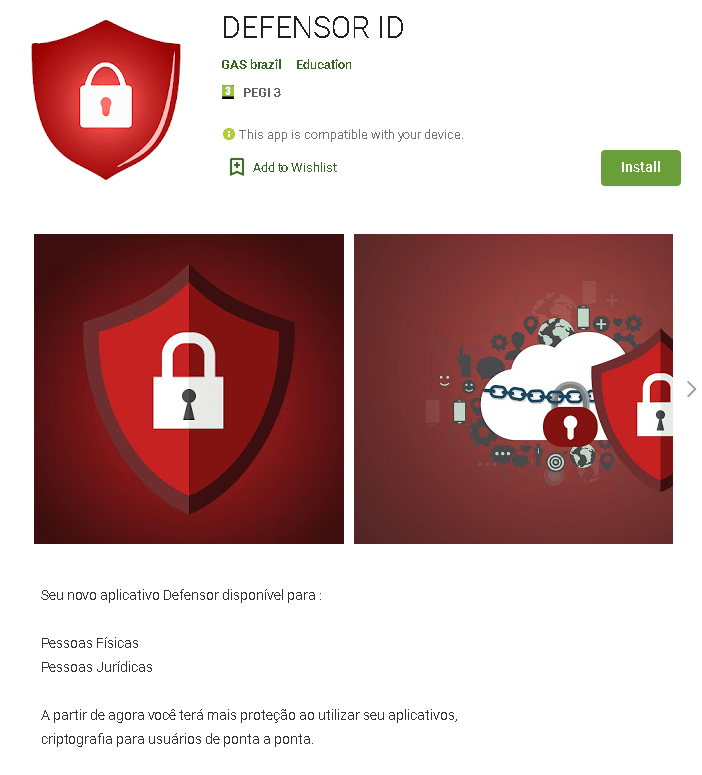
 The DEFENSOR ID app on Google Play – Portuguese version (Google Translate: “Your new Defensor app available for: / Physical People / Legal entities / From now on you will have more protection when using your applications, encryption for end-to-end users”)

About Version 2 Digital

Version 2 Digital is one of the most dynamic IT companies in Asia. The company distributes a wide range of IT products across various areas including cyber security, cloud, data protection, end points, infrastructures, system monitoring, storage, networking, business productivity and communication products.

Through an extensive network of channels, point of sales, resellers, and partnership companies, Version 2 offers quality products and services which are highly acclaimed in the market. Its customers cover a wide spectrum which include Global 1000 enterprises, regional listed companies, different vertical industries, public utilities, Government, a vast number of successful SMEs, and consumers in various Asian cities.

About ESET
For 30 years, ESET® has been developing industry-leading IT security software and services for businesses and consumers worldwide. With solutions ranging from endpoint security to encryption and two-factor authentication, ESET’s high-performing, easy-to-use products give individuals and businesses the peace of mind to enjoy the full potential of their technology. ESET unobtrusively protects and monitors 24/7, updating defenses in real time to keep users safe and businesses running without interruption. Evolving threats require an evolving IT security company. Backed by R&D facilities worldwide, ESET became the first IT security company to earn 100 Virus Bulletin VB100 awards, identifying every single “in-the-wild” malware without interruption since 2003.

ESET to Lead Linux Malware Workshop and Showcase Groundbreaking Amazon Echo KRACK Research at RSA 2020

Bratislava, Slovakia – January 23, 2020 ESET, a global leader in IT security, today announced a number of activities at next month’s RSA Conference 2020 (February 24-28 in San Francisco). 

ESET Malware Researcher Marc-Etienne M. Léveillé will lead a main stage workshop titled “Hunting Linux Malware for Fun and Flags.” The 50-minute workshop will take place on February 27 at 1:30 PM at Moscone West 3002. Attendees will learn to fight real-world Linux malware targeting server environments and to search for malicious processes and concealed backdoors in a compromised web server. Several examples of malware will be demonstrated with increasing layers of complexity, from scripts to ELF binaries with varying degrees of obfuscation.

ESET Senior Malware Researcher Robert Lipovský and Senior Detection Engineer, Štefan Svorenčík will present a 30-minute session on “Kr00k: How KRACKing Amazon Echo Exposed a Billion+ Vulnerable Wi-Fi Devices” on Wednesday, February 26 at 3:00pm PT at Moscone South. 

On the RSA trade show floor, ESET will be located at booth #753 in the South Hall. Senior Malware Researcher Robert Lipovský will discuss ESET’s latest cutting-edge threat research, including Operation Ghost and KRACKing the Amazon Echo. Malware Removal Support Supervisor James Rodewald will be leading demonstrations of ESET’s award-winning enterprise, SMB and consumer products. Malware Researcher Marc-Etienne M. Léveillé will also review his conference presentation and answer questions from attendees. 

Directly outside the conference, ESET will be running a four-day contest. Attend any of ESET’s inspiring presentations or live demos and get a chance to win the newest MacBook Pro 13, an iPhone 11, iPad, or Apple Watch in a prize raffle. Please see here for more details and contest rules. 

“RSA is a fantastic opportunity for our customers – both current and prospective – to see our multilayered suite of security solutions in action,” said Tony Anscombe, chief security evangelist at ESET. “The cybersecurity landscape has evolved drastically over the past decade, and we expect this to continue in the years to come. ESET is proud to be at the forefront of the field, and we are looking forward to showcasing our groundbreaking research, both on stage and at our trade show booth. We’re excited to meet and talk to attendees next month at RSA.”

Want to meet on-site with ESET at RSA? Please visit https://www.eset.com/us/rsac/.

About Version 2 Limited

Version 2 Limited is one of the most dynamic IT companies in Asia. The company develops and distributes IT products for Internet and IP-based networks, including communication systems, Internet software, security, network, and media products. Through an extensive network of channels, point of sales, resellers, and partnership companies, Version 2 Limited offers quality products and services which are highly acclaimed in the market. Its customers cover a wide spectrum which include Global 1000 enterprises, regional listed companies, public utilities, Government, a vast number of successful SMEs, and consumers in various Asian cities.

About ESET

Founded in 1992, ESET is a global provider of security software for enterprises and consumers. ESET’s award-winning, antivirus software system, NOD32, provides real-time protection from known and unknown viruses, spyware, rootkits and other malware. ESET NOD32 offers the smallest, fastest and most advanced protection available, with more Virus Bulletin 100 Awards than any other antivirus product. ESET was named to Deloitte’s Technology Fast 500 five years running, and has an extensive partner network, including corporations like Canon, Dell and Microsoft. ESET has offices in Bratislava, SK; Bristol, U.K.; Buenos Aires, AR; Prague, CZ; San Diego, USA; and is represented worldwide in more than 100 countries.

EQUIFAX DISCLOSES MASSIVE DATA BREACH

Today, September 8, 2017, Equifax, one of the largest credit reporting agencies in the United States, has disclosed that they suffered a massive data breach because their network was compromised by unknown hackers. According to the Equifax’s press release, attackers gained access to personal data of almost 143 million Americans. Social security numbers, birth dates and addresses of nearly half the population lost in this breach of the US could be misused by hackers for years to come. Credit card numbers of US-customers and non-US customers were also stolen. After Equifax announced the cyberattack, their shares dropped 13%.
Official information posted on the Equifax website states: “Based on the company’s investigation, the unauthorized access occurred from mid-May through July 2017.” The breach was disclosed only yesterday, meaning it took six weeks to detect the cyberattack.
Network security solutions like GREYCORTEX that identify anomalous behavior within your network are especially important in this situation. These solutions mean your IT team can identify malware by its anomalous movement within the network, and identify it as it replicates. GREYCORTEX MENDEL identifies such anomalous behavior, offers deep network visibility, and differentiates between human and machine behavior, meaning you can find infected devices within your network and secure your company’s data and reputation.

BEING “SMART” DOESN’T MAKE YOU SAFE

As you may have noticed, we have posted a lot on LinkedIn recently about new cyber attacks. The biggest link between these is that those attacks are commonly caused by not following best practices, or relying only on “legacy” security tools and/or the use of weak passwords.
Even with the use of today’s most advanced security tools, it can all fail at the weakest link of the security chain – people. According to csoonline, 56% of IT decision-makers claim that targeted phishing attacks are their top security threat. And this fear isn’t wrong. Everyone can be conned, even conmen. In many cases, it’s easier to get inside of the network if you abuse that fact. The most commonly used methods of exploiting people are phishing and blackmailing.
Phishing in its simplest form can be easily detected by regular humans. Because it’s not targeted, people on the receiving end can simply ask question “why did I get this email when it has nothing to do with me?” When it comes to more advanced phishing forms, like “whale” (going for the big target, e.g. top management or CEO) or spear phishing (targeted attacks against certain group/ individual), the attacker does the research and gets to know as much as possible about victims, which can be done with a search on the Internet or dumpster diving (think about what you throw away – are there any documents?). Once equipped with knowledge about the target, those attempts are way more effective.
Let’s examine it the security context. In this example, paraphrased from Christopher Hadnagy’s book “Social Engineering: The Art of Human Hacking,” an overconfident CEO is the target. The CEO thought that it’s not possible to hack him mainly for two reasons: he doesn’t utilize much technology in his personal life, and he thought that he was too smart to fall for phishing. Turns out he wasn’t that smart after all. In this example, the CEO expected an audit and readied himself for it. After scouring various sources of information, attackers decided to go with: the name of his favorite baseball team, favorite restaurant, and that he contributed funding to cancer research. On one Friday evening, a phone call took place. In it, the attacker approached the CEO with a plea asking about small contribution to the cancer cure research stating that here will be also a contest for contributors – winners will get two tickets to CEO’s favorite baseball team match (claiming that they know that baseball is not everyone’s cup of tea) and a voucher to one of three restaurants, including CEO’s favorite one. The CEO was willing to contribute, motivated by his desire to cure cancer and the possibility of winning tickets and a voucher, he told the attacker his email address, so they would be able to send him a .pdf file. That file contained a malicious code and CEO opened it, thus providing the attacker with access to his computer and everything in its reach.
Now that his computer has been compromised, as well as access to everything within the organization his authority (and passwords) will let him touch. So what to do? The attacker has access from his computer, so access rights to sensitive files are not an issue, nor is it an issue for the security team that the CEO is accessing files throughout the company. Is there a way to identify that the “CEO” accessing sensitive data is not actually the “real” CEO? Here’s where NTA technology can help. The next step following gaining access to the CEO’s accounts is to exfiltrate data. Network traffic analysis identifies that the computer in question is transmitting data where it shouldn’t, and/or in volumes that it shouldn’t. The computer can then be quarantined, the CEO alerted, and the attacker caught.
But while phishing may be the attack that’s on the mind of management, IT teams understand that “legacy” security tools, like sandbox, IDS, endpoint security or even a firewall, are not sufficient anymore. Let’s look at why.
Modern malware has many methods of detecting if it has infiltrated a “real” environment, or in cases of targeted attacks, if it has hit the right target. When such malware determines that it could be exposed, it lies dormant. This means that if you check everything that enters your company using a sandbox, malicious software can still enter the network if it is sufficiently advanced.
Known threats are usually detected by known patterns or hashes used by endpoint security or IDS, which makes them ineffective against new or advanced threats. Some endpoint security tools use AI to determine malicious behavior and are better equipped to fight new threats, but not every device can have endpoint security. Personal or “bring your own device (BYOD)” are a great example – like a laptop that an employee brings from home and connects to the network – or an IoT sensor where endpoint software cannot be installed. These devices are connected, but not secured by endpoint security.
Firewalls are essential to any networks security infrastructure, and stop communication that goes through them, meaning that generally they are able to protect the company for any threat that comes from the external network. But what if the attack starts after a user accidentally opens a communication link which allows the attacker to get behind the firewall and inside the network? What if the threat was brought inside the company by other means than through the Internet and then tries to spread in the internal network?
While the technology is different in each of these possible attacks, they all have one thing in common – attackers who exploit a gap in the security. The best gap fillers currently available are NTA solutions, like MENDEL from GREYCORTEX. MENDEL monitors all network traffic and analyzes changes of behavior in hosts, detects policy violations, data leaks, and much more. Not every unauthorized entry can be prevented before hit happens. Relying on legacy security tools means it can take months (some statistics reference nearly 200 days) to detect attackers as they move in the network. NTA solutions like MENDEL lower this time to between minutes and a few hours, often before actual damage happens in the network or the attacker knows they’ve gained access.
The question is not if you will get hacked. The question is when you will get hacked. And when that happens, are you ready for it and can you stop it, or will you still rely solely on best practices, as the CEO did, or on “legacy” security tools?

2018 足球狂熱 – ESET VS Malware


關於Version 2 Limited

Version 2 Limited是亞洲最有活力的IT公司之一,公司發展及代理各種不同的互聯網、資訊科技、多媒體產品,其中包括通訊系統、安全、網絡、多媒體及消費市場產品。透過公司龐大的網絡、銷售點、分銷商及合作夥伴,Version 2 Limited 提供廣被市場讚賞的產品及服務。Version 2 Limited 的銷售網絡包括中國大陸、香港、澳門、台灣、新加坡等地區,客戶來自各行各業,包括全球1000大跨國企業、上市公司、公用機構、政府部門、無數成功的中小企及來自亞洲各城市的消費市場客戶。

關於ESET

ESET成立於1992年,是一家面向企業與個人用戶的全球性的電腦安全軟件提供商,其獲獎產品 — NOD32防病毒軟件系統,能夠針對各種已知或未知病毒、間諜軟件 (spyware)、rootkits和其他惡意軟件為電腦系統提供實時保護。ESET NOD32佔用 系統資源最少,偵測速度最快,可以提供最有效的保護,並且比其他任何防病毒產品獲得了更多的Virus Bulletin 100獎項。ESET連續五年被評為“德勤高科技快速成長500 強”(Deloitte’s Technology Fast 500)公司,擁有廣泛的合作夥伴網絡,包括佳能、戴爾、微軟等國際知名公司,在布拉迪斯拉發(斯洛伐克)、布里斯托爾(英國 )、布宜諾斯艾利斯(阿根廷)、布拉格(捷克)、聖地亞哥(美國)等地均設有辦事處,代理機構覆蓋全球超過100個國家。 

THREAT HUNTING WITH MENDEL

“Threat hunting,” or “cyber threat hunting” is the process of proactively and iteratively searching through networks and datasets to detect threats that evade existing automated tools and is done by a threat hunter or security analyst. It is essential for network security because it works to identify hidden threats within an existing set of network data.
Threat hunting utilizes manual techniques from the threat hunter and machine-assisted techniques, the combination of which aims to find Tactics, Techniques, and Procedures (TTPs) of advanced adversaries. While this methodology is both time-tested and effective, it is also time consuming, and can sometimes miss important clues in mountains of network data. In the article below, we will discuss not only what threat hunting is, but also how it can be made more efficient through the use of modern tools.
Download the article here.

GREYCORTEX MENDEL DETECTS BADRABBIT

GREYCORTEX is happy to report that it is able to detect the BadRabbit ransomware. This ransomware appeared in Eastern Europe (Russia, Ukraine) but has begun to spread across several countries including South Korea, Poland, the Baltic, and regions. It uses an NSA-based exploit known as “EternalRomance” to enter networks and spreads by SMB port.
MENDEL is able to detect this ransomware in two different ways:

  • MENDEL’s integrated ruleset includes a rule specifically detecting the BadRabbit ransomware.
  • Independent from this IDS rule, MENDEL’s advanced artificial intelligence and machine learning detects the ransomware’s anomalous port sweep activity.

This detection capability demonstrates that MENDEL can identify unknown threats before rules are created in rules-based security tools. MENDEL provides network security teams vital extra time to protect their networks.

“TALES FROM THE MALWARE LAB” IS LIVE!

Following the success of our video describing the WannaCry ransomware, we are happy to announce an ongoing series of YouTube videos: “Tales from the Malware Lab – Powered by GREYCORTEX.” In it, we will leverage our in-house malware lab, complete with the latest version of GREYCORTEX MENDEL to provide useful information about emerging network security threats in an easy-to-follow visual format.

 The videos will provide an overview of each threat’s activity within the network, and visualize these attacks from the network traffic analysis standpoint. We are releasing these videos as a public service to the greater network security community, which will benefit from this video-based approach to malware.

 The first video, addressing the “EternalRocks” malware, is available here: https://youtu.be/vI1lRi5e-SM

GREYCORTEX PROTECTS AGAINST WANNACRY

GREYCORTEX is happy to report that MENDEL, our network traffic analysis solution, affirmatively detects infection by the WannaCry ransomware, its possible variants/clones, and protects users more effectively than rule-based detection tools alone.
Because GREYCORTEX MENDEL uses advanced artificial intelligence, machine learning, and data analysis to identify network anomalies, it easily identifies threats like WannaCry, allowing network security teams to take rapid action and stop threats before they do damage.
In the case of WannaCry, GREYCORTEX tested the ransomware in our malware lab. It was found to engage in aggressive and anomalous practices, like port-scanning behavior on an SMB port (445), attempting to connect to over 4000 devices in 175 countries across the Internet in five minutes, and downloading TOR network software. All of these behaviors were identified by MENDEL’s advanced network behavior analysis.
MENDEL users are better protected from malware like WannaCry and its variants/clones than users of firewall, IDS, or other rule-based security solutions alone. Rule-based security solutions require a known malware signature in order to create a rule. This means an attack must happen before the signature of the attack can be added as a rule. MENDEL doesn’t need a signature to identify the attack. It’s network behavior analysis features detect the attack’s symptoms before it harms the network. This means security teams have the peace of mind to know that should an attack happen, they will see it, and be able to stop it before it does damage.
If you are concerned about malware attacks, either from WannaCry or from other ransomware or malware, you may benefit from a 30 day Proof of Concept (PoC) from GREYCORTEX. During the PoC, MENDEL automatically learns your network to identify threats which may exist, including ransomware which is lying dormant in your network, or unpatched applications, which may leave you vulnerable. Do not hesitate to contact your network security professional, or GREYCORTEX  directly to arrange a PoC.

MS VULNERABILITIES EXPOSED BY GOOGLE

Google has disclosed the latest of several unpatched flaws in Microsoft software. GREYCORTEX MENDEL’s advanced machine learning and predictive analysis can identify these attacks.
Google’s “Project Zero” team recently disclosed a second unpatched Microsoft Windows security flaw, after Microsoft failed to fix the bug within Google’s set 90 day window. The vulnerability is identified as CVE-2017-0037, and is classed as a “type confusion flaw” in a module of Microsoft Edge and Internet Explorer. This flaw can lead to arbitrary code execution, and be used to crash IE or Edge, and allow hackers to execute code and gain administrator privileges on infected systems.
Advanced hackers may have either already exploited this flaw or they may soon exploit it. Network security solutions like GREYCORTEX that identify anomalous behaviour within your network are especially important in this situation. These solutions mean your IT team can identify malware by its anomalous movement within the network, and identify it as it replicates. GREYCORTEX MENDEL identifies such anomalous behavior, offers deep network visibility, and differentiates between human and machine behavior, meaning you can find infected devices within your network and secure your company’s data and reputation even without relying on Microsoft to fix vulnerabilities in its browsers.

You can read more about the vulnerability here: http://thehackernews.com/2017/02/google-microsoft-edge-bug.html