裝置失竊是個日益嚴峻的問題。全球每年有超過 7000 萬台流動裝置遺失或遭竊。若裝置中存有未加密的公務資料,便可能導致未經授權的非法存取。BYOD 裝置一旦遺失,不僅可能暴露儲存於其上的所有資料,更可能為攻擊者提供潛在的「入侵破口」,尤其在裝置缺乏適當安全防護的情況下。著名的 Lifespan Health System 案例中,便因一台未加密的失竊手提電腦,導致超過兩萬名病患的個人資料外洩,最終被處以 104 萬美元的罰款。
解決方案:啟用遙距資料清除(Remote Wipe)功能與高強度密碼鎖。建立強制通報機制,要求員工在裝置遺失後立即回報 IT 部門。在這種情況下,迅速採取應對措施,是防止重大企業資料外洩的關鍵。
8. 影子 IT(Shadow IT)
當員工繞過 IT 部門,私自採用未經核准的工具或雲端服務時,便產生了所謂的「影子 IT」。例如使用個人即時通訊軟件、或來路不明的檔案共享平台等。這類未受監管的行為不僅增加了 BYOD 的管理難度與安全風險,更可能衍生出潛藏的安全漏洞。
解決方案:制定清晰的 BYOD 安全政策,明確規範允許使用的軟件與服務。加強員工資訊安全意識培訓,使其了解使用未經審核平台所潛藏的風險。部署企業級瀏覽器也有助於封鎖對未授權工具的存取。及早偵測並加以管理,可防止影子 IT 問題惡化,演變成嚴重的 BYOD 安全威脅。
共享 IP 或動態 IP 是指多個使用者共用的 IP 位址。就外部 IP 位址而言,單一網絡上的多個使用者會使用同一個共享 IP 位址連線到網際網絡。此 IP 位址由網際網絡服務供應商(ISP)分配,並由連接到該網絡的所有裝置共享。
ISP 負責管理共享 IP 位址的輪換,並在其使用者群之間輪換這些位址。共享 IP 位址通常從 ISP 維護的位址池中分配,以改善資源使用率,任何使用者都無法獨佔。這有助於降低 IP 位址的維護成本,並提升 ISP 的使用效率。
共享 IP 如何運作?
共享 IP 位址的運作方式與其他 IP 位址相同 —— 它支援兩個目的地之間的數據交換。由於共享 IP 位址會在大量使用者之間輪換,因此外部網站無法區分透過共享 IP 位址池存取網站的裝置或使用者。
這可能會導致一些問題,例如:
難以識別特定裝置:當多個裝置共用同一個 IP 位址時,就很難識別造成問題或從事可疑活動的特定裝置
聲譽問題:如果使用共享 IP 位址的任何裝置從事垃圾郵件、網絡釣魚或其他惡意活動,可能會導致該共享 IP 位址被列入黑名單,進而對使用該 IP 位址的所有裝置的聲譽產生負面影響
效能考量:共用 IP 位址本身不會降低網際網絡速度或效能。然而,當多個使用者共用相同的網絡資源(例如頻寬或伺服器容量)時,某些使用者的過度使用可能會導致其他使用者的回應時間變慢或效能降低
不過,在內部,同一共享 IP 位址上的每個裝置或使用者都會擁有一個獨特的內部 IP 位址。網絡會使用稱為網絡位址轉換(NAT)的程序,在外部共享 IP 位址和每個裝置的內部 IP 位址之間進行轉換。
什麼是專用 IP?
專用 IP 是指由單一實體獨佔的 IP 位址,而不是在多個使用者或裝置之間共享。通常需要支付額外費用才能取得,通常是透過 ISP、VPN 服務、託管供應商或其他網絡服務供應商。這些位址由區域網際網絡註冊管理機構(RIR)分配,通常用於安全遙距存取、電子郵件傳遞和其他特殊網絡需求。
在某些情況下,企業需要對其 IP 位址進行更嚴格的控制,這時專用 IP 就非常有用。允許列表(僅限制特定資源的存取權限給批准的 IP 位址)有助於網絡管理員最大限度地減少安全漏洞,並降低未經授權存取的風險。
專用 IP 如何運作?
專用 IP 會獨自分配給特定的裝置或使用者,而不是在多個裝置或服務之間共享。這表示位址不會重置或分配給其他使用者。
缺點是專用 IP 位址通常需要額外費用。然而,它們能提供更大的網絡管理控制權。例如,網絡管理員可以透過指定允許列表中的專用 IP 位址來防止未經授權存取內部系統。如此一來,只有符合的 IP 才能被允許連線,從而防止入侵者嘗試連線。此外,擁有固定的 IP 可以減少使用者在瀏覽時必須填寫的驗證碼數量,並降低 IP 被列入黑名單的風險,從而實現更快、更安全的連線。
專用 IP 與共享 IP 位址的比較
專用 IP 和共享 IP 位址之間的主要差異在於其專有性。共享 IP 位址可供所有使用者免費使用,且其所有權會輪換。而專用 IP 位址則保留給單一實體。
在大多數情況下,共享 IP 位址符合成本效益,且不需要任何維護。然而,在商業環境中,使用專用 IP 位址通常更有意義。
電子郵件行銷:企業經常使用外部專用 IP 位址向客戶發送大量電子郵件。與共享 IP 不同,專用 IP 可確保乾淨的寄件者聲譽,因為它不受其他使用者行為的影響。這能更好地控制電子郵件的送達率和聲譽管理,降低電子郵件被標記為垃圾郵件的風險
網站託管:專用 IP 位址通常由需要高安全性或有特定法規遵循要求的企業使用。這能更輕鬆地確保網站或 Web 應用程式與同一伺服器上的其他網站隔離,並降低跨站污染的風險
虛擬私人網絡(VPN):需要遙距存取其內部網絡的企業(例如遙距員工或承包商)會使用專用 IP 位址。專用 IP 位址可確保遙距使用者始終連線到同一個 IP 位址,從而提供更高的安全性和控制力。這也為網絡管理員提供了更多安全客製化選項。
簡而言之,共享 IP 位址既便宜又易於維護,但缺點是網絡安全風險較高。另一方面,專用 IP 位址提供更高的控制力、私隱性和安全性,但成本也較高。
選擇共享 IP 或專用 IP 取決於您的需求 —— 無論是電子郵件行銷、網站託管還是安全遙距存取。如果網絡安全和受控遙距存取是您的優先事項,那麼專用 IP 可以提供額外的保護層。
NordLayer 提供專用 IP 位址,以建立虛擬私人閘道、啟用 IP 白名單,並實施多層網絡安全措施。這可確保安全存取公司資源,同時維持網絡的可見性和控制力。
透過 NordLayer,您可以簡化安全存取,無需額外的硬件投資,也能隨著公司企業的成長輕鬆擴展。立即聯絡我們,深入了解專用 IP 如何強化您的網絡安全策略。
關於 NordLayer NordLayer 是現代企業的自適應性網絡存取安全解決方案,來自世界上其中一個最值得信賴的網絡安全品牌 Nord Security。致力於幫助 CEO、CIO 和 IT 管理員輕鬆應對網絡擴展和安全挑戰。NordLayer 與零信任網絡存取(ZTNA)和安全服務邊緣(SSE)原則保持一致,是一個無需硬件的解決方案,保護公司企業免受現代網絡威脅。通過 NordLayer,各種規模的公司企業都可以在不需要深入專業技術知識的情況下保護他們的團隊和網絡,它易於部署、管理和擴展。
關於 Version 2 Digital 資安解決方案 專業代理商與領導者 台灣二版 ( Version 2 ) 是亞洲其中一間最有活力的 IT 公司,多年來深耕資訊科技領域,致力於提供與時俱進的資安解決方案 ( 如EDR、NDR、漏洞管理 ),工具型產品 ( 如遠端控制、網頁過濾 ) 及資安威脅偵測應 變服務服務 ( MDR ) 等,透過龐大銷售點、經銷商及合作伙伴,提供廣被市場讚賞的產品及客製化、在地化的專業服務。
台灣二版 ( Version 2 ) 的銷售範圍包括台灣、香港、中國內地、新加坡、澳門等地區,客戶涵 蓋各產業,包括全球 1000 大跨國企業、上市公司、公用機構、政府部門、無數成功的中小企業及來自亞 洲各城市的消費市場客戶。
Starting a business is in itself a daunting task, but keeping it successful on top of that requires immense effort and skill. A tight budget and so many choices when it comes to managing said business can take a toll on any startup. Moreover, a huge part of maintaining that success is having the right tools.
Nowadays, enterprise applications and software play a vital role when it comes to having a flourishing business as they help keep organizational and scaling headaches to a minimum. From office management to cybersecurity solutions, we’ve compiled a list of apps that will take your startup to the next level!
Flanco introduces itself as “the future of workspace” – and for good reason! It’s an office app that helps manage desk space and workplace resources. Need to easily book a desk or meeting room? Flanco has got you covered. Need to know which meeting rooms are booked in real time? Flanco comes to the rescue once again. Not to mention that the app itself has an intuitive interface and is fairly simple to use. For startups, it’s an all-in-one property manager. Effortlessly manage assets, accounting, vendor contracts, parking – Flanco has it all.
Slack is definitely king when it comes to communicating with the team, and doing so quickly and efficiently. A rock-solid communication platform will always be a crucial cog in the successful startup, especially when so many things are discussed on the go. Message people directly, create project-focused channels, or break into smaller chats to share key information with relevant stakeholders. Slack has searchable history and numerous app integrations that just make the job easier. In addition, you can set up reminders, add team members in the middle of conversations to keep them in the loop, and that’s only the tip of the iceberg when it comes to this app.
NordLayer – for your business privacy and security
Business cybersecurity is a must, period. In this day and age, when it comes to protecting your assets, customers, and team, there can be no shortcuts. Having your business fortified is essential – and NordLayer does just that and more. A robust network access security tool, it has numerous useful features like shared gateways for employees, DNS filtering, and other tricks to keep you secure. NordLayer will ensure that your company’s resources are protected and employees can securely access their work from anywhere. Furthermore, it offers a centralized control panel for convenient payment, features, and user management. Already have an existing company infrastructure? No worries, NordLayer can be easily integrated into Azure, Google Workspace, AWS and more.
Project management is no easy task, especially when there are multiple projects, deadlines and stakeholders involved. Want to keep track of the status of your project? Need to know what’s already been done? Notion is the tool you need. It’s useful for keeping tasks in order, and having workflows, docs, and guidelines in one place. You can create your own Wiki, and Notion even helps with building roadmaps and planning sprints. It’s a great tool for a neat and uncomplicated visual workflow in general. Another excellent feature is the ability to integrate it with Jira, Slack, Google Drive, and other apps for a truly seamless workflow.
Let’s face it, competition is everywhere. If you’re running a business, social media is a tried-and-trusted approach to being seen, heard, and having a place under the sun. Social media is important for numerous reasons – increasing brand awareness, receiving direct feedback, customer engagement, and posting relevant content. However, managing multiple social media accounts can be a bit of a hassle. This is where Hootsuite comes in. This tool helps to schedule and publish content, monitor trends, and understand your audience. Everything can be done from a single handy dashboard, saving you precious time and resources.
Just the tip of the iceberg
This apps list for startups only scratches the surface of the myriad of possibilities out there. Depending on the category and profile of your business, there are dozens if not hundreds of apps and tools that could help you raise and maintain a successful business. These are just a few of what we think would be a good base to start out with, as they cover the most fundamental of needs. As mentioned previously, having the right tools can immensely help to stay on track, meet your goals, and simply be better organized – this is what tools are made for!
5 business apps for startup success in 2023
About NordLayer NordLayer is an adaptive network access security solution for modern businesses – from the world’s most trusted cybersecurity brand, Nord Security.
The web has become a chaotic space where safety and trust have been compromised by cybercrime and data protection issues. Therefore, our team has a global mission to shape a more trusted and peaceful online future for people everywhere.
About Nord Security The web has become a chaotic space where safety and trust have been compromised by cybercrime and data protection issues. Therefore, our team has a global mission to shape a more trusted and peaceful online future for people everywhere.
About Version 2 Digital
Version 2 Digital is one of the most dynamic IT companies in Asia. The company distributes a wide range of IT products across various areas including cyber security, cloud, data protection, end points, infrastructures, system monitoring, storage, networking, business productivity and communication products.
Through an extensive network of channels, point of sales, resellers, and partnership companies, Version 2 offers quality products and services which are highly acclaimed in the market. Its customers cover a wide spectrum which include Global 1000 enterprises, regional listed companies, different vertical industries, public utilities, Government, a vast number of successful SMEs, and consumers in various Asian cities.
Penetration testers hunt for weak spots in applications so vulnerabilities can be fixed before bad actors find them. One way to find those weak spots is to inspect application memory to see if sensitive data is being stored in a way that hackers can access. In this article, we’ll explain how pen testers use the memory inspection process to strengthen app security.
What is memory inspection? Applications have memories — data that is generated from application processes is then stored within the app’s files, either on a device or in the cloud. If an app hasn’t been set up securely, a hacker could dive into those files and retrieve sensitive data.
White hat hackers — the people who hunt for vulnerabilities so they can be patched — can also use these same methods for good. By searching through the memories of mobile and desktop apps, as well as inspecting the installer file contents, they can unearth potential risks and keep users safe.
Dumping the memory
The first step in the inspection process is extracting the memory from an application. This is easily done on a Windows OS — we just open the task manager and create a dump file. On a Unix operating system, the relevant information is kept in /proc/<PID>/mem and /proc/<PID>/maps.
MacOS, on the other hand, requires us to boot into recovery mode and disable System Integrity Protection. This feature protects processes from being modified or tampered with. Having done this, we can then make a process dump.
Memory dumping gets a bit trickier when we approach mobile applications. Mobile devices usually require root privileges in order to extract the contents from an app’s memory with the help of the Frida tool.
After this step, we should be left with a “.txt” or a “.dmp” file which contains the extracted memory. It is a good idea to run this file through the “strings” utility to filter human-readable strings of a particular length because the dump might contain non-ASCII characters.
Searching for secrets
Once we have dumped the memory, we can start working with what we have. Primarily, we are now searching for information that reveals the following:
Session identification values
Access tokens
Service account credentials
Personally identifiable information
Authentication passwords
Database connection strings
Encryption keys and other master secrets
Data of a higher security classification than the logging system is allowed to store
Commercially sensitive information
Information that is illegal to collect in the relevant jurisdictions
Information a user has opted out of collection, or not consented to
The sensitive information listed above could be used by malicious actors for their own benefit. If this information is available through memory inspection, that’s a problem that needs to be fixed.
It would also be a good idea to use automated scripts that are able to pick out various access tokens, API keys, and any other values. For example, the following regex rule can be used to find AWS keys:
With many applications now storing data and running processes in the cloud, the risks posed by hackers who dumpster dive app memory are even greater. If bad actors can find service account credentials, Google API keys, and Firebase URLs in the dump, they could use these to their advantage.
Usually, service account credentials are used to retrieve an application’s remote configuration. If an attacker gets hold of valid credentials to access cloud systems that are improperly configured, no amount of firewalls can keep them from accessing the computing, network, and storage assets in that cloud environment.
It should be noted, however, that leaving account keys in the memory is not a problem as long as the IAM is configured correctly and the principle of least privilege is applied.
A penetration tester should pay close attention to the scope of tokens left in app memory as well as privileges to service accounts, both of which can be as dangerous as the exposed service account credentials.
Even if we do not find any security vulnerabilities, memory inspection is still worthwhile. We might discover unused tokens or accounts that are no longer needed, and deleting these can cut costs in addition to reducing security risks.
Fixing the vulnerabilities
The purpose of memory inspection is to find possible vulnerabilities and sensitive data that might be exposed. Afterwards, such vulnerabilities have to be fixed.
The principle of least privilege should be applied when resolving memory issues. Keep only absolutely necessary data and throw out everything else. This is a simple concept that will limit the potential for you to disclose sensitive information.
Checking application memory may be considered low hanging fruit in the cybersecurity world. However, any information stored or processed in a client’s memory is available to administrators and should be regularly checked from the vendor’s side.
We all make mistakes, and it is useful to carry out an inspection periodically. Doing so not only helps us to find and fix the errors but also deepens our understanding of the application’s inner workings.
About NordLayer NordLayer is an adaptive network access security solution for modern businesses – from the world’s most trusted cybersecurity brand, Nord Security.
The web has become a chaotic space where safety and trust have been compromised by cybercrime and data protection issues. Therefore, our team has a global mission to shape a more trusted and peaceful online future for people everywhere.
About Version 2 Digital
Version 2 Digital is one of the most dynamic IT companies in Asia. The company distributes a wide range of IT products across various areas including cyber security, cloud, data protection, end points, infrastructures, system monitoring, storage, networking, business productivity and communication products.
Through an extensive network of channels, point of sales, resellers, and partnership companies, Version 2 offers quality products and services which are highly acclaimed in the market. Its customers cover a wide spectrum which include Global 1000 enterprises, regional listed companies, different vertical industries, public utilities, Government, a vast number of successful SMEs, and consumers in various Asian cities.
Cybersecurity is a critical concern for organizations worldwide. In 2022, we saw an unprecedented increase in the number and severity of cyber attacks. With more people working remotely, organizations have become more vulnerable to attacks. Cybercriminals continue to target businesses across all industries, using various tactics to breach networks and access personal data.
This article will delve into the most significant cybersecurity statistics of 2022, including the key numbers, data breaches with the most substantial impact, vulnerable industries, types of attacks, prevention actions, and the cost of cybercrime. Understanding these statistics is mandatory for businesses to develop effective security strategies and protect their data from malicious actors.
Key numbers of 2022
A staggering 82% of all breaches involved the “human element” using stolen credentials, phishing, human error, and misuse. (Verizon)
Data compromises, such as data breaches, exposure, and leakage, impacted over 422 million people. (ITRC)
Supply chain attacks accounted for 19% of all cyber security incidents. (IBM)
In Q4 of 2022, the number of cyberattacks worldwide reached an unparalleled level, with each organization experiencing an average of 1168 attacks per week. (Checkpoint)
Servers were involved in 84% of all cyber security incidents, with web application servers and mail servers accounting for 56% and 28% of these incidents, respectively. (Verizon)
Nearly half of all cyber security incidents (47%) pertained to personally identifiable information (PII), while another 46% involved authentication credentials. Payment card data was affected in only 7% of the incidents. (Verizon)
Cyberattacks surged in the USA, with a staggering 57% increase. Latin America experienced a 29% increase, while Europe and Singapore both saw a 26% increase. Meanwhile, the UK encountered a shocking 77% spike in cyberattacks. (Checkpoint)
83% of organizations experienced more than one data breach. (IBM)
There was a 38% increase in global cyberattacks compared to the previous year. (Checkpoint)
Almost 1 billion emails were exposed, affecting one in five internet users. (AAG)
The top 10 most significant data breaches of 2022
We present the most impactful data breaches of the last year.
10. The Axie Infinity’s crypto theft
Axie Infinity is an online video game that uses Ethereum-based cryptocurrencies and NFTs. As the games services heavily rely on blockchain service Ronin, cyber criminals managed to infiltrate the system. They were able to take control of the network and send 173,600 ethers worth about $600 million and withdraw $25.5 million worth of coin. This has now become one of the largest thefts in the history of cryptocurrencies and online gaming.
9. Cash App data breach
In April, a disgruntled former employee of Cash App, a payment company, took it upon himself to breach the company’s system. The hacker managed to access sensitive reports, including the names, portfolio values, and brokerage account numbers of more than 8 million clients, which they then stole.
8. Costa Rica’s government ransomware attack
The Costa Rican government suffered a major cyberattack when the Conti ransomware gang successfully breached their systems. The group gained access to highly valuable data, which they stole and then demanded a hefty ransom of $20 million.
This forced the Central American government to declare a state of emergency. Shockingly, weeks after the attack, 670 GB of data, representing 90% of the information that had been accessed, was posted to a leak site by the threat group.
7. Neopets data breach
Last July, a database with account details of 69 million Neopets game users was found for sale on an internet forum. The data included names, email addresses, zip codes, genders, and birth dates. An inquiry found that cyber attackers had infiltrated the Neopets IT systems and had unauthorized access to it for a prolonged period, from January 3, 2021, to July 19, 2022, spanning over 18 months.
6. Revolut data breach
In September 2022, a data breach occurred at fintech start-up Revolut, resulting in personal information of more than 50,000 users being accessed by a third-party. The breached data included names, addresses, and partial payment card information. However, Revolut assured that the card details were masked. The Lithuanian government commended Revolut for taking immediate action to eliminate the attacker’s access to the data once the breach was detected.
5. Shein data breach
In October, Shein and Romwe’s parent company Zoetop Business was fined $1.9 million by the state of New York for not disclosing a data breach that impacted 39 million customers. The breach occurred in July 2018 when a malicious third party accessed Shein’s payment systems. Shein was informed by their payment processor that their system had been infiltrated and customer card data had been stolen. The discovery was made after the credit card net work found Shein customers’ payment details for sale on the dark web.
4. Hacker allegedly hits both Uber & Rockstar
Between September 15-19, a hacker allegedly targeted both Uber and Rockstar. In the Uber breach, the hacker accessed the company’s internal servers using malware installed on a contractor’s device. They then posted a message to a company-wide Slack channel and reconfigured Uber’s OpenDNS to display a graphic image to employees on some internal sites.
In the same timeframe, the Rockstar Games’ developer suffered a network intrusion, leading an unauthorized third party to illegally access and download confidential information, including gameplay footage of the unreleased Grand Theft Auto 6 game. The hacker claimed they obtained the footage by hacking into a Slack channel used for communication about the game.
3. Medibank data leak
Australian healthcare and insurance provider Medibank detected “unusual activity” on its internal systems on October 13. By November 7, Medibank announced that a hacker had stolen the confidential data of 9.7 million past and present customers, including personally identifying information and medical procedure codes. Despite the hacker’s demands for ransom, Medibank refused to pay.
On November 9, the hacker released files containing customer data labeled “good-list” and “naughty-list,” with the latter reportedly including sensitive information on those who sought medical treatment for HIV, drug addiction or alcohol abuse, and mental health issues like eating disorders. The hacker posted a file labeled “abortions” containing information on claimed procedures to a site backed by the Russian ransomware group REvil on November 10.
BidenCash had leaked the details of a few thousand credit cards in June, likely as a promotional stunt, and as the site had launched new URLs in September due to a series of DDoS attacks, some experts speculated that this new release could be another attempt at advertising.
The stolen data also included information from “OGs,” which are highly desirable Twitter handles consisting of one or two letters or a word with no misspelling, numbers, or punctuation. The hacker demanded a minimum of $30,000 for the database. The data breach, resulting from a vulnerability in Twitter’s system that was discovered in January, caused significant concern among the public and further highlighted the ongoing need for strong cybersecurity measures.
Most targeted industries in 2022
As we embark on a new year, the cyber threat landscape is continuously evolving, making it more challenging for organizations to keep up with the pace of these attacks. From ransomware to phishing scams, no industry is immune to cyber threats.
This list highlights the top 10 most targeted industries in 2022, based on the IBM X-Force 2022 Threat Intelligence Index report. And hopefully, a better understanding of the threat landscape in different industries can help organizations adopt robust cybersecurity strategies to safeguard their systems, data, and customers against cybercriminals.
Media & telecommunications – 0.5%
Last year, media and telecommunications industries remained relatively unscathed, with a mere 0.5% of incidents reported. However, it is worth noting that external remote services such as VPNs and valid domain accounts were often exploited to gain unauthorized access, resulting in ransomware attacks.
The consequences of these attacks were severe, ranging from data theft, leaks, and destruction to extortion, and involved the deployment of data exfiltration tools and ransomware. Despite their low incidence rate, the potential impact of cyber threats on media and telecom companies cannot be underestimated.
Transportation – 3.9%
Transportation dropped from seventh to ninth place in the 2022 X-Force report, but the industry remained a frequent target, accounting for 3.9% of incidents. Phishing was the primary method of initial access, with links, attachments, and spear phishing equally represented. Valid local accounts were also exploited in 33% of cases, while valid cloud accounts were used in 17%.
The top objectives were server access and deployment of remote access tools, followed by spam campaigns, ransomware, backdoors, and defacement. Data theft was the most common outcome, occurring in half of all cases, with extortion and brand reputation damage also common. European transportation entities were the hardest hit, accounting for 62% of cases, with Asia-Pacific in second place at just over 37%.
Government – 4.8%
Government entities were one of the prime targets of cyberattacks in 2022, with backdoors and DDoS attacks accounting for 25% of cases each. Public sector networks contain a wealth of sensitive information, making them a popular objective for cyber espionage campaigns aimed at stealing PII and other data. Malicious Office documents were found in 17% of cases, while the remaining 83% involved cryptominers, credential acquisition tools, ransomware, and web shells.
X-Force attributed incidents in this sector to cybercriminals, insider threats, hacktivists, and state-sponsored groups conducting espionage, each accounting for an equal share. Infection vectors were primarily public-facing applications and spear phishing attachments, with valid default accounts exploited in 20% of cases. Asia-Pacific governments were hit the hardest, with 50% of cases, followed by Europe at 30% and North America at 20%.
Healthcare – 5.8%
Still being the top object of international cyberattacks, the healthcare industry experienced a decline from sixth place in 2021. X-Force responded to approximately 5%-6% of healthcare cases in the last three years. Backdoor attacks and web shells were prevalent, accounting for 27% and 18% of cases, respectively.
Adware, BEC, cryptominers, loaders, reconnaissance and scanning tools, and remote access tools made up 9% of cases each. Most of the observed impacts were from reconnaissance at 50%, while data theft and digital currency mining each accounted for 25% of cases. European-based healthcare entities were targeted the most, comprising 58% of incidents, with the remaining 42% in North America.
Education – 7.3%
Backdoor attacks in the education sector comprised 20% of incidents X-Force responded to. Ransomware, adware, and spam each accounted for 13% of incidents. Exploitation of public-facing applications was the most common initial access vector at 42%, followed by spear phishing attachments at 25%. Asia-Pacific was the region with the highest number of cases at 67%, followed by North America at 27%, and Latin America at 6%.
Retail and wholesale – 8.7%
The retail and wholesale industry maintained its position as the fifth-most targeted industry, as per the X-Force report for 2022. Spear phishing emails with malicious links were the most common initial access vector at 33%. Ransomware, backdoors and BEC were the most common attack types, each accounting for 19% of incidents.
Victims experienced extortion in half of the cases, while credential harvesting and financial loss were observed in 25% of cases each. North America and Latin America had the highest number of cases at 39% each, while Europe accounted for 22% of incidents.
Energy – 10.7%
The energy sector, encompassing electric utilities and oil and gas companies, was the fourth-most targeted industry with 10.7% of attacks. Attackers commonly gained initial access through the exploitation of public-facing applications (40%), spear phishing links (20%), or external remote services (20%). Botnets were the top method of attack in 19% of cases, followed by ransomware and BEC at 15% each.
North American organizations were the most targeted at 46%. Incidents involved data theft and extortion in 23% of cases, while credential harvesting and botnet infections were observed in 15% of cases each. The energy sector faces pressure from various global factors, particularly those exacerbated by Russia’s aggression in Ukraine and its impact on the already unstable global energy trade.
Professional, business & consumer services – 14.6%
The professional services industry, including consultancies and law firms, was the target of 52% of cyber attacks in this category. Business services, such as IT and advertising, accounted for 37% of attacks, while consumer services made up 11%.
Ransomware and backdoor attacks were the most frequent types of attacks, with public-facing applications and remote services being the top infection vectors. Extortion was the most common attack type.
Finance & insurance – 18.9%
Last year the finance and insurance organizations were the target of 18.9% of cyber attacks, earning it second place in this list. Despite a slight decrease in attacks over the past few years, finance and insurance organizations remain prime targets due to their advanced digital transformation and cloud adoption progress.
Backdoor attacks were the most common objective at 29%, followed by ransomware and maldocs at 11% each. Spear phishing attachments were the top infection vector, responsible for 53% of attacks. Europe experienced the highest volume of attacks at 33%, followed by Asia-Pacific at 31%. Latin America, North America, and the Middle East and Africa experienced approximately 15%, 10%, and 10% of incidents, respectively.
Manufacturing – 24.8%
The manufacturing industry was the most targeted in 2022, with backdoors being deployed in 28% of incidents and spear phishing and public-facing applications being the top infection vectors at 28% each. External remote services accounted for 14% of incidents, while spear phishing links and valid default accounts were tied for third place at 10%.
Extortion was the top impact on manufacturing organizations, followed by data theft and leaks. The Asia-Pacific region had the most incidents at approximately 61% of cases, while Europe and North America tied for second place at 14%. Latin America accounted for 8% of incidents, and the Middle East and Africa had 4%.
Most common cyber attacks in 2022
With the increasing use of technology in our daily lives, cybercriminals are finding new ways to exploit vulnerabilities in web applications, cloud services, Internet of Things (IoT) devices, and human behavior.
We present to you the top 10 list of cyber attacks with the hope that you can take steps to protect yourself and your data from potential cyber threats in the future.
10. SQL injection & Cross-site Scripting (XSS)
SQL injection and Cross-site Scripting (XSS) are common types of cyber attacks in 2022 that exploit vulnerabilities in web applications. SQL injection attacks can be used to insert malicious code into an SQL database, potentially giving attackers access to sensitive information or control over the entire system. Use parameterized queries to prevent SQL injection attacks and keep your software up-to-date.
XSS attacks use third-party online resources to insert malicious scripts into legitimate websites or applications to obtain user information. Attackers commonly use JavaScript, Microsoft VBScript, ActiveX, or Adobe Flash for XSS attacks. Web apps are often vulnerable to XSS attacks when they receive user input without validating or encoding it in their output.
9. Cloud jacking
Cloud jacking, also known as cloud hijacking, targets data stored in external cloud services such as Salesforce or Microsoft Azure. Hackers exploit poorly secured loopholes to steal data since modern enterprises increasingly use cloud-based services. Since most users do not store many files locally, cyber criminals find targeting the centers housing the data more worthwhile. Common methods include exploiting cloud provider management software vulnerabilities or cracking default security configurations.
8. Internet of Things (IoT) attacks
An IoT attack targets Internet of Things devices or networks, allowing hackers to take control of devices, steal data, or join a network of infected devices to execute DoS or DDoS attacks. The IoT encompasses a wide range of internet-connected devices, from smartphones to smart home appliances, making them vulnerable to cyberattacks.
Attackers can exploit IoT devices to launch attacks on other devices, causing significant damage that can be challenging to detect. There was a noticeable increase of IoT attacks last year.
7. Insider threats
Insider threats refer to the risks associated with an organization’s own staff. These threats can come from rogue employees with malicious intent or from employees who are simply negligent. In some cases, hackers can bribe insiders to help them gain access to sensitive information. However, the line between insider threat and whistleblower can sometimes be blurry.
Unlike social engineering, where attackers pretend to have legitimate access, insiders actually have legitimate access but use it for malicious purposes. Organizations must have policies and procedures to detect and prevent insider threats. It’s also reported that insider threats have risen 44% over the past two years.
6. Man-in-the-Middle attack
Man-in-the-middle attacks aim to steal sensitive information by intercepting and manipulating messages between two parties who believe they are communicating directly and securely. While most communication channels use some encryption to make such snooping attempts more difficult, expired SSL certificates on various websites and the use of freemium VPNs, proxies, or public wifi can create open gaps that attackers can exploit.
Attackers can read, modify, or even delete data during such attacks, which can be challenging to detect. To protect against man-in-the-middle attacks, it is essential to use encryption whenever possible, be mindful of which websites and emails you access, and avoid using public networks. Estimates show that 35% of exploits involve man-in-the-middle attacks.
Cyber attackers use various methods to break into password-protected systems, including dictionary attacks, brute-force attacks, and password spray attacks. A dictionary attack involves systematically entering every word in a dictionary as a password or key to decrypt an encrypted message. On the other hand, a brute-force attack involves automated trial and error by spraying all possible character combinations and lengths into a password field until a match is found. More than 80 percent of breaches involve brute-force or the use of lost or stolen credentials.
Meanwhile, password spray attacks, involve hackers trying many common passwords against many different accounts using automated software. To protect yourself, use strong and unique passwords, enable two-factor authentication if available, and avoid using common words or phrases that can be easily guessed.
4. Social engineering
Social engineering is a cyber attack that exploits human vulnerability rather than system weaknesses. It involves tricking individuals into revealing sensitive information through deception. Threat actors may even impersonate someone else to gain physical or remote access to a target system.
Unfortunately, these attacks are still prevalent in 2022, as approximately one-third of data breaches occur due to social engineering. It is important to remain vigilant and cautious of unsolicited communication, verify identities, and practice proper security protocols to avoid falling victim to these attacks.
Meanwhile, ransomware is a more specific form of malware that infects a machine’s storage and encrypts stored data, demanding payment for decryption. These attacks can be highly profitable for hackers, as organizations often pay the ransom with no guarantee of a successful outcome.
Keyloggers are a type of spyware that captures every keystroke made on a device, allowing malicious actors to access sensitive information such as passwords and credit card numbers. Keylogger spyware is typically installed on a user’s device by clicking on a malicious link or attachment. Protect yourself from keyloggers by using strong and unique passwords for all accounts, as well as enabling two-factor authentication where possible.
2. DoS and DDoS
DoS and DDoS attacks flood servers or routers with requests, making it impossible for legitimate users to access a website or service. Attackers may use botnets or darknet marketplaces to orchestrate large-scale attacks. Defend against these attacks by having a robust firewall and keeping software up-to-date. These attacks are difficult to defend against, so be vigilant and prepared. According to reports, DDoS attacks grew 150% compared to the year before.
1. Phishing & vishing
Phishing, the list’s leader, tricks users into revealing sensitive information by posing as a legitimate institution. Attackers often use genuine-looking emails that redirect victims to fake websites where they input their actual credentials. Once attackers have the user’s information, they can take over their account, blackmail them, or sell the data on dark web marketplaces.
Vishing, a combination of voice and phishing, tricks victims into revealing confidential information through social engineering tactics. Protect yourself by being suspicious of emails asking you to click on links or download attachments. If in doubt, contact the company directly to verify the email’s legitimacy. Phishing attacks amount to more than 255 million attacks, a 61% increase in the rate of phishing attacks compared to 2021.
The top 10 must-take actions to protect your organization from cyberattacks
With the increasing sophistication of cybercriminals, it’s crucial to take proactive steps to safeguard your organization’s sensitive data and protect it in all ways possible.
Here we’ll explore the top 10 must-take actions to secure your business from cyber incidents. Implementing these measures can significantly reduce the risk of potential financial and reputational damage.
10. Backup your data regularly
Regularly backing up your data is crucial for protecting your organization against cyber attacks. In the event of a ransomware attack, having backup servers allows you to restore your data without having to pay a ransom.
However, ensuring that your backups are secure and protected from cyber threats is essential. Negligently leaving data backups unprotected in public cloud services can leave them vulnerable to cyber criminals. Organizations can recover quickly from a cyber attack using data backups and maintain business continuity.
9. Have a response plan in place
Even with all the necessary precautions, it’s impossible to guarantee that a cyber attack won’t happen. That’s why having a well-designed response & risk management plan is crucial to minimize the damage caused by a cyber attack. A comprehensive response plan should include:
Clear steps for containing the attack.
Notifying stakeholders.
Restoring operations as quickly as possible.
It’s important to regularly review and update the plan to ensure it remains effective and relevant to your organization’s evolving risks and operational needs. The impact of a breach can be minimized by having a response plan in place. Quickly and effectively responding to a cyber attack can get your organization back to normal operations.
8. Conduct regular security audits
Regular security audits are a crucial step in protecting organizations from cyberattacks. These audits can help identify vulnerabilities in systems and processes, allowing organizations to address them before hackers can exploit them.
Hiring an external audit firm or cybersecurity consultant agency can provide valuable insights into potential weak points in a network. By actively seeking out and addressing these vulnerabilities, organizations can save themselves the cost and headache of dealing with a successful hacking attempt in the future.
7. Engage in active threat monitoring
Active threat monitoring is critical in protecting an organization from cyber attacks. Network monitoring tools can be used to detect unusual ac tivity that could signal an ongoing attack.
By monitoring network activity, organizations can quickly detect and respond to security incidents, including suspicious activity, using intrusion detection systems to alert the security team to potential threats.
6. Control access to your network & resources
Controlling access to your network and resources is essential for protecting your organization from cyberattacks. With the rise of remote work and temporary employees, enforcing security policies for every worker or device is difficult, increasing the risk of malware infections and insider threats.
IP allowlisting can help mitigate these risks by limiting access to only the resources required to complete their work. Organizations should also limit access to sensitive data to only those employees who need it, reducing the risk of unauthorized access and data breaches. Organizations can better protect their network and data from potential security incidents by controlling access.
5. Encrypt your data
Encrypting your organization’s data, especially user passwords, is critical in preventing cyber attacks. Hashing and salting are effective methods of encryption that scramble passwords into unintelligible characters and add additional elements before hashing, making them impossible to reverse-engineer.
Unfortunately, many significant data breaches occur because encryption was not implemented. As a business manager, prioritize data encryption to enhance the security of your user data. By adopting encryption, you can significantly reduce the likelihood of a data breach and protect your organization’s sensitive data.
4. Keep software updated
It’s crucial for organizations to keep their software up-to-date. Outdated software is an easy target for hackers always looking for vulnerabilities to exploit. This is especially true for large organizations, as their large pool of users may postpone updates. Therefore, it’s recommended to have forced updates to ensure that all machines are updated with the latest patches.
Additionally, it’s important to have antivirus and anti-malware software installed, kept up-to-date, and run regular scans to detect and remove any malicious software that could harm the system.
3. Secure your network & hardware
Securing your network and hardware is crucial in protecting your organization from cyberattacks. Hackers often exploit unpatched loopholes and other vulnerabilities to gain access to your system. To minimize the attack surface, take all possible steps to secure every endpoint device.
One effective measure is enforcing the use of a virtual private network (VPN) when accessing sensitive company documents to secure the exchanged data and prevent unauthorized access. Additionally, services such as NordLayer can provide a safety net to further enhance your network and data security. By securing your network and hardware, you can significantly reduce the risk of a cyberattack and protect your organization’s sensitive information.
2. Enforce strong passwords and multi-factor authentication
Using weak passwords, such as ‘Tom1234,’ can make user accounts vulnerable to cyber attacks. To prevent this, organizations should implement password complexity requirements and provide guidance on using password phrases, which are secure and memorable.
Also, multi-factor authentication (MFA) systems should be used, which require multiple factors to verify a user’s identity. MFA provides reliable assurance of an authorized user’s identity, reducing the risk of unauthorized access and providing better data protection than passwords alone.
1. Regularly train your workforce on cybersecurity awareness
Regularly training your workforce on cybersecurity awareness is one of the most critical steps to protect your organization from cyberattacks. Employees, especially those working remotely, are often the weakest link and can unintentionally introduce security vulnerabilities.
Organizations can reduce their risk of a cyber attack by educating employees on best practices such as using strong passwords, identifying phishing emails, and reporting suspicious activity. A well-trained employee will be able to identify different types of cyber threats and distinguish them from genuine ones, as most cyber attacks follow common patterns. It’s essential to provide ongoing training that reflects your enterprise’s risks and proper responses to future attacks since cyberattacks are evolving daily.
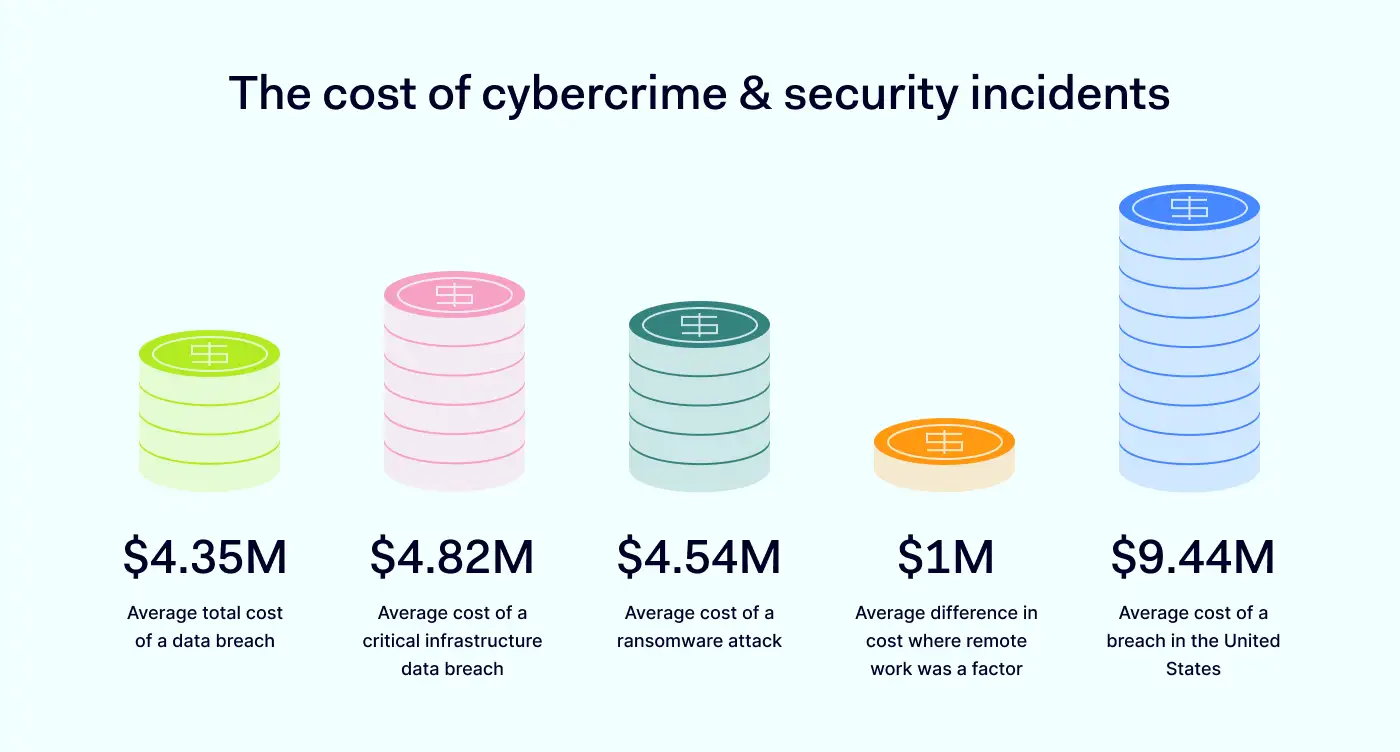
The cost of cybercrime & security incidents
The cost of cybercrime in 2022 is at an all-time high. Companies are facing an average cost of $4.35 million due to data breaches alone, with 60% of these breaches resulting in increased prices passed on to customers. In the UK, businesses have had to bear an average cost of £4200, while nearly 1 in 10 US organizations remain uninsured against cyber attacks.
These numbers are just the tip of the iceberg, indicating that constant vigilance and strong security measures are necessary to protect sensitive data and minimize the financial risks that come with cybercrime.
In this part, we delve into the cost of cybercrime in 2022 and examine the key findings that underscore the importance of organizations taking proactive steps to guard against potential cyber threats.
5. $4.35 million – average total cost of a data breach
In 2022, the average data breach cost hit an unprecedented peak of $4.35 million, surging by 2.6% from the previous year’s average cost of $4.24 million. This year-on-year increase has been consistent, with the average cost rising by a staggering 12.7% from $3.86 million as reported in 2020. These statistics demonstrate the relentless nature of cyber attacks, highlighting the need for constant vigilance and robust security measures to counter these threats.
4. $4.82 million – average cost of a critical infrastructure data breach
When analyzing critical infrastructure organizations, such as those operating in financial services, industrial, technology, energy, transportation, communication, healthcare, education, and public sector industries, the average cost of a data breach was notably higher at $4.82 million. This cost was $1 million more than the average cost of data breaches in other industries.
Shockingly, 28% of critical infrastructure organizations studied had been subjected to destructive or ransomware attacks, whereas 17% had encountered a breach due to their business partners’ security compromise. These findings underscore the importance of strengthening cyber security strategies for critical infrastructure organizations and their third-party partners to safeguard against potential cyber threats.
3. $4.54 million – average cost of a ransomware attack
Ransomware attacks accounted for 11% of all breaches, marking a 41% increase from the previous year’s figures of 7.8%. Despite this surge, the average cost of a ransomware attack experienced a slight decrease, from $4.62 million in 2021 to $4.54 million in 2022. However, this cost was still marginally higher than the average total data breach cost, which stood at $4.35 million.
These findings highlight the continued threat of ransomware attacks and the necessity for organizations to implement robust preventive measures to mitigate the associated risks.
2. $1 million – average difference in cost where remote work was a factor
This difference amounts to remote work-related breaches costing approximately $600,000 more than the global average cost. These figures underscore the financial risks and consequences associated with remote work and the importance of implementing strong security measures to safeguard sensitive data when remote work is necessary.
1. $9.44 million – average cost of a breach in the United States
The top five countries and regions that experienced the highest average cost of a data breach were the United States, with a staggering $9.44 million, followed by the Middle East at $7.46 million, Canada at $5.64 million, the United Kingdom at $5.05 million, and Germany at $4.85 million. Notably, the United States has held the top position for 12 consecutive years.
Additionally, the country with the highest growth rate from the previous year was Brazil, with a significant increase of 27.8% from $1.08 million to $1.38 million. These findings reveal the persistence and costly nature of cyber attacks, irrespective of location, emphasizing the importance of maintaining robust cyber security measures to prevent such incidents.
To sum up 2022
As we close out 2022, it’s clear that cyber security continues to be a top concern for businesses of all sizes and industries. The year saw unprecedented levels of attacks, with organizations worldwide experiencing an average of 1168 attacks per week in Q4 alone.
Unsurprisingly, the human element was involved in a staggering 82% of all breaches, with phishing and stolen credentials continuing to be a significant concern. Despite the increase in attacks, however, many businesses still don’t have adequate security measures, and the cost of cybercrime continues to rise.
To protect their data and assets in 2023, organizations must prioritize implementing effective security strategies, risk management plans and staying up-to-date on the latest threats and prevention techniques.
If your organization needs top-notch cybersecurity solutions, NordLayer provides flexible and easy-to-implement tools for all businesses. Get in touch with our specialists today for more information.
About NordLayer NordLayer is an adaptive network access security solution for modern businesses – from the world’s most trusted cybersecurity brand, Nord Security.
The web has become a chaotic space where safety and trust have been compromised by cybercrime and data protection issues. Therefore, our team has a global mission to shape a more trusted and peaceful online future for people everywhere.
About Nord Security The web has become a chaotic space where safety and trust have been compromised by cybercrime and data protection issues. Therefore, our team has a global mission to shape a more trusted and peaceful online future for people everywhere.
About Version 2 Digital
Version 2 Digital is one of the most dynamic IT companies in Asia. The company distributes a wide range of IT products across various areas including cyber security, cloud, data protection, end points, infrastructures, system monitoring, storage, networking, business productivity and communication products.
Through an extensive network of channels, point of sales, resellers, and partnership companies, Version 2 offers quality products and services which are highly acclaimed in the market. Its customers cover a wide spectrum which include Global 1000 enterprises, regional listed companies, different vertical industries, public utilities, Government, a vast number of successful SMEs, and consumers in various Asian cities.
PCI-DSS is the set of security standards that seeks to extend consistent data protection practices across the credit processing industry. Any organization handling credit card data must comply with PCI-DSS regulations.
PCI-DSS compliance places a major burden on businesses, especially small and medium-sized enterprises. But companies can reduce the cost of compliance by intelligently scoping their credit processing environment.
Segmentation allows IT teams to apply network segmentation to protect credit card data while reducing the need to secure less critical system components.
This blog will introduce network segmentation in PCI-DSS. We will look at how segmentation works and how it contributes to robust financial sector cybersecurity strategies.
What is network segmentation?
Network segmentation separates network resources to control access and enhance security. In the context of PCI-DSS, network segmentation divides the cardholder data environment (CDE) from other system components.
Separating the cardholder data environment from other resources allows businesses to secure cardholder data. This is a major challenge of cybersecurity in finance. With proper segmentation, hackers will struggle to move from off-scope endpoints and apps to the CDE. Data breaches are much less likely.
Segmentation is not a PCI-DSS requirement. Itcomplements other compliance tools such as encryption, access management, and firewall protection. If you have any doubts about core requirements, check out our PCI-DSS compliance checklist for more information.
As the SSC says, “Effective segmentation can greatly reduce the risk of CDE systems being impacted by security weaknesses or compromises originating from out-of-scope systems.” But it is not a magic bullet. Segmentation must work with other technologies and controls to achieve PCI-DSS compliance.
Understanding PCI DSS network segmentation scope
When discussing network segmentation for PCI-DSS, it’s important to assess the “scope” of controls required.
Scope refers to the extent of protection required to achieve compliance. Establishing PCI-DSS scope is a critical priority before applying segmentation.
Proper scoping provides security teams with the visibility and knowledge needed to locate and defend critical data. Scoping allows you to segment cardholder data from other parts of the network, boosting security and cutting costs.
There are three main categories to think about when carrying out a PCI-DSS assessment.
In-scope assets
Network resources that make direct contact with cardholder information. This includes payment systems, points of sale, credit card databases, communication tools, and even CRM systems. If an app or device holds credit card data, it is “in scope.”
Connected-to assets
These systems connect to in-scope assets but do not hold card data themselves. They may not require segmentation but must be tightly secured as part of the CDE.
Out-of-scope assets
Anything without access to the cardholder data environment is defined as “out of scope” and does not require the same level of protection.
The PCI-DSS regulations state that “even if the out-of-scope system component was compromised, it could not impact the security of the CDE.” This is a good way of approaching the scoping task.
If system components provide attackers with indirect access to cardholder data, it qualifies as in-scope. If not, you can relegate it to a lower priority level and concentrate resources where they matter most.
“Flat” networks where system components are connected to a single network switch are an important exception. In these cases, the entire network is categorized as in-scope.
In flat network settings, there is no such thing as an out-of-scope system. If an attacker gains access to any node on the network, they can potentially spread to systems handling credit data.
Why scoping matters to network segmentation
PCI-DSS scoping is a crucial first step in the segmentation process. You cannot create segments protecting cardholder data unless you know where that data resides.
Scoping maps data locations and flows. Compliance teams build a picture of how credit card data moves throughout the network, where it is stored, and who requires access. This provides a solid foundation for creating accurate and effective network segments.
Scoping also ensures that the segmentation process covers every asset. Security teams can start from the assumption that everything is in scope. They can then eliminate out-of-scope assets from the CDE and apply precise segmentation for cardholder data.
How to implement network segmentation for PCI DSS?
When carrying out a PCI-DSS assessment, it’s essential to keep one thing in mind: segmentation is not a substitute for comprehensive cybersecurity controls and policies. Network segmentation is part of a wider toolkit, not a solution to your compliance worries.
Having said that, PCI-DSS best practices advise that companies segment the cardholder data environment from other network systems. So how should you approach this task?
Network segmentation applies specific security controls to create sub-networks containing critical cardholder data. There are various ways of achieving this, including:
Firewall barriers between the rest of the network and cardholder data
Firewalls regulate network traffic across the CDE perimeter, preventing unauthorized access requests.
Data loss prevention (DLP) solutions
DLP tracks the movement of critical data, and works in tandem with firewall protection. Users cannot move or copy protected data without authorization. Security controls automatically block any unauthorized transfers.
Physical access controls for in-scope devices
Some workplaces may impose physical identity checks between CDE-connected devices and other offices or workstations.
Air gaps
Physical air gaps can also divide cardholder data from other network assets. Companies may choose to use two separate systems for payment processing and general operations.
Identity and access management (IAM) systems and multi-factor authentication (MFA)
Authentication systems require multiple credentials for any login. Secure network zones can require extra credentials before granting access.
Zero Trust controls on user privileges
Network managers should keep the number of users with administrative privileges as low as possible. Cardholder data environment access should only be available for users with appropriate permissions. All user access is seen as illegitimate until proven otherwise.
Continuous activity monitoring
Security teams can automate monitoring to track suspicious behavior. Tracking systems raise alerts when out-of-scope assets request access to a network segment within the CDE.
When you decide how to apply segmentation, the core challenge is determining which assets are in-scope and what lies out-of-scope.
Security teams must interview employees throughout the organization to understand how they use data. Employees can provide invaluable information about where cardholder data resides – knowledge that may not be immediately obvious.
The next step in PCI-DSS compliance is ensuring that network segmentation covers every part of the CDE. Elements to consider include:
Applications handling cardholder data. This could cover web apps and locally hosted databases.
Authentication servers and internal firewalls that connect with or defend the CDE. Protecting sensitive authentication data is a critical priority.
Security services that ensure data security and guard cardholder data. This includes intrusion detection systems, malware scanners, and anti-virus tools.
Log storage servers and backups. Any audit logs must be properly secured, including connections between active payment databases and historical logs.
Virtual machines, apps, hypervisors, or virtual routers that store or process cardholder data.
Network infrastructure such as routers, switches, hardware firewalls, and any other equipment that connects to the CDE.
Network servers handling cardholder data flows from sites of payment and within the corporate network. This may include web, mail, proxy, and DNS servers.
Third parties. Any third-party applications or users with access to payment or cardholder data storage systems lie within the CDE.
The critical task when applying PCI-DSS controls is mapping connections. Any endpoint or application that can access cardholder data needs to be secured.
It isn’t always easy to discover connections between system components. But a comprehensive planning process will generate enough information to keep your data breach risk low.
How can NordLayer solutions help?
Network segmentation is a critical part of PCI-DSS compliance. It allows organizations to separate the cardholder data environment from other system components. Attackers seeking access via remote devices or insecure endpoints will find it much harder to extract cardholder data.
NordLayer can help you build a security setup that meets PCI-DSS requirements. Our PCI-DSS compliance solutions make it easy to segment networks to protect cardholder environments. With Nordlayer, you can:
Create groups of network users and assign different network access privileges to each group.
Create Virtual Private Gateways for specific groups, resources, or websites.
Use IP allowlisting with Dedicated IP addresses to allow authorized users and block others.
In the near future, we will also offer Cloud firewall functionality. This will simplify segmenting cloud-based credit processing environments with granular and flexible access controls.
However, network segmentation is not a single solution. Companies must couple PCI-DSS network segmentation with other security tools to be compliant. Nordlayer can help here as well. In addition to segmentation, our tools can help you:
Install secure remote access solutions to transmit cardholder data safely.
Set user permissions to block unauthorized access to every network segment.
Employ quantum-safe cryptography in tunnel encryption to hide your traffic and online activity from users on the open internet.
Put in place multi-factor authentication for users accessing cardholder data. Ensure only trusted users can handle customer information and keep data breach risks low.
Make PCI-DSS compliance manageable by partnering with an experienced security provider. Get in touch with the NordLayer team to explore smart data security solutions that make damaging data breaches much less likely.
About NordLayer NordLayer is an adaptive network access security solution for modern businesses – from the world’s most trusted cybersecurity brand, Nord Security.
The web has become a chaotic space where safety and trust have been compromised by cybercrime and data protection issues. Therefore, our team has a global mission to shape a more trusted and peaceful online future for people everywhere.
About Nord Security The web has become a chaotic space where safety and trust have been compromised by cybercrime and data protection issues. Therefore, our team has a global mission to shape a more trusted and peaceful online future for people everywhere.
About Version 2 Digital
Version 2 Digital is one of the most dynamic IT companies in Asia. The company distributes a wide range of IT products across various areas including cyber security, cloud, data protection, end points, infrastructures, system monitoring, storage, networking, business productivity and communication products.
Through an extensive network of channels, point of sales, resellers, and partnership companies, Version 2 offers quality products and services which are highly acclaimed in the market. Its customers cover a wide spectrum which include Global 1000 enterprises, regional listed companies, different vertical industries, public utilities, Government, a vast number of successful SMEs, and consumers in various Asian cities.


 務
務

 Nowadays, enterprise applications and software play a vital role when it comes to having a flourishing business as they help keep organizational and scaling headaches to a minimum. From office management to cybersecurity solutions, we’ve compiled a list of apps that will take your startup to the next level!