Skip to content

runZero 與 Abira Security 合作

runZero partners with Abira Security, a full service cybersecurity advisor 
and managed services provider.

runZero is excited to announce our partnership with Abira Security, a market-leading provider of comprehensive cybersecurity solutions. As part of this partnership, Abira will be offering runZero as a solution to solve the challenges of cyber asset management. runZero’s asset inventory and discovery capabilities are the key to delivering a complete security package.

At runZero, we believe network visibility and asset inventory is a foundational part of maintaining a strong security posture. Abira offers a complete portfolio of cybersecurity solutions, paired with exceptional strategy expertise and real-world experience. Partnering with Abira Security allows runZero to expand and reach more organizations that are searching for a complete security strategy that includes deep network visibility and comprehensive asset inventory.

Eric Goldstein, Director of Channel at runZero, says, “We’re thrilled to be partnering with Abira Security to deliver cyber asset management to our joint customers. A comprehensive asset inventory is essential for any security program and is often the very first step in a security assessment. Together with runZero, Abira will help customers achieve their security goals and maximize their security tech stack value.”

“Abira is a pure play cybersecurity services firm and a true VAR. Our quality, flexibility, and cost structure is hard to beat,” says Ray Harrison, Sales Director at Abira Security.

Organizations today face ever-increasing cyber threats that can compromise their sensitive data and operations. The first step in securing any network is developing a complete asset inventory that accounts for all devices: managed or unmanaged; IT, OT, or IoT; cloud, on-prem, or remote. Combining runZero’s asset inventory capabilities and Abira’s cybersecurity expertise, customers have the benefit of an end-to-end solution that helps them identify, secure, and manage all of their assets, no matter where they exist, safely and effectively.

For more information, visit https://abirasecurity.com/.

Strengthen your security posture with cyber asset management

runZero is a cyber asset management solution that delivers full cyber asset inventory–quickly, easily, and safely. The solution enriches existing IT & security infrastructure data–from vuln scanners, EDRs, and cloud service providers–with detailed asset and network data from a purpose-built unauthenticated active scanner. No credentials required. Just deploy an Explorer and start scanning.

Get runZero for free 

About runZero
runZero, a network discovery and asset inventory solution, was founded in 2018 by HD Moore, the creator of Metasploit. HD envisioned a modern active discovery solution that could find and identify everything on a network–without credentials. As a security researcher and penetration tester, he often employed benign ways to get information leaks and piece them together to build device profiles. Eventually, this work led him to leverage applied research and the discovery techniques developed for security and penetration testing to create runZero.

About Version 2 Digital

Version 2 Digital is one of the most dynamic IT companies in Asia. The company distributes a wide range of IT products across various areas including cyber security, cloud, data protection, end points, infrastructures, system monitoring, storage, networking, business productivity and communication products.

Through an extensive network of channels, point of sales, resellers, and partnership companies, Version 2 offers quality products and services which are highly acclaimed in the market. Its customers cover a wide spectrum which include Global 1000 enterprises, regional listed companies, different vertical industries, public utilities, Government, a vast number of successful SMEs, and consumers in various Asian cities.

引入 runZero 的新 ServiceNow 服務圖集成:為您的 CMDB 獲得更高的數據準確性

Big news: runZero now integrates with ServiceNow Service Graph. The runZero Service Graph integration offers a robust solution for organizations who need to get a comprehensive and up-to-date view of asset data across IT (information technology), OT (operational technology), cloud, and remote environments. This new integration will quickly and easily enrich CMDBs with high-fidelity, contextualized asset details, superseding the existing ETL integration.

The importance of data quality in CMDBs

According to Gartner, nearly one third of CMDB challenges stem from data completeness or quality concerns, which highlights the importance of prioritizing data quality in an organization’s configuration management database (CMDB). This is not just a theoretical concern: Gartner also notes that 99% of organizations using CMDB tooling who do not address configuration item data quality gaps will experience visible business disruption. This makes sense when you consider that IT infrastructure and services are critical components of most modern businesses. Without accurate information about these assets, it becomes difficult to make informed decisions related to security, compliance, risk management, and more.

To deliver better and complete visibility across your environment, the Service Graph Connector brings your runZero asset inventory into your ServiceNow CMDB. With better data quality in your CMDB, you can ensure they get managed in accordance with your organization’s policies. By leveraging runZero’s ServiceNow Service Graph integration, you can improve your CMDB accuracy and reduce the likelihood of costly disruptions caused by inaccurate data. You can be confident that you’re operating on every asset–even the ones your CMDB didn’t know about.

Eliminate data quality gaps and improve IT/IoT/OT asset visibility with runZero’s ServiceNow Service Graph integration

Many organizations are turning to Cyber Asset Management (CAM) solutions to gain better visibility into IT, IoT, and OT assets. These solutions can help proactively identify unmanaged devices and uncover security risks within networks. By using both API data sources and unauthenticated active scanning, runZero is one of the few solutions capable of discovering unmanaged IT, IoT, and OT devices. This approach is especially valuable in OT environments, where visibility may be limited.

runZero’s ServiceNow integration provides you with a powerful tool to improve your asset inventory and cyber asset management. With this integration, you can gain better visibility into IT, IoT, and OT assets, as well as identify and address data quality gaps. This can help you reduce the cost of downtime, improve labor productivity, and get more value from your CMDB investments. In addition, runZero’s active scanner is safe to use in OT environments, ensuring that you can get the most out of your cyber asset management solutions without compromising the safety of your systems. Dozens of organizations are using runZero’s combination of integrations and active discovery, including those in manufacturing, healthcare and utilities, to achieve full asset inventory.

How Capgemini helped their client get better quality data for their CMDB

Let’s take a look at the real world implications of not having a dedicated cyber asset management solution in place.

Capgemini, a global IT consulting firm, was contracted by a French manufacturer and retailer of luxury products to deploy an asset discovery solution and set up the integration with the new CMDB to store the company’s IT asset inventory. However, they were struggling to get the data they needed using MID Servers–especially for managed assets such as routers and switches. They knew they had to explore other asset discovery options.

One of the primary requirements established for the project was unauthenticated asset discovery. The IT department, part of the holding company, was having a hard time collecting credentials for service accounts for many parts of the business. Without credentials, ServiceNow was struggling to inventory most assets. As Capgemini looked into other solutions, they discovered runZero, which delivered everything their client needed: speed, accuracy, a rich API, and unauthenticated scans. runZero’s asset discovery was fast, efficient, and worked without credentials. With runZero, they found 2.5x as many devices as ServiceNow.

After seeing the results with runZero, Capgemini has other ideas for capitalizing on its capabilities. As they work with clients in future projects, runZero will give them an accurate picture of their client’s asset inventory enabling them to provide precise project plans with known scope, schedule, and cost estimates.

Ready to get better results from your CMDB investments? To get started, sign up for runZero and then get the ServiceNow Service Graph integration on the SNOW marketplace.

Be confident in your CMDB’s data quality

runZero is a cyber asset management solution that delivers full asset inventory–quickly, easily, and safely. The solution enriches CMDBs with detailed asset and network data from a purpose-built unauthenticated active scanner. Discover every asset–even the ones your CMDB didn’t know about. 

About runZero
runZero, a network discovery and asset inventory solution, was founded in 2018 by HD Moore, the creator of Metasploit. HD envisioned a modern active discovery solution that could find and identify everything on a network–without credentials. As a security researcher and penetration tester, he often employed benign ways to get information leaks and piece them together to build device profiles. Eventually, this work led him to leverage applied research and the discovery techniques developed for security and penetration testing to create runZero.

About Version 2 Digital

Version 2 Digital is one of the most dynamic IT companies in Asia. The company distributes a wide range of IT products across various areas including cyber security, cloud, data protection, end points, infrastructures, system monitoring, storage, networking, business productivity and communication products.

Through an extensive network of channels, point of sales, resellers, and partnership companies, Version 2 offers quality products and services which are highly acclaimed in the market. Its customers cover a wide spectrum which include Global 1000 enterprises, regional listed companies, different vertical industries, public utilities, Government, a vast number of successful SMEs, and consumers in various Asian cities.

runZero 3.7:自定義集成和 SDK

What’s new with runZero 3.7?

  • Custom integrations and Python SDK
  • ServiceNow Service Graph Connector for runZero
  • Protocol improvements
  • New and improved fingerprints

Custom integrations and Python SDK

runZero Enterprise customers can now import assets from custom sources using the runZero SDK. The new Python SDK supports runZero’s custom integration API functions for ease of automation and use for those familiar with Python. These custom integrations allow for creating and importing asset types not previously supported within runZero, along with assigning the integration a name, description, and custom icon. Once imported, you can manage these custom integration sources from the runZero UI, and remove them from assets if desired. This will allow you to build new integrations and further enrich the asset data within runZero.

ServiceNow Service Graph Connector for runZero

The runZero Service Graph connector is now available in the ServiceNow marketplace. The connector can automatically pull your runZero asset data into your CMDB, merging with your ServiceNow data to improve asset visibility and accuracy. This connector does not replace the ServiceNow IntegrationHub ETL integration; both the connector and integration are available to Enterprise customers.
ServiceNow Service Graph connector for runZero

Protocol improvements

The 3.7 release includes improved support for the Checkmk host agent. Checkmk is an open source host monitoring service and is deployed as part of many solutions and network appliances. Customers with Checkmk in their environment will benefit from improved software inventory and EDR detection for these assets. The accuracy of operating system fingerprinting has also been improved using available Checkmk data.
The scanner now supports the Steam In-Home Streaming Discovery Protocol, allowing for identification of devices running the Steam client from Valve Software.

New and improved fingerprints

A number of fingerprints and fingerprint capabilities have been improved in this release. These improvements include fingerprinting of TLS stacks, better coverage of Roku devices based on AirPlay responses, and improved OS fingerprinting of devices speaking the BACnet protocol.
New fingerprints were added for products by Abbott, Aruba, Audioscan, Bayer, Canon, Ciena, Cisco, Crestron, FloLogic, GE HealthCare, GE MDS, Google, H3C, Huawei, IBM, Keyence, Meross, Logitech, NetApp, Panduit, Proofpoint, Roku, Quantum, Raritan, Roku, Shelly, SonicWall, Tesla, TP-Link, and VMware.

See runZero 3.7 in action

Watch the video to see a preview of some of the newest features in runZero, including the ServiceNow connector, Checkmk protocol parser, and custom integrations leveraging the Python SDK.

Release notes

The runZero 3.7 release includes a rollup of all the 3.6.x updates, which includes all of the following features, improvements, and updates.

New features

  • Customers with an enterprise license can now create custom integrations and import assets from any external asset data source using the runZero Python SDK.
  • Improved performance and reliability of metrics calculations.
  • Improved performance of the vulnerabilities inventory.
  • AWS permission errors are now more detailed to make troubleshooting easier.
  • A bug where the asset ownership tag was not able to be changed successfully has been resolved.
  • A bug where email addresses were case sensitive on sign in has been resolved.
  • A bug where the “Create Organization” button appeared disabled but was still clickable has been resolved.
  • A bug preventing the Asset Ownership goals toggle from being clickable has been resolved.
  • Upgraded npcap to version 1.73
  • Fingerprint updates.

Security fixes

  • A bug that could show cross-tenant Queries and their associated author email addresses was resolved. This issue only applied to a cloud-hosted version of the runZero platform that was live for slightly more than two hours on March 29th, 2023. Any customers affected by this issue received a detailed notice. This affected version 3.6.14.
  • A bug that could allow an organization admin to see the names of other organizations in the tenant, even without explicit access, has been resolved. This affected versions 3.6.0 to 3.6.5.
  • A bug that could expose limited information about an organization to cross-tenant users has been resolved. This issue could have allowed an attacker that guessed the v4 UUID of an organization to view the name, description, and top-level statistics (asset count, service count, task count, etc.) without appropriate authorization. This affected versions 3.6.0 to 3.6.4.

Product improvements

  • Improved quality of errors reported by the CLI Scanner.
  • Improved user experience of user management.
  • Improved user experience of organization management.
  • Packets sent/received are now visible from the tasks preview.
  • Enterprise customers can now scan all ports and up to a /8 at a time using the hosted scan engines.
  • Attribute searches and reports are now faster in large organizations.
  • It is now possible to download the task log for a failed scan.
  • Hosted scans no longer ignore responses from common firewalls.
  • Daily asset expiration now records an assets-expired event with the count.
  • The task-failed event now includes information about the associated Explorer.
  • Scans can now configure specific probes for Subnet and Host pings.
  • Asset queries can now surface overlaps in asset names, IP addresses, and MAC addresses across inventory.
  • Behavior around parent/child organizations has been improved.
  • A change to Chrome which caused web screenshots to fail has been addressed.
  • Alert rules now support software and vulnerability queries.
  • Asset ownership now supports references to runZero users and groups.
  • Vulnerability inventory now includes an Exploit status, indicating whether the vulnerability is known exploitable. The Exploit status will only be populated for vulnerabilities imported after this release.
  • Datagrids across the UI no longer use the incorrect theme.
  • Task WLAN listing functionality has been improved to enforce a timeout if the underlying utility is slow or unresponsive.
  • The maximum time to complete an SNMP walk is now configurable.
  • The default maximum time to complete an SNMP walk has been increased to 5 minutes from 1 minute.
  • The maximum results for an SNMP walk have been increased to 8k from 4k.
  • Assets owned by a runZero user will now be displayed on the user details page.
  • The Reason column in the failed tasks table will now properly persist the hidden state between page loads.
  • Saved queries can now be created for software, vulnerabilities, and screenshots.
  • Attribute reports now group unique values within a single key.
  • The View More link is now accessible for in-progress tasks.
  • Asset owner names now suggest auto-complete options.
  • Accessibility improvements.
  • Client-side timezone updates.
  • Improved performance of the organization details page.

Integration improvements

  • The AWS integration now supports the GovCloud partition for assumed roles.
  • Validation warnings for internal IPs when using LDAP and InsightVM integrations has been improved.
  • Filtering of non-unique MAC addresses has been improved to better support Cisco virtual MAC addresses.
  • Cisco virtual MAC addresses are now handled more consistently.
  • Increased timeouts for the Tenable integration.
  • Improved reliability of CrowdStrike credentials verification.
  • The API response for a PUT request to /org/sites now returns the details of the new site.
  • Improved reliability of the Tenable integration.
  • API requests to apply tags to one or more assets now complete much faster.

Bug fixes

  • A race condition that could occur during self-hosted installation has been resolved.
  • A bug that could cause the Tenable connector to fail intermittently for some customers has been resolved.
  • A bug that could cause task details not to render on the task overview screen has been resolved.
  • A bug that could prevent organization administrators from creating new projects has been resolved.
  • A bug that could prevent some CrowdStrike software from importing successfully has been resolved.
  • A bug that caused misaligned values when exporting assets to CSV has been resolved.
  • A bug that could cause the SSO page to render off screen has been resolved.
  • A bug that could prevent asset modifications triggered by alert rules has been resolved.
  • A bug that could prevent the dashboard from loading successfully has been resolved.
  • A bug that caused misaligned values when exporting assets to CSV has been resolved.
  • A bug that could cause assets to incorrectly merge has been resolved.
  • A bug that could prevent validation of hostname scan targets has been resolved.
  • A bug that could lead to inaccurate asset correlation has been resolved.
  • A bug which could result in runZero attributes being removed from Offline assets has been resolved.
  • A bug that could prevent subnet stats from being exported has been resolved.
  • A bug that could prevent analysis queries from running for directory users and groups has been resolved
  • A bug that prevented match counts from being displayed on the queries page has been resolved
  • A bug that could prevent updating assets with a large number of vulnerabilities has been resolved
  • A bug that prevented access to runZero canned Queries has been resolved.
  • A bug that could lead to the self-hosted installer not removing temporary files has been resolved.
  • A bug that led to slow SNMP scans of specific Cisco switches has been resolved.
  • Addresses bug where recurring tasks that are “Removed” were still showed in the tasks page after the associated site is deleted
  • A bug preventing asset owners from being updated has been resolved.
  • A bug that could result in inaccurate vulnerability counts for assets has been resolved.
  • A bug that could prevent a subset of vulnerabilities from being saved for multi-source assets has been resolved.
  • A bug that caused errors for Crowdstrike integrations with large amounts of applications has been resolved.


About NordPass
NordPass is developed by Nord Security, a company leading the global market of cybersecurity products.

The web has become a chaotic space where safety and trust have been compromised by cybercrime and data protection issues. Therefore, our team has a global mission to shape a more trusted and peaceful online future for people everywhere.

About Nord Security
The web has become a chaotic space where safety and trust have been compromised by cybercrime and data protection issues. Therefore, our team has a global mission to shape a more trusted and peaceful online future for people everywhere.

About Version 2 Digital

Version 2 Digital is one of the most dynamic IT companies in Asia. The company distributes a wide range of IT products across various areas including cyber security, cloud, data protection, end points, infrastructures, system monitoring, storage, networking, business productivity and communication products.

Through an extensive network of channels, point of sales, resellers, and partnership companies, Version 2 offers quality products and services which are highly acclaimed in the market. Its customers cover a wide spectrum which include Global 1000 enterprises, regional listed companies, different vertical industries, public utilities, Government, a vast number of successful SMEs, and consumers in various Asian cities.

社交網絡如何讓您的生物識別數據面臨風險

Social networks have become integral to our lives, enabling us to share photos, videos, and audio to connect with others, build our social presence, and even generate income. However, by sharing this content, we may unintentionally expose our faces, irises, fingerprints, voices, and other biometric patterns to hackers, who can exploit them for malicious purposes.

In this blog post, together with Andrius Januta, Cybersecurity Technical Manager at Nord Security, we’ll explore how content shared online can be used to steal our biometrics and discuss ways to protect ourselves from this threat. Let’s dive in.

Biometric data: What is it?

Biometric data, or biometrics for short, are body measurements and calculations related to an individual’s biological, physical, and behavioral characteristics. This can range from DNA, blood type, signature, and walking gait to the more commonly known fingerprints, face, iris, and voice patterns.

Each person’s biometrics are unique, so they offer a superior alternative to passwords for ease of use and enhanced privacy and security. As a result, biometric identification has become increasingly widespread, not only in high-security facilities but also in people’s everyday lives.

Today, over 80% of smartphones offer biometric capabilities for their users, enabling device unlocking, user authentication for purchases, and confirmation of sensitive actions within various applications.

Social networks: An endless source of biometrics

Our digital lives are dominated by biometric features that can be exposed on social media platforms like Facebook, Twitter, Instagram, YouTube, TikTok, and others. So by posting seemingly innocent-looking eye makeup, unboxing or live-painting videos, profile photos, stories featuring our daily life, and voicemails, we’re also sharing our unique identifiers with the world.

Rapidly advancing technology and media platforms supporting high-resolution image and video can inadvertently expose our face, iris, fingerprints, and voice patterns that can be cloned and used by threat actors.

How can biometric recognition systems be fooled?

Face, iris, fingerprints, and voice patterns are the four most common biometrics that can easily be harvested from social networks.

Andrius Januta, Cybersecurity Technical Manager at Nord Security, says that while, in general, biometric data offers greater security than passwords, several cases also demonstrate its inherent vulnerabilities.

  • Facial recognition systems can be fooled by gathering high-quality images or videos of an individual, which can then be utilized to craft makeup that mimics another person’s facial features, produce hyper-realistic masks, generate 3D renderings, fabricate full-size head replicas, and even employ deepfake technology.

  • Fingerprint recognition systems, designed to permit authorized users to unlock or access applications, can be compromised by silicone fingerprint replicas or even crafted duplicates made from wood glue.

  • Iris recognition systems are generally more challenging to falsify compared to facial and fingerprint equivalents. Nevertheless, A. Januta highlights that a few years ago, a high-resolution photograph of the iris, in combination with a contact lens, was sufficient to mimic an eye for unlocking personal devices.

  • Voice recognition systems are widely used in smart home devices, banking, and finance. However, voice cloning AI software can replicate the voice captured from video or audio messages. Important to highlight is that today, even a short three-second recording is enough to create a high-quality replica of someone’s voice.

Malicious use cases

While it’s possible that biometric data can be extracted from social networks, the majority of it doesn’t leak directly from these platforms. Rather, the greater risk for biometric data leaks is from poorly secured databases. In both cases, exposed biometric data can be exploited in various malicious cases.

Accessing devices and accounts

With access to your personal devices and a convincing replica of your facial features, fingerprint, or iris, a cybercriminal can bypass authentication requirements to unlock your device. As a result, they can gain full access to your private information, including contact lists, personal photos and videos, work files, financial data, login credentials, and other sensitive documents.

They can access online shopping portals and financial accounts and make unauthorized withdrawals, transactions, or purchases. They could install malicious software on your device to extract data or monitor your activities. A compromised device may even be used to distribute spam or malware to others.

Accessing services or committing fraud

Exposed biometric data can also enable fraudsters to impersonate you when accessing various services and facilities. This may include unauthorized entry to restricted areas and accessing financial, educational, governmental, or medical services. A.Januta adds that in some countries, biometric data already enables people to withdraw money from ATMs, enter sports events, and even pay for goods in supermarkets.

Equipped with your biometric data, threat actors can impersonate you while committing crimes. Examples of this include wearing hyper-realistic masks to take loans, accessing bank accounts using AI-synthesized voice clones, or scamming contacts with deepfakes, which according to A. Januta is one of the most common cases today.

He mentions that in one of the cases, threat actors impersonated a Binance executive, copying his image during video meetings and compromising multiple crypto projects. In another case, fraudsters created a deepfake video of one American in which he encouraged his friend to invest in Bitcoin mining.

Compromising your reputation

Deepfake videos or AI-generated images can falsely portray you participating in inappropriate activities or experiencing emergencies. Additionally, this data could be employed to fabricate your fingerprints at crime scenes or impersonate your voice in vishing schemes aimed at your family members.

How to protect biometric data?

Biometric system spoofing is like a cat-and-mouse game. Once cybersecurity specialists or threat actors find a vulnerability in biometric recognition systems that can be exploited, biometric system providers and tech companies quickly fix them. While it’s less likely to happen to average people, high-profile individuals like celebrities, businesspeople, or politicians remain vulnerable, so we cannot overlook the potential risks associated with the exposure of biometric data on social media,” warns A. Januta.

To address these concerns, A. Januta offers a range of practical suggestions for safeguarding our biometric information and preventing its extraction from social networks.

  • Be cautious about sharing biometrics on social media: Stay vigilant when posting videos or images that may expose your unique biometric features, such as fingerprints, face, or iris patterns.

  • Modify media quality and cover sensitive areas: Reduce the resolution of videos and images featuring you, and consider editing or blurring sensitive biometric information before sharing.

  • Opt for less exposed biometric factors: Choose biometric authentication methods that are less commonly exposed publicly or have a lower risk of being compromised, such as iris or retina.

  • Review shared media thoroughly: Scrutinize any media featuring your biometrics before sharing it on social networks, ensuring that no unintended exposure occurs.

  • Conduct regular media searches: Periodically search for your own image online and assess the context in which your images appear, taking necessary actions to remove any unwanted or potentially harmful exposure.

  • Prioritize multi-factor authentication (MFA): Use biometrics that are less exposed for single-factor authentication, or better yet, incorporate biometrics as part of a multi-factor authentication process rather than relying solely on a single biometric factor.

  • Use an additional hardware authentication device: Enhance security with a FIDO-enabled hardware device, providing an extra layer of protection against unauthorized access via standardized protocols.

  • Instead of biometrics, use complex and unique passwords: For less important accounts, use strong passwords, just don’t forget to update them regularly and securely store them in a reputable password manager.

  • Exercise caution with new services and technologies: Be vigilant when providing your biometric data to emerging services or technologies, and ensure that these entities have robust security measures in place to protect your sensitive information.

About Version 2 Digital

Version 2 Digital is one of the most dynamic IT companies in Asia. The company distributes a wide range of IT products across various areas including cyber security, cloud, data protection, end points, infrastructures, system monitoring, storage, networking, business productivity and communication products.

Through an extensive network of channels, point of sales, resellers, and partnership companies, Version 2 offers quality products and services which are highly acclaimed in the market. Its customers cover a wide spectrum which include Global 1000 enterprises, regional listed companies, different vertical industries, public utilities, Government, a vast number of successful SMEs, and consumers in various Asian cities.


檔案類型檔案名稱下載分享
產品資料Atera for MSPs Features List (PDF)
產品資料Atera for IT Departments Features List (PDF)

Board of Innovation 如何管理安全以保護其團隊合作和客戶數據

Board of Innovation is a global innovation firm imagining tomorrow’s products, services, and businesses – and creating them today. The company joins forces with the world’s most ambitious businesses to make what life needs next.

Working with prospects and new ideas requires creative flexibility that the company initially doesn’t want to block with security restrictions and limitations. On the other hand, protecting business and client data remains one of the company’s top priorities. Hence, Mehdi Lahmamsi Pinel, Global Operations & IT Manager at Board of Innovation tells how juggling those equally important things in the context of cyber threats aligns with the right security approach. 

The challenge

Trust over control within client confidentiality

The company culture at Board of Innovation is based on trust and employee enablement. These are critical elements for a creative industry. To succeed, the company is remote-first, and collaboration with freelancers and consultants of different backgrounds supplements full-time employees to generate new-of-the-kind products and services.

“Board of Innovation team is diverse as we have around 100 people of about 30 different nationalities in 60 places varying in cities, countries, and continents.”

Click to tweet

Yet, with a dynamic network of company innovators, consultants who move to client facilities, and third-party partners, IT managers face many challenges maintaining high levels of security that don’t interfere with team workflow.

“Business with client companies makes data security and confidentiality imperative, balancing it with the IT Manager’s responsibility to ensure the team works efficiently and effectively.”

Click to tweet

Board of Innovation works with high-profile companies and industry leaders. High traffic of changing projects, collaborators, and partners also requires precise supervision to mitigate the risks.

Since employees are unrestricted with their choices of how they want to work, self-awareness of the entire organization must be on board to achieve security goals. But how does one define the proper data protection standards and make security implicit yet not dominant? It’s a tough and subtle challenge for the IT manager to tackle.

The solution

Depicting minimums of must-security

With evaluation of team setup, work environments, and the need for flexibility, a VPN solution was the most straightforward tool for Board of Innovation. It enables many different security protocols defined in the company. One of the policies is establishing a safe connection to the company network — this is where NordLayer comes into play.

A newly assigned IT manager started by reviewing the then-current cybersecurity strategy applied in the organization. Deployed by the previous responsible manager, Board of Innovation already had an ongoing NordLayer subscription. Yet, it needed a strategy that fits company culture to its benefit.

“I’ve started by revisiting and improving the existing cybersecurity setup. NordLayer was there but not utilized to its fullest potential.”

Click to tweet

So what needed to be added to create a sound cybersecurity strategy that works?

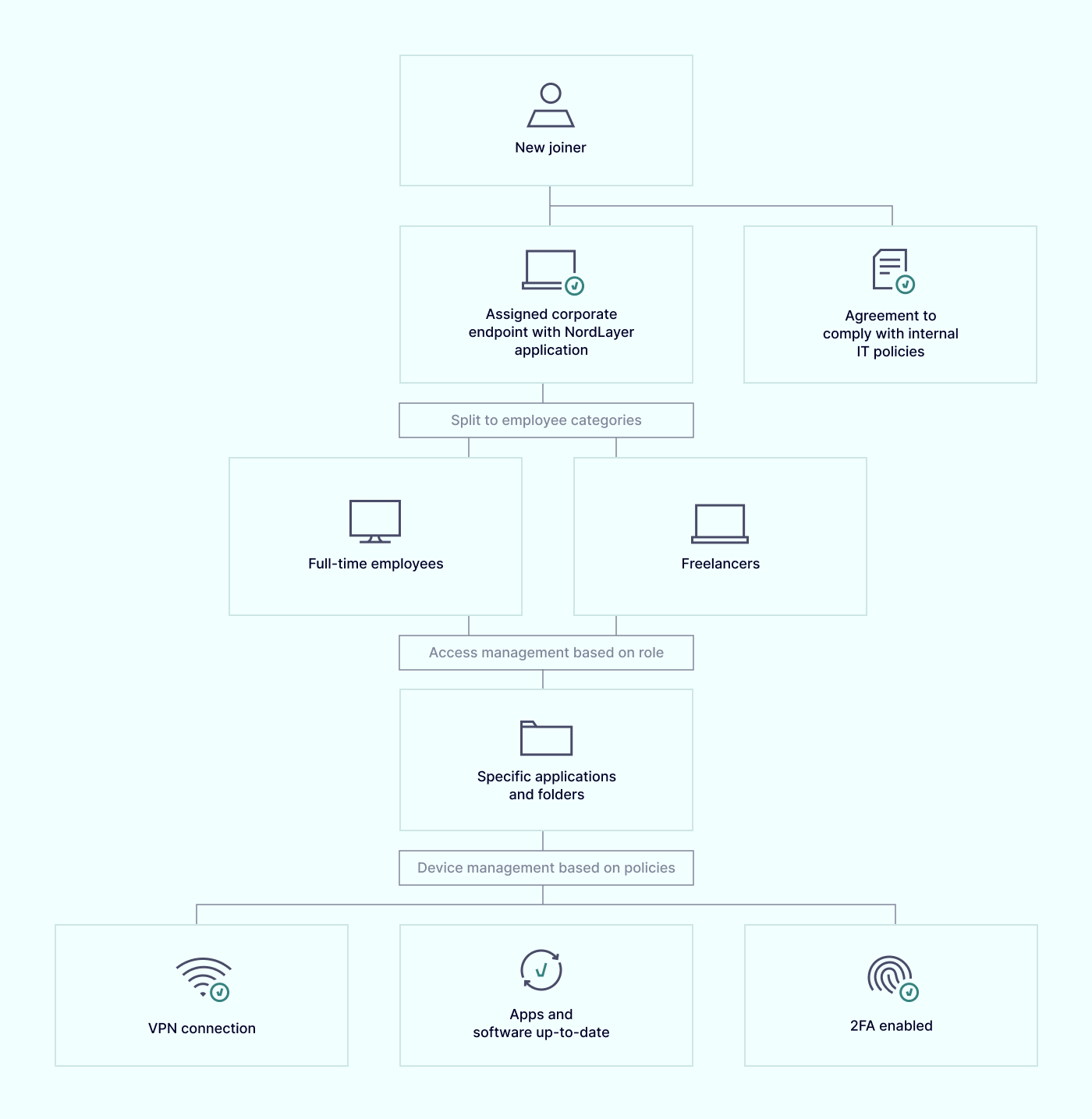
The company has a secure network access solution in place. VPN is a mandatory factor of encrypted connection, and every organization member has to familiarize themselves and agree to data protection policies.

“Whether our collaborators and employees use personal or corporate devices for the job, they must acknowledge internal IT security policies to follow.”

Click to tweet

Board of Innovation follows a streamlined approach to managing its workforce — company policies define access levels to internal data. To put policies into force, corporate devices became a connecting point for every user with access to company resources.

“Mandatory apps like NordLayer and tools for password management, specific internet navigation, and work organization are pre-installed by default. That’s how we enforce security via device management on corporate devices.”

Click to tweet

Having the tools that fulfill internal and client data security requirements relieves the security manager from dependency on employees. And having those corporate devices set up and readily distributed to the hands of the workforce is half the job done.

Users have to launch VPN once connecting to untrusted networks wherever and whenever they work, and the admin can supervise the whole process if the rules are followed.

Why choose NordLayer

Creative freedom and trust are the fou
ndation of the Board of Innovation culture. Thus, any tools and solutions used to keep up with the security requirements must be convenient and simple, enabling and not disrupting the workers.

The organization decided to keep the NordLayer solution due to its user-friendliness. Moreover, the well-known service provider has to sustain being a reputable vendor of a safe and efficient solution.

Role and endpoint management leaves more space for protecting digital company assets by enforcing authenticated user identities. More granular network access segmentation enables careful supervision over the organization members. 

How NordLayer enables data security on different network layers

Systems and policies allow the IT manager to achieve consistency in business processes and operations. Having an overview on the NordLayer dashboard makes it easier to see who complies with the rules, like having the 2FA enabled. Moreover, or get a report of the connection history.

The outcome

Streamlined consistency aligned with internal policies 

Now, Board of Innovation has all workforce onboarded to the NordLayer solution. The solution present in every corporate device and combined with two-factor authentication makes it easier for the IT manager to ensure policies are up and running.

“We distribute NordLayer licenses to all organization members and contributors as a basic rule in our company. We aim to reinforce security policies in as many places as possible.”

Click to tweet

The remote network access solution enables the organization to collaborate with various clients, partners, and freelancers. Managing access to internal resources and project information creates barriers to stopping data leaks and breaches. And importantly, security policies don’t overcome and interrupt innovators’ creativity and workflow.

“Using NordLayer is so easy — simply open the user interface, choose a gateway, get connected, and here you go.”

Click to tweet

All that is left for the IT manager is to distribute access and privileges to internal resources according to the company policies and check that everyone is on board with the process. 

Pro cybersecurity tips

Sharing best practices is what helps businesses of any industry innovate in their own way of security. Creating a strategy for protecting the company network and securing information of different levels can be based on the most unconventional and unexpected advice. Thus, this time just like every time, we asked Mehdi Lahmamsi Pinel, the Global Operations & IT Manager at Board of Innovation, to share his professional insights on business cybersecurity:

Have you ever hesitated to impose security policies because they might overcrowd business operations and disrupt employees’ daily work? Creative freedom and simplicity can remain a priority since cybersecurity doesn’t have to become dominant yet effective and efficient.

NordLayer solution secures and enables every way of working, even if you want to prioritize trust and flexibility. The application, running in the background, simply does its job encrypting connections and segmenting the teams wherever the employees are. They can combine organization-provided devices with personal endpoints securely enabling BYOD policy within the company and IT managers can attend to their work stress-free. Sounds good? Reach out to learn more about NordLayer possibilities.

About Version 2 Digital

Version 2 Digital is one of the most dynamic IT companies in Asia. The company distributes a wide range of IT products across various areas including cyber security, cloud, data protection, end points, infrastructures, system monitoring, storage, networking, business productivity and communication products.

Through an extensive network of channels, point of sales, resellers, and partnership companies, Version 2 offers quality products and services which are highly acclaimed in the market. Its customers cover a wide spectrum which include Global 1000 enterprises, regional listed companies, different vertical industries, public utilities, Government, a vast number of successful SMEs, and consumers in various Asian cities.


檔案類型檔案名稱下載分享
產品資料Atera for MSPs Features List (PDF)
產品資料Atera for IT Departments Features List (PDF)

2023 年值得關注的頂級網絡安全趨勢

Much like seasonal flu, cyber threats are constantly evolving every year. While the coronavirus curve has been, for the most part, flattened and more enterprises opened up their offices for on-premise employees, the number of cyberattacks continues to grow. Even last year, cyberattacks increased by 38% in 2022, compared to 2021.

Even without covid as a catalyst, businesses are still becoming more digital, leading to increased attacks. In this environment, cybersecurity is a real challenge, and both business managers and network administrators have a real head-scratcher on their hands. Here are our predictions on the cybersecurity trends for this year.

Cybersecurity is no longer an IT manager’s concern. It’s something that comes into play when making key business decisions. Data breaches can turn the business upside down with penalties and loss of customer trust. It’s a challenge that can come from outside and inside with improperly configured networks.

As digital transformation is becoming more prevalent among businesses, so does the increase of various threats. Here are the eight main cybersecurity trends shaping this year’s digital environment.

Top cybersecurity trends for 2023 blog visual web 1400x843Chat GPT-enforced attacks

Soon after OpenAI launched the intelligent chatbot ChatGPT, it was quickly revealed that it could do more than just form responses across many knowledge domains. Cybercriminals have already started to use this tool for building hacking tools, while scammers are gathering knowledge to build similar chatbots to use for impersonation.

While the publicly available ChatGPT-coded tools are quite rudimentary, it seems that it’s only a matter of time before hackers can turn the AI to their advantage. In general, the least of its contributions is that it lowers the entry threshold by being a huge help for novice malware developers. Even without coding assistance, it helps to write genuine-sounding phishing emails for hackers.

Although ChatGPT has various safeguards to prevent it from being used for exploitation, this is something that businesses should keep in mind. Artificial intelligence is going mainstream which levels the playing field for hackers and can put increased pressure on your cybersecurity plan.

Remote and hybrid employees risks

After the pandemic, businesses have settled with hybrid workforce models. In some cases, these models are relics of a period when the Covid-19 outbreak forced the digital transition. As this development had to happen very quickly and not interrupt business operations, this also meant that the security measures weren’t always without gaps.

This blend of employees working on-premises, remote working contractors, and a wide variety of their used company-issued and personal devices makes it a colossal job to secure everything. For IT administrators, the attack surface is too huge to oversee everything that is happening. As data breach cases pile up, we’ll likely continue to see an increased interest in securing business networks and balancing them with workplace flexibility.

Automation of cybersecurity

As hackers themselves are starting to leverage AI for their exploits, it’s only natural that businesses should keep up. Data sources multiply exponentially, so automation is necessary to crunch numbers before humans can analyze them. This allows companies to get the best of both worlds and dramatically improve their cybersecurity status.

Various sources show that successful AI pairings can extend network visibility by up to 35%. These developments clearly show that AI has the potential to be a key component when transforming network security operations. Leveraging machine learning moves organizations forward and builds more sophisticated systems to withstand the most complex online threats.

International state-sponsored attacks

While state-sanctioned cyberattacks are nothing new, the ongoing war in Ukraine marked a turning point for a steep increase. Russia remains largely isolated from the rest of the Western world, and 64% of Russian hacking was directed directly at Ukraine. These are huge numbers, even without factoring in hacking attempts at their allies. Cyber espionage is escalating in other areas as the US recently shot down the Chinese surveillance balloon.

As all this is happening, a business can easily be caught in the crossfire. This makes private companies and critical infrast
ructure organizations prime targets for credential theft, vulnerability exploitation, or ransomware. In such a climate, not having a cybersecurity plan in place is a severe liability, and businesses will likely take action to address IT security shortcomings.

Building a security-aware culture

According to Verizon, 85% of breaches involve a human element, so investing in cybersecurity technologies but skimping on the workforce is missing the forest for the trees. In today’s climate, thinking that cybersecurity risks are a problem for the IT department can blow up when you least expect it. Every single employee must be aware of potential cyber risks and know how to deal with them.

In some cases, this may require building transparent information security policies. In others, security awareness training may be necessary. Security culture building will become a key factor in many organizations this year. As social engineering attack numbers aren’t subsiding, there’s no other way to combat these threats than through company culture.

Data breaches will continue to increase

Data breaches increase yearly more than they did the previous year, and this year will be no exception. Data is still one of the most valuable assets, and organizations still leave plenty of room for attackers to exploit gaps in the fence. Building a firm infrastructure isn’t cheap or simple, either, so most companies exist hoping they won’t be the next target.

This said prevention is much more effective (and cheaper) than settlements, lawsuits, and fines for data security violations. Yet, many businesses still rely on legacy software without any risk management policy and procedure updates. We can expect that more businesses will be caught off guard this year while others will try to learn from others’ mistakes rather than their own.

Global recession serves as a catalyst for hackers

As many experts are warning about economic downturns, this can catalyze cybercrime. Most cyberattacks are financially backed, so as the economy shrinks due to global geopolitical events like Russia’s war in Ukraine, this sends a shockwave throughout all spheres of life. Hacking, therefore, can become a lucrative option if a person has the skills and no other options to earn a living wage.

Hackers-for-hire, therefore, may emerge in search of easy money, which can have various devastating consequences for companies. While some might perform penetration tests or collect bug bounties, others may not be so ethical. This should be considered, especially in Europe, considering its geopolitical tensions.

Credential stealing will continue to rise

Various reports show that mobile device vulnerabilities targeting credentials are on the rise. Hackers know that employees use their IoT devices to access the company network. So these devices are user-managed. They tend to have quite more vulnerabilities that hackers could exploit.

What also helps hackers is that most systems are still protected with only passwords. It’s especially easy to crack such a setup when employees reuse the same passwords. A move towards passwordless or hardware identity tokens is happening slowly. This proves to be a lucrative opportunity for thieves. Some experts claim that we’ll also see more second-factor authentication exploits via SMS and push-based multi-factor authentication solutions this year.

Tips on how to prepare your business for 2023

To prepare for this year, companies should start with budgeting. The amount spent on cybersecurity in 2021 and 2022 should be a benchmark for the 2023 budget. It should also adjust according to how many significant changes occurred in the organization and the cybersecurity landscape.

Adjusting the cybersecurity budget according to your company size is also common. A rule of thumb is to allocate at least 10-20% of your total budget. Revising the budgeting plan as you go is always a good idea. Cybersecurity threats and landscape can change a lot throughout the year, so staying flexible is one of the methods to stay ahead of the curve.

How can NordLayer help to protect your business in 2023?

Most recent developments in cyberspace are relevant to every business as most of them will be affected by them. Organizations need trustworthy allies to deter cyber threats as the threats keep piling up.

A modern remote network access solution like NordLayer is developed to integrate threat, network, and security management centrally to provide an explicit range of issue-targeted features. Especially with the help of a convenient design that combines cloud-based platforms, data privacy protection, and access control security strategies. 

NordLayer covers security with a centralized control interface and product integration to existing infrastructure. It provides secure remote access solutions for hybrid environments and implements zero trust for distributed workforces conveying everything to the cloud environment.

Achieve a multilayered security protection network and data environment — secure your business in 2023 with NordLayer — reach out to talk more.

About Version 2 Digital

Version 2 Digital is one of the most dynamic IT companies in Asia. The company distributes a wide range of IT products across various areas including cyber security, cloud, data protection, end points, infrastructures, system monitoring, storage, networking, business productivity and communication products.

Through an extensive network of channels, point of sales, resellers, and partnership companies, Version 2 offers quality products and services which are highly acclaimed in the market. Its customers cover a wide spectrum which include Global 1000 enterprises, regional listed companies, different vertical industries, public utilities, Government, a vast number of successful SMEs, and consumers in various Asian cities.


檔案類型檔案名稱下載分享
產品資料Atera for MSPs Features List (PDF)
產品資料Atera for IT Departments Features List (PDF)