HIPAA 違規後果:法律、財務和聲譽風險

The Health Insurance Portability and Accountability Act (HIPAA) is the most important data protection regulation for healthcare providers in the USA. It covers health insurers, clinics, hospitals, private practices, and developers of health apps, care settings, and pharmacies.

If you handle patient records, you need to be HIPAA-compliant. For your convenience, we have created a handy HIPAA compliance checklist for covered organizations. However, this blog looks at another critical HIPAA-related issue: the different types of violations and the penalties for breaching HIPAA rules.

Violations matter. Poor compliance causes customers to lose trust in your data protection policies. It’s only a matter of time before patients move their business elsewhere. Regulators can also issue significant financial penalties or even jail offenders in the most extreme cases.

This makes protecting sensitive data a critical task for health companies and their partners. So let’s explore the issue in-depth and explain everything you need to know about HIPAA violations.

What qualifies as a HIPAA Violation?

Before talking about HIPAA penalties, we need a clear understanding of what exactly constitutes a HIPAA violation. Fortunately, the legal definition of a violation is extremely clear.

HIPAA violations take place when either a covered entity (CE) or a business associate (BA) of a covered entity breach HIPAA Security, Private, or Breach Notification Rules.

HIPAA has three main rules. Here is a quick summary of what you need to know about them:

  • The HIPAA Privacy Rule sets out protections for private health data. CEs must keep data confidential and prevent unauthorized disclosure. They must also make health records available if patients desire.

  • The HIPAA Security Rule states that healthcare organizations must keep patient records secure. This includes physical, administrative, and electronic safeguards. You could see this rule as putting the privacy rule into practice.

  • The HIPAA Breach Notification Rule requires CEs to inform patients about any actual or potential data breaches. Notification must occur within 60 days of the breach.

Covered entities must become familiar with these rules when creating a compliance strategy. If you suffer a penalty, ignorance of HIPAA guidelines is not a valid defense. Covered entities must be aware of their responsibilities under the law.

Business associates, third parties your company uses also need to be part of compliance strategies. If partners can access your network assets, they could potentially cause a data breach.

Deliberate versus accidental violations

The first thing to note is that violating HIPAA can be deliberate or accidental. Covered entities need policies to cover both types of violations.

Deliberate breaches could include nurses passing the health records of a celebrity to media contacts or selling records on the Dark Web. But they also extend to simply sharing patient data without the consent of the individual concerned. In these cases, penalties tend to be severe.

Deliberate breaches also include offenses where organizations fail to act when they should do so. For instance, companies may refuse to issue breach notifications to customers within the required 60-day limit.

Company policies that clash with HIPAA rules are often deemed deliberate breaches if regulators decide that the covered entity knew about the issue and was able to remove the conflict.

Accidental breaches of HIPAA rules carry less severe penalties. They could include the absence of encryption on mobile devices or failure to train staff in cybersecurity practices.

For example, physicians could click on phishing links disguised as communications from pharmaceutical partners. There is probably no deliberate or malicious breach here. But the covered entity would be liable due to poor security training and policies.

Broadly speaking, if companies fail to take action to conform to HIPAA rules, this will qualify as a breach. That’s why having a comprehensive HIPAA compliance strategy is essential.

Criminal versus civil violations

It’s also important to understand the difference between criminal and civil HIPAA breaches.

Criminal cases are mounted by the Department of Justice and are much less common than civil penalties. They deal with deliberate violations and can lead to prison sentences for individuals at the organizations involved. Offenses leading to criminal charges include:

  • Wrongful disclosure of Protected Health Information (PHI)

  • Wrongful disclosure of PHI under false pretenses (e.g. seeking access to medical records of patients not under the care of a physician)

  • Wrongful disclosure of PHI under false pretenses with malicious intent (to sell or otherwise benefit from stealing PHI)

Most of the time, you or your staff won’t risk criminal charges. Instead, the challenge is to minimize the risk of civil cases.

Civil cases may involve behavior that is deliberate, but not malicious. Instead, civil offenses tend to involve poor risk assessment processes or simply ignorance of what HIPAA requires.

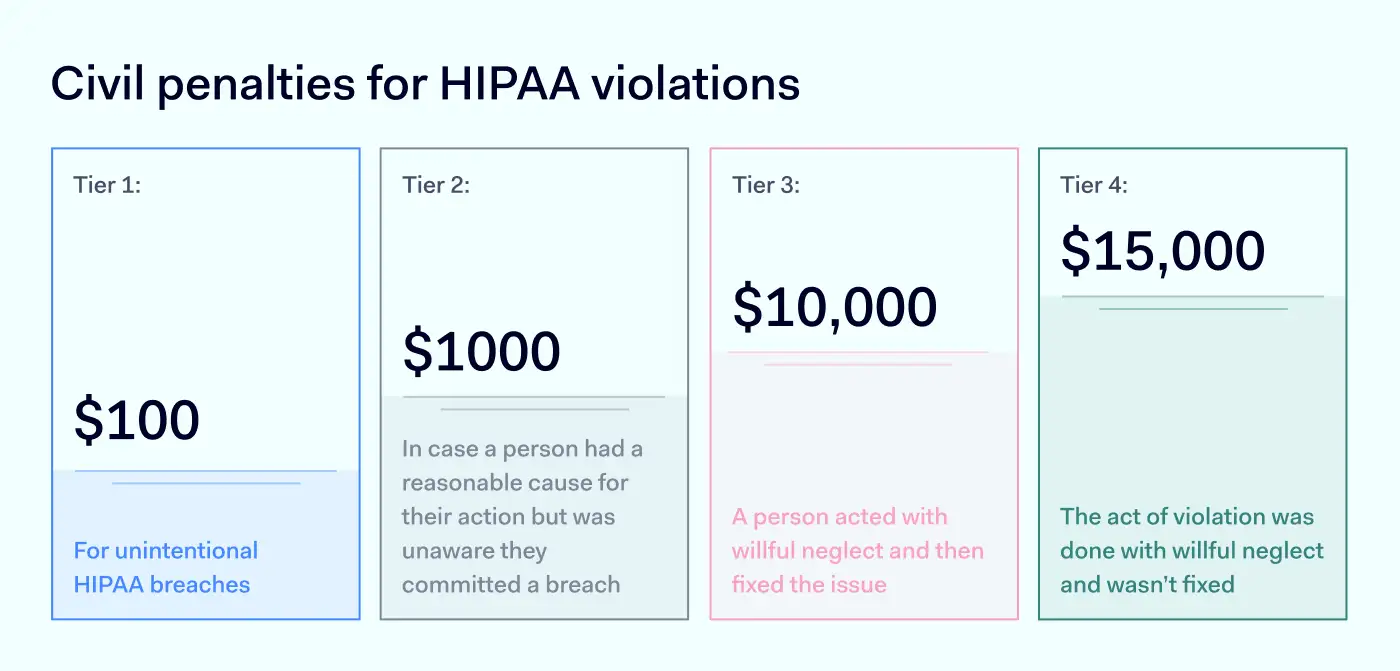
In these cases, the OCR or Attorneys General will seek a financial penalty under the HIPAA enforcement rule. Civil violations are covered by four tiers, which we will look at in more detail below.

4 types of HIPAA violations

In most instances, the Office for Civil Rights (OCR) receives complaints and decides whether organizations have violated HIPAA regulations. When the OCR deliberates, its regulators use a four-tier system to categorize potential violations.

The four tiers differ in terms of severity, with rising financial penalties. They also differ in terms of culpability. In some cases, organizations are not aware of HIPAA violations. In others, breaches are wilful and systematic.

The size of the financial penalty is related to various factors. Regulators consider:

  • How long the violation has existed

  • How many individuals are affected

  • The value and amount of the data at risk

  • Whether the organization willingly collaborates with OCR

  • Whether the organization has a clean regulatory history

Tier 1 – Accidental violation

At this tier, organizations are not aware of HIPAA breaches. The organization also had no way to avoid the violation, even with complete adherence to HIPAA regulations. At this level, covered entities must show evidence of compliance. This proves that the breach could not be avoided.

Highest penalty: $100 per incident, with a limit of $50,000

Tier 2 – Aware of violation, but no remediation possible

At tier 2, organizations know about HIPAA violations before OCR is informed. In this category, staff should have been aware of the fault. But the organization could not avoid violating HIPAA rules, even while administering adequate levels of care. This level falls short of the definition of “wilful neglect.”

Highest penalty: $1,000 per incident, with a limit of $100,000</ p>

Tier 3 – Wilful neglect with remediation

At tier 3, organizations commit “wilful neglect”. This means they were aware of the violation. the covered entity could have taken action to remedy the breach but failed to do so. However, there is a caveat here. Tier 3 penalties are lower because the organization involved has taken action to remediate the issue.

Highest penalty: $10,000 per incident, with a limit of $250,000

Tier 4 – Wilful neglect without remediation

At tier 4, organizations are also guilty of “wilful neglect”. The violation was known and the organization failed to take remedial action. Breaches in this category could continue for months or years, with serious consequences for patient welfare and data protection. For these reasons, Tier 4 penalties are far higher than other categories.

Highest penalty: $50,000 per incident, with a limit of $1.5 million

The consequences of a HIPAA violation

According to US law, if a covered entity breaks the HIPAA regulations, it may face a penalty of up to $50,000 and up to one-year imprisonment. The actual consequences depend on the type and severity of the HIPAA violation, and whether they were committed by a healthcare employee or an employer, i.e., covered entities.

There are two types of violations: civil and criminal. Each category has tiers to determine penalties for a specific breach.

Civil HIPAA penalties

HIPAA violations committed without malicious intent fall into the category of civil penalties. What’s the most common reason for these violations? Most of the time, it’s because healthcare employees or covered entities don’t know the HIPAA Privacy Rule. Yet, unawareness or negligence of HIPAA standards is not an excuse for escaping a penalty.

Criminal HIPAA penalties

Intentional HIPAA violations, such as disclosing or selling personal health information, are a crime. The criminal penalties for these violations can be severe and restitution may be also paid to the victims. A covered entity that committed a HIPAA violation must settle it with OCR and state attorneys general.

The height of the criminal penalties depends on the following factors:

  • the seriousness of HIPAA violations

  • the length of time that the violation has been taking place

  • the number of violations identified.

Who issues penalties?

HIPAA is a Federal regulation. So you might assume that penalties are issued exclusively by the Federal Government. However, the actual situation is more complex. Covered entities should be familiar with all regulatory bodies in their specific business sector.

The Office for Civil Rights (OCR)

To start with, the Office for Civil Rights processes most HIPAA violations and issues penalties. OCR is part of the Department of Health and Human Services (HHS), and it has a general bias towards negotiation instead of penalizing organizations.

As a rule, before mandating penalties, OCR will issue technical assistance and monitor voluntary compliance agreements with covered entities. However, if breaches persist, OCR will launch civil cases to demand HIPAA violation penalties. This is particularly likely if covered entities have a previous history of repeat violations.

OCR has the power to launch civil proceedings. But it can also pass HIPAA cases to the Department of Justice (DOJ) to handle criminal violations. So a violation at the federal level can lead to jail time alongside large financial penalties.

State-level Attorneys General

HIPAA penalties may also be issued at a state level by Attorneys General. Attorneys General can use powers granted by the 2009 HITECH Act to launch lawsuits against organizations breaching HIPAA rules. These suits are civil cases, so they do not lead to prison sentences. But they can result in large financial penalties.

Additionally, HIPAA violations can stretch across state boundaries. In these situations, covered entities may face lawsuits from numerous Attorneys General. This multiplies the financial cost of non-compliance.

Internal penalties

Proactive organizations may also create policies to penalize staff members when they violate HIPAA regulations. This could be developed autonomously, or in collaboration with the Office for Civil Rights as part of compliance strategies.

Internal penalties tend to range in severity and seek to deter unsafe behavior when handling patient data. They are an important data security measure, especially when deployed with mandatory security training.

How can NordLayer solutions mitigate HIPAA risks?

Violating HIPAA suggests that your data protection measures are below the standard needed in today’s digital marketplace. That’s why organizations need modern security solutions that easily adapt to the complexities of today’s hybrid working environments and HIPAA rules. All locations, users, devices, apps, and data must have the same advanced level of protection. 

With Nordlayer’s solutions, you can secure access to sensitive information, prevents reputational, legal, and financial damage, and helps achieve HIPAA compliance.  Whatever area of healthcare you work in, Nordlayer is ready to help you succeed. Get in touch and discuss your options today.


About NordLayer
NordLayer is an adaptive network access security solution for modern businesses – from the world’s most trusted cybersecurity brand, Nord Security.

The web has become a chaotic space where safety and trust have been compromised by cybercrime and data protection issues. Therefore, our team has a global mission to shape a more trusted and peaceful online future for people everywhere.

About Nord Security
The web has become a chaotic space where safety and trust have been compromised by cybercrime and data protection issues. Therefore, our team has a global mission to shape a more trusted and peaceful online future for people everywhere.

About Version 2 Digital

Version 2 Digital is one of the most dynamic IT companies in Asia. The company distributes a wide range of IT products across various areas including cyber security, cloud, data protection, end points, infrastructures, system monitoring, storage, networking, business productivity and communication products.

Through an extensive network of channels, point of sales, resellers, and partnership companies, Version 2 offers quality products and services which are highly acclaimed in the market. Its customers cover a wide spectrum which include Global 1000 enterprises, regional listed companies, different vertical industries, public utilities, Government, a vast number of successful SMEs, and consumers in various Asian cities.

社交網絡如何讓您的生物識別數據面臨風險

Social networks have become integral to our lives, enabling us to share photos, videos, and audio to connect with others, build our social presence, and even generate income. However, by sharing this content, we may unintentionally expose our faces, irises, fingerprints, voices, and other biometric patterns to hackers, who can exploit them for malicious purposes.

In this blog post, together with Andrius Januta, Cybersecurity Technical Manager at Nord Security, we’ll explore how content shared online can be used to steal our biometrics and discuss ways to protect ourselves from this threat. Let’s dive in.

Biometric data: What is it?

Biometric data, or biometrics for short, are body measurements and calculations related to an individual’s biological, physical, and behavioral characteristics. This can range from DNA, blood type, signature, and walking gait to the more commonly known fingerprints, face, iris, and voice patterns.

Each person’s biometrics are unique, so they offer a superior alternative to passwords for ease of use and enhanced privacy and security. As a result, biometric identification has become increasingly widespread, not only in high-security facilities but also in people’s everyday lives.

Today, over 80% of smartphones offer biometric capabilities for their users, enabling device unlocking, user authentication for purchases, and confirmation of sensitive actions within various applications.

Social networks: An endless source of biometrics

Our digital lives are dominated by biometric features that can be exposed on social media platforms like Facebook, Twitter, Instagram, YouTube, TikTok, and others. So by posting seemingly innocent-looking eye makeup, unboxing or live-painting videos, profile photos, stories featuring our daily life, and voicemails, we’re also sharing our unique identifiers with the world.

Rapidly advancing technology and media platforms supporting high-resolution image and video can inadvertently expose our face, iris, fingerprints, and voice patterns that can be cloned and used by threat actors.

How can biometric recognition systems be fooled?

Face, iris, fingerprints, and voice patterns are the four most common biometrics that can easily be harvested from social networks.

Andrius Januta, Cybersecurity Technical Manager at Nord Security, says that while, in general, biometric data offers greater security than passwords, several cases also demonstrate its inherent vulnerabilities.

  • Facial recognition systems can be fooled by gathering high-quality images or videos of an individual, which can then be utilized to craft makeup that mimics another person’s facial features, produce hyper-realistic masks, generate 3D renderings, fabricate full-size head replicas, and even employ deepfake technology.

  • Fingerprint recognition systems, designed to permit authorized users to unlock or access applications, can be compromised by silicone fingerprint replicas or even crafted duplicates made from wood glue.

  • Iris recognition systems are generally more challenging to falsify compared to facial and fingerprint equivalents. Nevertheless, A. Januta highlights that a few years ago, a high-resolution photograph of the iris, in combination with a contact lens, was sufficient to mimic an eye for unlocking personal devices.

  • Voice recognition systems are widely used in smart home devices, banking, and finance. However, voice cloning AI software can replicate the voice captured from video or audio messages. Important to highlight is that today, even a short three-second recording is enough to create a high-quality replica of someone’s voice.

Malicious use cases

While it’s possible that biometric data can be extracted from social networks, the majority of it doesn’t leak directly from these platforms. Rather, the greater risk for biometric data leaks is from poorly secured databases. In both cases, exposed biometric data can be exploited in various malicious cases.

Accessing devices and accounts

With access to your personal devices and a convincing replica of your facial features, fingerprint, or iris, a cybercriminal can bypass authentication requirements to unlock your device. As a result, they can gain full access to your private information, including contact lists, personal photos and videos, work files, financial data, login credentials, and other sensitive documents.

They can access online shopping portals and financial accounts and make unauthorized withdrawals, transactions, or purchases. They could install malicious software on your device to extract data or monitor your activities. A compromised device may even be used to distribute spam or malware to others.

Accessing services or committing fraud

Exposed biometric data can also enable fraudsters to impersonate you when accessing various services and facilities. This may include unauthorized entry to restricted areas and accessing financial, educational, governmental, or medical services. A.Januta adds that in some countries, biometric data already enables people to withdraw money from ATMs, enter sports events, and even pay for goods in supermarkets.

Equipped with your biometric data, threat actors can impersonate you while committing crimes. Examples of this include wearing hyper-realistic masks to take loans, accessing bank accounts using AI-synthesized voice clones, or scamming contacts with deepfakes, which according to A. Januta is one of the most common cases today.

He mentions that in one of the cases, threat actors impersonated a Binance executive, copying his image during video meetings and compromising multiple crypto projects. In another case, fraudsters created a deepfake video of one American in which he encouraged his friend to invest in Bitcoin mining.

Compromising your reputation

Deepfake videos or AI-generated images can falsely portray you participating in inappropriate activities or experiencing emergencies. Additionally, this data could be employed to fabricate your fingerprints at crime scenes or impersonate your voice in vishing schemes aimed at your family members.

How to protect biometric data?

Biometric system spoofing is like a cat-and-mouse game. Once cybersecurity specialists or threat actors find a vulnerability in biometric recognition systems that can be exploited, biometric system providers and tech companies quickly fix them. While it’s less likely to happen to average people, high-profile individuals like celebrities, businesspeople, or politicians remain vulnerable, so we cannot overlook the potential risks associated with the exposure of biometric data on social media,” warns A. Januta.

To address these concerns, A. Januta offers a range of practical suggestions for safeguarding our biometric information and preventing its extraction from social networks.

  • Be cautious about sharing biometrics on social media: Stay vigilant when posting videos or images that may expose your unique biometric features, such as fingerprints, face, or iris patterns.

  • Modify media quality and cover sensitive areas: Reduce the resolution of videos and images featuring you, and consider editing or blurring sensitive biometric information before sharing.

  • Opt for less exposed biometric factors: Choose biometric authentication methods that are less commonly exposed publicly or have a lower risk of being compromised, such as iris or retina.

  • Review shared media thoroughly: Scrutinize any media featuring your biometrics before sharing it on social networks, ensuring that no unintended exposure occurs.

  • Conduct regular media searches: Periodically search for your own image online and assess the context in which your images appear, taking necessary actions to remove any unwanted or potentially harmful exposure.

  • Prioritize multi-factor authentication (MFA): Use biometrics that are less exposed for single-factor authentication, or better yet, incorporate biometrics as part of a multi-factor authentication process rather than relying solely on a single biometric factor.

  • Use an additional hardware authentication device: Enhance security with a FIDO-enabled hardware device, providing an extra layer of protection against unauthorized access via standardized protocols.

  • Instead of biometrics, use complex and unique passwords: For less important accounts, use strong passwords, just don’t forget to update them regularly and securely store them in a reputable password manager.

  • Exercise caution with new services and technologies: Be vigilant when providing your biometric data to emerging services or technologies, and ensure that these entities have robust security measures in place to protect your sensitive information.

About Version 2 Digital

Version 2 Digital is one of the most dynamic IT companies in Asia. The company distributes a wide range of IT products across various areas including cyber security, cloud, data protection, end points, infrastructures, system monitoring, storage, networking, business productivity and communication products.

Through an extensive network of channels, point of sales, resellers, and partnership companies, Version 2 offers quality products and services which are highly acclaimed in the market. Its customers cover a wide spectrum which include Global 1000 enterprises, regional listed companies, different vertical industries, public utilities, Government, a vast number of successful SMEs, and consumers in various Asian cities.


檔案類型檔案名稱下載分享
產品資料Atera for MSPs Features List (PDF)
產品資料Atera for IT Departments Features List (PDF)

Board of Innovation 如何管理安全以保護其團隊合作和客戶數據

Board of Innovation is a global innovation firm imagining tomorrow’s products, services, and businesses – and creating them today. The company joins forces with the world’s most ambitious businesses to make what life needs next.

Working with prospects and new ideas requires creative flexibility that the company initially doesn’t want to block with security restrictions and limitations. On the other hand, protecting business and client data remains one of the company’s top priorities. Hence, Mehdi Lahmamsi Pinel, Global Operations & IT Manager at Board of Innovation tells how juggling those equally important things in the context of cyber threats aligns with the right security approach. 

The challenge

Trust over control within client confidentiality

The company culture at Board of Innovation is based on trust and employee enablement. These are critical elements for a creative industry. To succeed, the company is remote-first, and collaboration with freelancers and consultants of different backgrounds supplements full-time employees to generate new-of-the-kind products and services.

“Board of Innovation team is diverse as we have around 100 people of about 30 different nationalities in 60 places varying in cities, countries, and continents.”

Click to tweet

Yet, with a dynamic network of company innovators, consultants who move to client facilities, and third-party partners, IT managers face many challenges maintaining high levels of security that don’t interfere with team workflow.

“Business with client companies makes data security and confidentiality imperative, balancing it with the IT Manager’s responsibility to ensure the team works efficiently and effectively.”

Click to tweet

Board of Innovation works with high-profile companies and industry leaders. High traffic of changing projects, collaborators, and partners also requires precise supervision to mitigate the risks.

Since employees are unrestricted with their choices of how they want to work, self-awareness of the entire organization must be on board to achieve security goals. But how does one define the proper data protection standards and make security implicit yet not dominant? It’s a tough and subtle challenge for the IT manager to tackle.

The solution

Depicting minimums of must-security

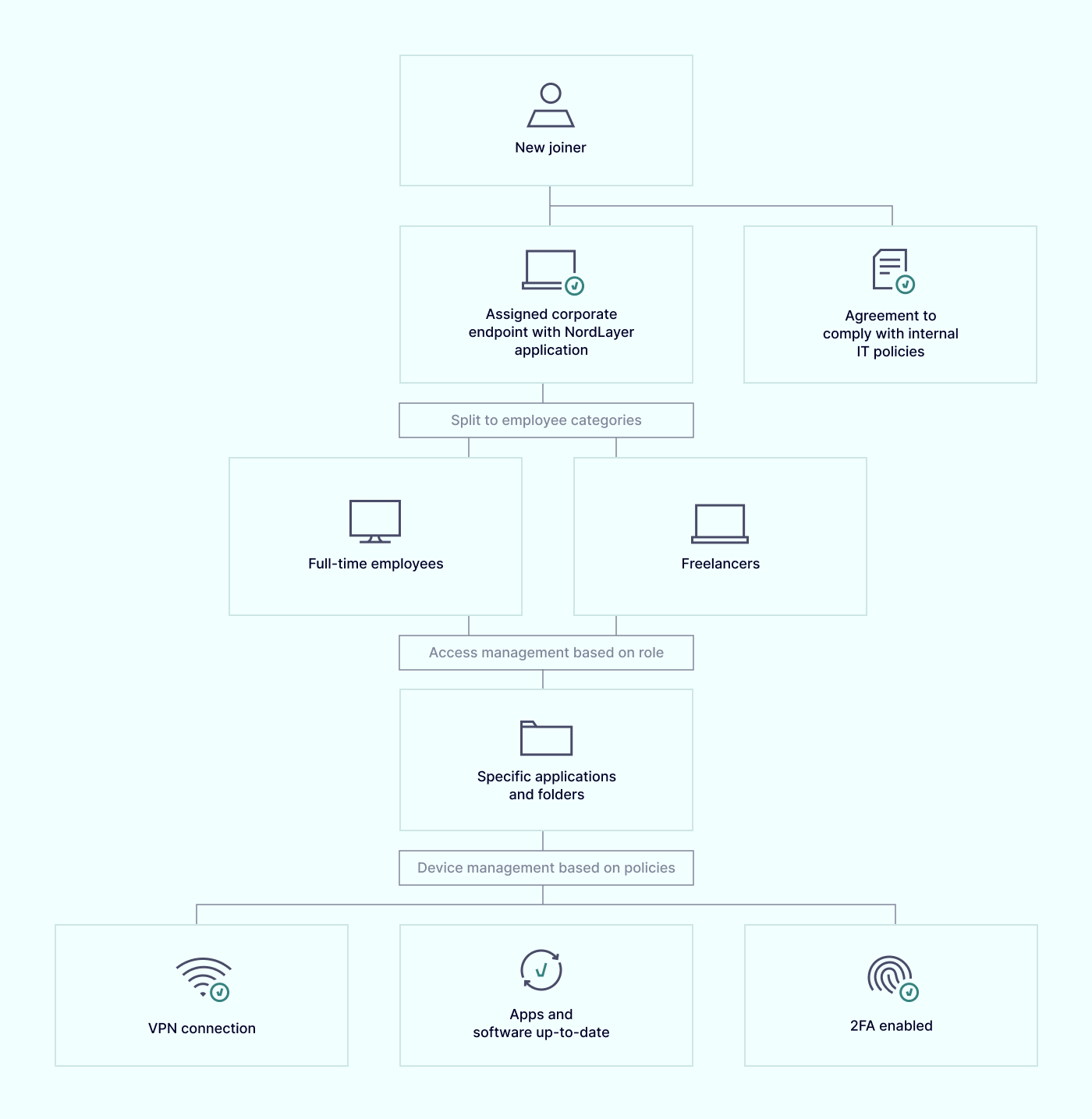
With evaluation of team setup, work environments, and the need for flexibility, a VPN solution was the most straightforward tool for Board of Innovation. It enables many different security protocols defined in the company. One of the policies is establishing a safe connection to the company network — this is where NordLayer comes into play.

A newly assigned IT manager started by reviewing the then-current cybersecurity strategy applied in the organization. Deployed by the previous responsible manager, Board of Innovation already had an ongoing NordLayer subscription. Yet, it needed a strategy that fits company culture to its benefit.

“I’ve started by revisiting and improving the existing cybersecurity setup. NordLayer was there but not utilized to its fullest potential.”

Click to tweet

So what needed to be added to create a sound cybersecurity strategy that works?

The company has a secure network access solution in place. VPN is a mandatory factor of encrypted connection, and every organization member has to familiarize themselves and agree to data protection policies.

“Whether our collaborators and employees use personal or corporate devices for the job, they must acknowledge internal IT security policies to follow.”

Click to tweet

Board of Innovation follows a streamlined approach to managing its workforce — company policies define access levels to internal data. To put policies into force, corporate devices became a connecting point for every user with access to company resources.

“Mandatory apps like NordLayer and tools for password management, specific internet navigation, and work organization are pre-installed by default. That’s how we enforce security via device management on corporate devices.”

Click to tweet

Having the tools that fulfill internal and client data security requirements relieves the security manager from dependency on employees. And having those corporate devices set up and readily distributed to the hands of the workforce is half the job done.

Users have to launch VPN once connecting to untrusted networks wherever and whenever they work, and the admin can supervise the whole process if the rules are followed.

Why choose NordLayer

Creative freedom and trust are the fou
ndation of the Board of Innovation culture. Thus, any tools and solutions used to keep up with the security requirements must be convenient and simple, enabling and not disrupting the workers.

The organization decided to keep the NordLayer solution due to its user-friendliness. Moreover, the well-known service provider has to sustain being a reputable vendor of a safe and efficient solution.

Role and endpoint management leaves more space for protecting digital company assets by enforcing authenticated user identities. More granular network access segmentation enables careful supervision over the organization members. 

How NordLayer enables data security on different network layers

Systems and policies allow the IT manager to achieve consistency in business processes and operations. Having an overview on the NordLayer dashboard makes it easier to see who complies with the rules, like having the 2FA enabled. Moreover, or get a report of the connection history.

The outcome

Streamlined consistency aligned with internal policies 

Now, Board of Innovation has all workforce onboarded to the NordLayer solution. The solution present in every corporate device and combined with two-factor authentication makes it easier for the IT manager to ensure policies are up and running.

“We distribute NordLayer licenses to all organization members and contributors as a basic rule in our company. We aim to reinforce security policies in as many places as possible.”

Click to tweet

The remote network access solution enables the organization to collaborate with various clients, partners, and freelancers. Managing access to internal resources and project information creates barriers to stopping data leaks and breaches. And importantly, security policies don’t overcome and interrupt innovators’ creativity and workflow.

“Using NordLayer is so easy — simply open the user interface, choose a gateway, get connected, and here you go.”

Click to tweet

All that is left for the IT manager is to distribute access and privileges to internal resources according to the company policies and check that everyone is on board with the process. 

Pro cybersecurity tips

Sharing best practices is what helps businesses of any industry innovate in their own way of security. Creating a strategy for protecting the company network and securing information of different levels can be based on the most unconventional and unexpected advice. Thus, this time just like every time, we asked Mehdi Lahmamsi Pinel, the Global Operations & IT Manager at Board of Innovation, to share his professional insights on business cybersecurity:

Have you ever hesitated to impose security policies because they might overcrowd business operations and disrupt employees’ daily work? Creative freedom and simplicity can remain a priority since cybersecurity doesn’t have to become dominant yet effective and efficient.

NordLayer solution secures and enables every way of working, even if you want to prioritize trust and flexibility. The application, running in the background, simply does its job encrypting connections and segmenting the teams wherever the employees are. They can combine organization-provided devices with personal endpoints securely enabling BYOD policy within the company and IT managers can attend to their work stress-free. Sounds good? Reach out to learn more about NordLayer possibilities.

About Version 2 Digital

Version 2 Digital is one of the most dynamic IT companies in Asia. The company distributes a wide range of IT products across various areas including cyber security, cloud, data protection, end points, infrastructures, system monitoring, storage, networking, business productivity and communication products.

Through an extensive network of channels, point of sales, resellers, and partnership companies, Version 2 offers quality products and services which are highly acclaimed in the market. Its customers cover a wide spectrum which include Global 1000 enterprises, regional listed companies, different vertical industries, public utilities, Government, a vast number of successful SMEs, and consumers in various Asian cities.


檔案類型檔案名稱下載分享
產品資料Atera for MSPs Features List (PDF)
產品資料Atera for IT Departments Features List (PDF)

2023 年值得關注的頂級網絡安全趨勢

Much like seasonal flu, cyber threats are constantly evolving every year. While the coronavirus curve has been, for the most part, flattened and more enterprises opened up their offices for on-premise employees, the number of cyberattacks continues to grow. Even last year, cyberattacks increased by 38% in 2022, compared to 2021.

Even without covid as a catalyst, businesses are still becoming more digital, leading to increased attacks. In this environment, cybersecurity is a real challenge, and both business managers and network administrators have a real head-scratcher on their hands. Here are our predictions on the cybersecurity trends for this year.

Cybersecurity is no longer an IT manager’s concern. It’s something that comes into play when making key business decisions. Data breaches can turn the business upside down with penalties and loss of customer trust. It’s a challenge that can come from outside and inside with improperly configured networks.

As digital transformation is becoming more prevalent among businesses, so does the increase of various threats. Here are the eight main cybersecurity trends shaping this year’s digital environment.

Top cybersecurity trends for 2023 blog visual web 1400x843Chat GPT-enforced attacks

Soon after OpenAI launched the intelligent chatbot ChatGPT, it was quickly revealed that it could do more than just form responses across many knowledge domains. Cybercriminals have already started to use this tool for building hacking tools, while scammers are gathering knowledge to build similar chatbots to use for impersonation.

While the publicly available ChatGPT-coded tools are quite rudimentary, it seems that it’s only a matter of time before hackers can turn the AI to their advantage. In general, the least of its contributions is that it lowers the entry threshold by being a huge help for novice malware developers. Even without coding assistance, it helps to write genuine-sounding phishing emails for hackers.

Although ChatGPT has various safeguards to prevent it from being used for exploitation, this is something that businesses should keep in mind. Artificial intelligence is going mainstream which levels the playing field for hackers and can put increased pressure on your cybersecurity plan.

Remote and hybrid employees risks

After the pandemic, businesses have settled with hybrid workforce models. In some cases, these models are relics of a period when the Covid-19 outbreak forced the digital transition. As this development had to happen very quickly and not interrupt business operations, this also meant that the security measures weren’t always without gaps.

This blend of employees working on-premises, remote working contractors, and a wide variety of their used company-issued and personal devices makes it a colossal job to secure everything. For IT administrators, the attack surface is too huge to oversee everything that is happening. As data breach cases pile up, we’ll likely continue to see an increased interest in securing business networks and balancing them with workplace flexibility.

Automation of cybersecurity

As hackers themselves are starting to leverage AI for their exploits, it’s only natural that businesses should keep up. Data sources multiply exponentially, so automation is necessary to crunch numbers before humans can analyze them. This allows companies to get the best of both worlds and dramatically improve their cybersecurity status.

Various sources show that successful AI pairings can extend network visibility by up to 35%. These developments clearly show that AI has the potential to be a key component when transforming network security operations. Leveraging machine learning moves organizations forward and builds more sophisticated systems to withstand the most complex online threats.

International state-sponsored attacks

While state-sanctioned cyberattacks are nothing new, the ongoing war in Ukraine marked a turning point for a steep increase. Russia remains largely isolated from the rest of the Western world, and 64% of Russian hacking was directed directly at Ukraine. These are huge numbers, even without factoring in hacking attempts at their allies. Cyber espionage is escalating in other areas as the US recently shot down the Chinese surveillance balloon.

As all this is happening, a business can easily be caught in the crossfire. This makes private companies and critical infrast
ructure organizations prime targets for credential theft, vulnerability exploitation, or ransomware. In such a climate, not having a cybersecurity plan in place is a severe liability, and businesses will likely take action to address IT security shortcomings.

Building a security-aware culture

According to Verizon, 85% of breaches involve a human element, so investing in cybersecurity technologies but skimping on the workforce is missing the forest for the trees. In today’s climate, thinking that cybersecurity risks are a problem for the IT department can blow up when you least expect it. Every single employee must be aware of potential cyber risks and know how to deal with them.

In some cases, this may require building transparent information security policies. In others, security awareness training may be necessary. Security culture building will become a key factor in many organizations this year. As social engineering attack numbers aren’t subsiding, there’s no other way to combat these threats than through company culture.

Data breaches will continue to increase

Data breaches increase yearly more than they did the previous year, and this year will be no exception. Data is still one of the most valuable assets, and organizations still leave plenty of room for attackers to exploit gaps in the fence. Building a firm infrastructure isn’t cheap or simple, either, so most companies exist hoping they won’t be the next target.

This said prevention is much more effective (and cheaper) than settlements, lawsuits, and fines for data security violations. Yet, many businesses still rely on legacy software without any risk management policy and procedure updates. We can expect that more businesses will be caught off guard this year while others will try to learn from others’ mistakes rather than their own.

Global recession serves as a catalyst for hackers

As many experts are warning about economic downturns, this can catalyze cybercrime. Most cyberattacks are financially backed, so as the economy shrinks due to global geopolitical events like Russia’s war in Ukraine, this sends a shockwave throughout all spheres of life. Hacking, therefore, can become a lucrative option if a person has the skills and no other options to earn a living wage.

Hackers-for-hire, therefore, may emerge in search of easy money, which can have various devastating consequences for companies. While some might perform penetration tests or collect bug bounties, others may not be so ethical. This should be considered, especially in Europe, considering its geopolitical tensions.

Credential stealing will continue to rise

Various reports show that mobile device vulnerabilities targeting credentials are on the rise. Hackers know that employees use their IoT devices to access the company network. So these devices are user-managed. They tend to have quite more vulnerabilities that hackers could exploit.

What also helps hackers is that most systems are still protected with only passwords. It’s especially easy to crack such a setup when employees reuse the same passwords. A move towards passwordless or hardware identity tokens is happening slowly. This proves to be a lucrative opportunity for thieves. Some experts claim that we’ll also see more second-factor authentication exploits via SMS and push-based multi-factor authentication solutions this year.

Tips on how to prepare your business for 2023

To prepare for this year, companies should start with budgeting. The amount spent on cybersecurity in 2021 and 2022 should be a benchmark for the 2023 budget. It should also adjust according to how many significant changes occurred in the organization and the cybersecurity landscape.

Adjusting the cybersecurity budget according to your company size is also common. A rule of thumb is to allocate at least 10-20% of your total budget. Revising the budgeting plan as you go is always a good idea. Cybersecurity threats and landscape can change a lot throughout the year, so staying flexible is one of the methods to stay ahead of the curve.

How can NordLayer help to protect your business in 2023?

Most recent developments in cyberspace are relevant to every business as most of them will be affected by them. Organizations need trustworthy allies to deter cyber threats as the threats keep piling up.

A modern remote network access solution like NordLayer is developed to integrate threat, network, and security management centrally to provide an explicit range of issue-targeted features. Especially with the help of a convenient design that combines cloud-based platforms, data privacy protection, and access control security strategies. 

NordLayer covers security with a centralized control interface and product integration to existing infrastructure. It provides secure remote access solutions for hybrid environments and implements zero trust for distributed workforces conveying everything to the cloud environment.

Achieve a multilayered security protection network and data environment — secure your business in 2023 with NordLayer — reach out to talk more.

About Version 2 Digital

Version 2 Digital is one of the most dynamic IT companies in Asia. The company distributes a wide range of IT products across various areas including cyber security, cloud, data protection, end points, infrastructures, system monitoring, storage, networking, business productivity and communication products.

Through an extensive network of channels, point of sales, resellers, and partnership companies, Version 2 offers quality products and services which are highly acclaimed in the market. Its customers cover a wide spectrum which include Global 1000 enterprises, regional listed companies, different vertical industries, public utilities, Government, a vast number of successful SMEs, and consumers in various Asian cities.


檔案類型檔案名稱下載分享
產品資料Atera for MSPs Features List (PDF)
產品資料Atera for IT Departments Features List (PDF)

雲端軟件開發:優勢與挑戰

Digital transformation touched most businesses operating today, and the transition to the cloud is an important step. The cloud became a primary environment for creating new software, particularly for software developers and IT professionals. Combining flexibility and efficiency for the price served as the new way of doing business.

Yet, not everything was all moonlight and roses — the outsourced model also brings a fair share of cybersecurity risks. This creates a head-scratcher for network administrators and developers in balancing the benefits with the risks to ensure a streamlined mode of operation that is as effective as it’s secure. Let’s take a deep dive into all things cloud software development.

What is cloud computing?

Cloud computing is an infrastructure model in which resources and processes are outsourced to data centers rather than done internally. This method relies on the public internet as the primary mode of delivery, allowing a much wider reach than possible using conventional methods.

Cloud computing often provides services like data storage, management, device access, networking, and cybersecurity. Externalizing these operations to cloud-based infrastructure allows businesses to focus their efforts elsewhere. In addition, this also enables them to flexibly adjust their operations according to their needs allowing them to be changed at a moment’s notice. It’s a key driving force behind the startup culture and innovations.

Service models

Reliable, fast, and secure services are what every customer takes as a baseline. Businesses are pressed to deliver on the highest level at all times. However, IT infrastructures can’t always stretch that fast, nor can every business owner issue blank checks for upgrades.

Cloud computing solves these pressing issues by providing a streamlined model delivered via the internet. According to specific business requirements, cloud computing services are classified into three distinct models.

Software as a Service (SaaS)

SaaS is primarily used for the delivery of web applications. Fully managed by the service provider, cloud software is accessed remotely and typically has pricing based on plans and subscriptions. In most cases, this provides a much cheaper solution that manages software internally and relieves the teams from the need to perform maintenance.

Platform as a Service (PaaS)

PaaS offers a remotely accessible environment allowing developers to build and deliver software applications. This bypasses the need to use Integrated Development Environments, which are expensive and difficult to set up and maintain. The model includes everything you’d need to start working on your applications, like various middleware tools and operating systems. PaaS uses the same pay-as-you-go model as other remaining cloud service models.

Infrastructure as a Service (IaaS)

IaaS offers core cloud computing services like servers, storage, and networking on demand. This type helps a company to adjust company resources on demand. In cases when new applications have launched, this type also helps to quickly provision them and extend the reliability of existing infrastructure. Usually, payment costs are collected based on using a particular resource, allowing you to install and manage your software on top.

Cloud deployment models

The cloud services deployment model may also have various distinct particularities like ownership, scale, access rights, etc. It defines the location of the servers your organization will be using, what can be changed, and the needed input from the client. This distinguishes different cloud deployment types.

Public cloud

As you can probably guess from the name, the public cloud is available for everyone to access. It’s provided for the general population, making it the least secure cloud type. Owned and managed by the cloud services provider, this type doesn’t require much maintenance but is also the most difficult to secure. On other hand, some public clouds are free to use, while some require a subscription to move beyond the basic plan. 

Private cloud

The polar opposite of the public cloud is a private type — it’s reserved for a single user using separate hardware. Often incorporated into the organization’s infrastructure, the private cloud facilitates handling all the hardware and software services within its perimeter. It offers the most flexibility of all the cloud service types allowing an organization to customize even the tiniest aspects of the setup.

Hybrid cloud

Hybrid combines the best private and public cloud features using proprietary software. This allows hosting applications in a safe environment and cheaper service due to reliance on the public internet. In a way, this functions like a partially locked public cloud with much more customization options.

Benefits of software development in the cloud

If your business rapidly expands, cloud technology is a natural addition to improving your operations. This allows you simultaneously to improve productivity and give more opportunities for your internal teams. Here is a list of the principal benefits related to cloud computing.

1. Scalability

Traditional server hosting always met various constraints as it was based on physical hardware — the capacity can only be proportional to your internal server stack. Cloud computing turns this premise on its head, removing all constraints. No matter the organization’s size or budget, it’s possible to find an option to fit any budget. 

When a bigger capacity is needed, allocating more servers to combine their processing power is easy. Various server service providers also offer flexible memory or CPU adjustments, so it’s possible to customize the cloud computing setup to the smallest details.

2. Cost-efficiency

For businesses looking for various entry points to test the waters before committing to a full-scale infrastructure, the cloud computing model’s cost efficiency is the key benefit. Unlike hosting everything internally, cloud doesn’t need any upfront investments, making it a perfect starting spot to increase usage, on a need basis.

Pricing-wise, cloud service providers widely adopt pay-per-usage fees, meaning that organizations are only charged for the resources they use. This means it’s much more convenient to manage overspending and provides a safety net if the operations need to be quickly shrunk. 

3. Disaster recovery and redundancy

No matter which method for application and data hosting a business chooses, emergency data recovery methods will have to be set up. Admittedly, cloud services should be much easier as they come out of the box with easy data mirroring and backup solutions.

Traditional on-premise setups will have to be configured from the ground up, meaning that additional investments are very likely. Setting the mirroring within the internal perimeter doesn’t help in case the whole network becomes infected. This could potentially damage the backup as well. This is one of the biggest advantages of cloud computing.

4. Fast provisioning of resources

Relying only on the currently available on-premises leaves companies with only a few resources. Various software development and test environments require thorough planning
in advance and take a while to get running. However, with the cloud model, everything can be available instantly.

Brand-new environments for testing or development purposes can be created instantly. This can speed up cloud software development by skipping preparation steps and getting the work environment ready instantly. The cloud provider periodically introduces new adjustments, ensuring that the prepared application seamlessly integrates into the new technological landscapes.

5. Multiple models and offerings

The cloud model is less restrictive and doesn’t operate in one-size-fits-all absolutes. By design, it’s flexible and aims to adapt to accommodate the organization’s needs, not the other way around.

On average, each provider has at least several options to choose from, while most will allow even greater personalization for an extra fee. As it was mentioned previously, various internal and outsourced cloud infrastructure models can be combined to develop a hybrid approach if that’s the direction in which a business wants to progress. 

6. Wide geographic reach

Unlike on-premises hardware, cloud-based infrastructures have a much wider reach. This can be helpful when connecting your globally distributed workforce and reaching your customers. The latter could be improved by optimizing the server load by leveraging cloud architecture.

Even if an application is hosted in a single location, a distributed cloud model allows users to easily access it through multiple points of presence scattered around the globe. This is further facilitated by content delivery networks allowing instant access to various resources and services.

7. Easy deployment

The innate flexibility of cloud infrastructures brings easy deployment capabilities. In practice, some operations could be automated by integrating various cloud processes into your existing setup. This could significantly speed up the application testing process.

Simultaneously this allows a business to ramp up the cloud software development speed allowing instant updates in testing environments. If everything works well, the slots could be easily swapped to go into production. This works wonders for testing new features and ensuring new upgrades work as intended before releasing them to the public.

Possible challenges of cloud software development

While it opens many doors of possibilities, cloud software development isn’t without its fair share of challenges. Outsourcing can be difficult, especially for companies with a functioning system. Here are the major challenges that face cloud application software development.

Seamless interoperability

The major challenge facing organizations that are considering cloud frameworks is interoperability. The written code needs to work with multiple cloud providers despite their differences. This even gets more complex when portability is involved. The same code might be difficult to transfer from one environment to another.

This needs to be addressed by introducing standards and facilitating data access across different software platforms. For this reason, operating protocols must be highly standardized to avoid potential interoperability errors.

Performance issues

When we’re talking about the cloud, we’re talking about distributed physical servers. This still means that their physical location is important, and customer connection to them could impact their experience.

Therefore it’s important to prepare in advance and figure out which data centers will be hosting your data. It will be much easier to set everything up correctly in advance rather than to plan the move once the operations are up and running. End-to-end testing is critical. Cutting corners will result in an inefficient mechanism that hurts your company in the long run. 

False promises of scalability

While it is true that all cloud computing providers can provide scalability, this still has the constraints of the provider’s capacity. Scalability is always limited to the number of resources a provider has, so if your scaling needs are beyond what the provider can deliver, you may be stuck with a service that doesn’t cover your needs.

The key risk here is choosing a predefined program that isn’t as flexible or adjusted to your needs. In some cases sticking with a hybrid model allows for the best solutions from the best worlds.

Reliability and availability

While the cloud model helps to maintain high uptime for cloud apps, this isn’t always a guarantee. Cloud providers rarely offer around-the-clock service, so outages could be left unresolved. Similarly, the provider might not inform leniently about maintenance schedules or other problems.

This requires additional effort on the client’s part. The used cloud service should be monitored using additional tools. Things like service usage and performance should be something that an organization knows at all times.

Dependency on the provider

When building applications, it is very convenient to tailor-make the code to work best within its cloud environment. However, this also has the side-effect of becoming heavily reliant on the external partner for your operations. Sometimes, changing the provider might be expensive, time-consuming, or difficult from a technical standpoint.

Your services should follow good architecture practices to avoid being tangled with underlying service logic if a business decides to move operations elsewhere. For developers, this means understanding different protocol particularities and responsibly adjusting application behavior.

Programming modes

Developing applications in the cloud require different programming skills. While most developers are familiar with SQL operations passing application-specific functions aligned with federated data sources, cloud software developments don’t work the same way. This requires developers to adopt query-oriented processing to derive federated data sets performing complex queries or function compositions that align better with cloud computing models.

Application security

Outsourcing such critical elements as application software development means their access should be heavily restricted. This makes application security a challenge due to the web delivery model and the state of the browsers.

For this reason, the connection outside the browser must be properly secured using encryption and tunneling protocols. Still, it’s a broad topic that could be addressed separately.

What measures should developers take to secure software in the cloud?

Transferring developing workflows in the cloud is one of the most important moves that a company could make. While it provides various benefits for developers, security is one of the most important concerns related to it. Here’s how it could be improved.

1. Establish governance policies

Clearly defined governance policies help to achieve better security in cloud software development operations. They put procedures and policies in place and give employees clear guidance in the workplace.

When aligned with your company’s internal security requirements, these policies create a holistic system defining organization-wide operational standards. This even out security across the board, creating transparent processes.

2. Segment your network

An architectural approach of dividing networks into smaller segments helps to manage various security risks in case of a data breach. As free lateral movement across the network is restricted, hackers are isolated within a subnet limiting the pa
ce and time during which they could undetected could stage an attack.

Resources can be shared between segments, so no additional processing power is needed. In addition, this approach helps from the security standpoint and allows control of traffic flow between subnets based on granular policies.

3. Automate security processes

Security automation is an essential component of a solid cloud software development operations model. Code analysis could be automated during the building and testing phases. Meanwhile, infrastructure as code practices can automate configuration management. Finally, various potential threats could be instantly responded to without human intervention preventing potential damage.  

4. Conduct vulnerability management

Identification, evaluation, and security vulnerability reporting is a critical procedure that is paramount to secure cloud software development. Applications should be provided to the customer if they have unresolved known vulnerabilities. Otherwise, hackers could easily exploit them. Penetration testing mechanisms are therefore needed to assess potential exploits better and address critical application shortcomings.

5. Regularly audit security

Organizations’ security practices should match their policies. If the two don’t align, this catalyzes a cybersecurity incident. Periodic evaluations of security practices should be one of the cybersecurity strategy pillars. Various improvements should also be considered helping to set benchmarks and progress measurements.

How NordLayer can help secure the cloud

As the cloud-first approach is a firmly established infrastructure organization method among modern businesses, its security is one of the most important disciplines of modern cybersecurity. Application software development relies heavily on cloud computing to make the heavy lifting possible, but this must always be secure.

NordLayer offers cloud-native tools incorporating ZTNA practices within a Secure Service Edge model. Allowing secure remote access by encrypting traffic from end to end can protect data, whether it’s hosted locally or on the cloud.

Features like IP allowlisting enable network administrators to approve authenticated connections and block everything else. This helps to create an airtight system that provides a secure access model when using external cloud services.

Get in touch with the NordLayer team and explore our cloud-based products today.

About Version 2 Digital

Version 2 Digital is one of the most dynamic IT companies in Asia. The company distributes a wide range of IT products across various areas including cyber security, cloud, data protection, end points, infrastructures, system monitoring, storage, networking, business productivity and communication products.

Through an extensive network of channels, point of sales, resellers, and partnership companies, Version 2 offers quality products and services which are highly acclaimed in the market. Its customers cover a wide spectrum which include Global 1000 enterprises, regional listed companies, different vertical industries, public utilities, Government, a vast number of successful SMEs, and consumers in various Asian cities.


檔案類型檔案名稱下載分享
產品資料Atera for MSPs Features List (PDF)
產品資料Atera for IT Departments Features List (PDF)

HIPAA 最低必要標準的基本指南

The HIPAA Minimum Necessary Rule applies to all Protected Health Information (PHI). And includes physical documents, spreadsheets, films, and printed images, patient data stored or processed electronically, and information communicated verbally.

Every covered entity and business associate must make reasonable efforts to ensure minimal access to Protected Health Information for a particular use. But how does it work in practice? And how can you interpret “reasonable effort” or “minimum necessary disclosure“? Read our complete guide on the HIPAA Minimum Necessary Standard.

The ABC of HIPAA compliance

Let’s start with what HIPAA is. Passed in 1996 by the US government, the Health Insurance Portability and Accountability Act (HIPAA) obligates every covered entity to protect sensitive health information. Five HIPAA rules define how healthcare professionals should proceed when they handle sensitive data. One of them, the HIPAA Privacy Rule, outlines patients’ rights regarding their health information and regulates who can access it.


HIPAA compliance ensures healthcare providers meet the regulatory requirements for Protected Health Information (PHI). For example, an insurance company can only get the reasonably necessary information on a patient’s clinical history. Or if a journalist requests a plastic surgeon to disclose their celebrity patient data, they can’t do that. In short, every covered entity must follow HIPAA regulations. And restrict access to their PHI. 

Why is it critical to be HIPAA-compliant?

HIPAA compliance is essential for healthcare organizations and patients. Here is why: 

  • It ensures healthcare organizations securely handle sensitive information according to the same rules.

  • It gives patients peace of mind about their sensitive data by keeping strict security checks on who can access it and why. 

So, is complying with the HIPAA Privacy Rule important only because of the law? Violating HIPAA rules indeed results in high penalties. Also, HIPAA compliance builds patients’ trust and your organization’s reputation. And boosts your staff morale. 

What is the HIPAA Minimum Necessary Standard?

The HIPAA Minimum Necessary Standard is a component of the HIPAA Privacy Rule. It states that covered entities must make reasonable efforts to ensure minimum access to physical or electronically protected health information.

But since both terms, “minimum necessary information” and “reasonable efforts,” are not defined in HIPAA, what do they mean? They mean that a covered entity can only share necessary information upon request. And decide about the disclosure or restriction of specific parts of information.

Also, the HIPAA Minimum Necessary Standard states that a rational justification for the decision should always follow.

Sounds complex? Let’s examine some examples to clarify how the HIPAA Minimum Necessary Standard works. 

  • A doctor can only access patient records except for their social security number, billing information, and other sensitive information unrelated to treatment. 

  • A billing specialist can obtain the name of the test that a patient did but not the results.

  • An insurance company can only get information about a patient’s records relevant to the request related to the insured event, not the whole medical history.

  • A physician can’t disclose a patient’s medical diagnosis to unauthorized personnel or third parties. 

Every covered entity must limit unnecessary or inappropriate access and disclosure of their patients’ sensitive data.

When does the HIPAA Minimum Necessary Standard apply?

As we said before, the HIPAA Minimum Necessary Standard applies to all HIPAA-covered entities and healthcare providers, such as:

  • Hospitals.

  • Insurance companies.

  • Healthcare clearing houses.

  • Business associates who provide services to healthcare services providers.

 It compels these organizations to take reasonable actions to limit oversharing of PHI. 

Exceptions to the HIPAA Minimum Necessary Standard 

There is an exception for every rule. And the HIPAA Minimum Necessary Standard is no different. Here we have six exceptions to the uses and disclosures of PHI. 

1. Patient’s access to their medical history

A patient of a covered entity has the right to access their own Protected Health Information. To do so, they need to make a written request.

2. Treatment of a patient

A healthcare provider may access a patient’s PHI for the purpose of treatment. It also applies to consultations between providers regarding a patient.

3. The HIPAA rules enforcement

The Department of Health and Human Services asks for a disclosure of PHI based on the HIPAA Enforcement Rule

4. Consent of the person whose PHI is in question

A patient may allow a covered entity to disclose or use their PHI, but he or she must sign an authorization. 

5. Requests required by law

HIPAA-covered entities may disclose PHI without authorization for judicial or administrative proceedings, for example, in adult abuse, neglect, or domestic violence. 

6. Requests required for compliance with HIPAA

It concerns uses or disclosures needed for compliance with the HIPAA Administrative Simplification Rule that ensures consistent electronic communication and data exchange across the U.S. healthcare system.

How to carry out the HIPAA Minimum Necessary Rule in your company

Before implementing the HIPAA Minimum Necessary Standard, check if your organization has adequate policies and procedures. Here is our guide to HIPAA compliance.

Establish your organization’s policy

The policy and procedures should identify the following:

  • Who within your organization can access sensitive data to perform their duties

  • The categories or types of PHI 

  • The conditions appropriate to access.  

It’s also crucial to consider the exceptions you must make, to whom they apply, and under what circumstances. 

Control access to PHI and monitor complia
nce

Develop role-based permissions and determine what information various employees or third parties need. Instal monitoring software solutions to ensure your staff can access only the necessary PHI.

Define your business associate’s access to PHI 

Before you sign an agreement with a new business associate, agree on what data they can access. 

Keep documentation

Demonstrate compliance with the HIPAA Minimum Necessary Standard by keeping all the relevant documents, such as policy changes and employee training,

Train employees on HIPAA compliance

Make sure they know how to follow the HIPAA Minimum Necessary Standard and what sensitive data can be transferred, to whom, and in what circumstances. It will help you avoid HIPAA violations.

Who determines the HIPAA Minimum Necessary Standard?

For routine or recurring requests, a covered entity must have a protocol to limit the disclosure of Protected Health Information to the minimum. For non-routine disclosures, covered entities must develop reasonable criteria for determining and limiting the disclosure. Each such request must be reviewed individually.

Here are a few cases when a reasonable judgment is permitted:

  • A researcher asks for information and suitable documentation from an Institutional Review Board or Privacy Board.

  • A workforce member or a covered entity’s business associate requests minimum necessary information for a stated purpose.

  • A covered entity asks another entity for minimum necessary information.

  • A public official or an agency needs minimum necessary information for public health purposes. 

How often is the HIPAA Minimum Necessary Standard violated?

Although the exact number of violations is not specified, HHS Enforcement Highlights claims the HIPAA Minimum Necessary Standard violations are the fifth most common non-compliance events. There is also no data on who reports these violations, whether self-reported or submitted by covered entities, patients, or health plan customers.

So, what kind of situations violate the HIPAA Minimum Necessary Rule?

  • A doctor requires access to a patient’s medical records to treat them and simultaneously accidentally accesses sensitive data, such as their Social Security number or payment details.

  • A gynecologist gossips with their colleague over lunch about a celebrity patient being pregnant. A cafeteria waitress overhears it, and the Minimum Necessary Rule is violated.

  • An IT professional performs maintenance work on a hospital’s database and clicks on a few files with patients’ medical records. Since they didn’t have permission, they violated the Minimum Necessary Rule.

  • A nurse reveals information about a patient having hepatitis C in a hallway. If other patients can hear it, they can file a complaint that his PHI was disclosed without permission.

The effects of sharing more than the minimum necessary PHI

The consequences of HIPAA violations are significant. Apart from financial penalties, organizations lose their reputation, patient trust, and their ability to operate a business. Filefax, a medical storage company, agreed to pay$100,000 to settle potential HIPAA violations of the HIPAA Privacy Rule. And although Filefax shut its doors during the Office for Civil Rights investigation, it still didn’t escape additional fines and penalties.

However, the Privacy Rule allows incidental or accidental disclosures.

Let’s explain it with examples. Suppose an authorized individual, such as a physician, provides a patient’s PHI to another authorized person, also a physician, and by mistake, they share records of another patient. In that case, we are talking about accidental disclosure breaking HIPAA rules. What about incidental exposure? A person visiting their relative at the hospital may see another patient’s x-ray or can overhear nurses talking about a patient. And in this way, they incidentally access Protected Health Information. 

How can NordLayer help?

Storing patient data in a cloud has become the primary archiving method in the healthcare industry. And healthcare organizations need modern security solutions that help them follow HIPAA regulations.

NordLayer’s policies, standards, and procedures were reviewed by independent assessors who concluded we meet the security objectives outlined in the HIPAA Security Rule. And we have the appropriate measures for securing access to Protected Health Information according to HIPAA requirements.

NordLayer’s HIPAA-compliant solutions can protect endpoints with your organization’s sensitive information, adding an extra security layer to access your network, cloud tools, or databases. Contact us if you want to learn more about how we can help.

Disclaimer: This article has been prepared for general informational purposes and is not legal advice. We hope that you will find the information informative and helpful. However, you should use the information in this article at your own risk and consider seeking advice from a professional counsel licensed in your state or country. The materials presented on this site may not reflect the most current legal developments or the law of the jurisdiction in which you reside. This article may be changed, improved, or updated without notice.


企業網絡安全:保護企業的基本指南

Enterprise cybersecurity protects company applications, data, and infrastructure from online threats. It protects local networks, cloud assets, and remote devices and aims to bolster enterprise security by countering hackers. By doing so, it minimizes the risk of data breaches.

This article will explain the scope and role of enterprise cybersecurity. We will look at some of the most recent cyber threats, as well as best practices to neutralize those dangers. And we will finish with a quick cybersecurity checklist to make implementing changes easier.

Why is enterprise security important?

Enterprise cybersecurity matters because companies must focus on data and network protection. Aside from that overarching need, there are several reasons to make cybersecurity a corporate priority:

  • Data breaches. Recent years have seen a rapid acceleration in the frequency and scope of data leaks. Countless small businesses have suffered, and many have gone out of business. Enterprise security excludes malicious actors and reduces financial and reputational damage.

  • Multi-layered protection. Enterprise cybersecurity creates a series of connected enterprise network defenses. This makes life far harder for would-be attackers. The more time it takes to access critical data, the lower the chances of hackers succeeding.

  • Risk management. Cybersecurity strategies systematically consider every aspect of data protection. Planners gain maximum awareness of network architecture. This includes connected devices, user behavior, identity management, threat detection, and data integrity.

  • Secure business growth. Enterprise cybersecurity helps businesses scale safely. Adding new branches, employees, and applications can compromise cybersecurity. Robust security measures accompany every network expansion, allowing stress-free long-term growth.

  • Third-party management. Enterprise cybersecurity assesses and manages third-party risks. Companies can choose secure partners and work safely to achieve their business goals.

  • Company-wide learning. A solid strategy for cyber security companies educates employees and strengthens the overall security posture. Without an enterprise-wide security plan, employees may miss phishing or authentication training.

Overview of common cyber threats for large organizations

The first step in solving enterprise cybersecurity worries is understanding critical threats.

An effective cybersecurity strategy assesses the risks from critical threats and implements controls to neutralize them.

Social engineering (Phishing)

Most data breaches start with a social engineering attack. Attackers persuade their targets to click malicious attachments. Or they entice users to visit websites infected with malware. They might send emails purporting to come from trusted co-workers or trusted partners. In some cases, phishing attacks involve phone or video conversations to build trust and plan attacks.

Phishing attackers work hard to create believable personas and stories. Only well-trained employees can spot their activities, which are hard for automated tools to detect. So building phishing awareness is an enterprise cybersecurity priority.

Malware

Malware is malicious software that disrupts networks and extracts valuable data. There are many different forms.

Ransomware locks applications until targets pay attackers. Spyware infects networks and sends information to malware operators. Trojans look legitimate but actually implant hazardous code. And worms replicate automatically throughout your network, causing havoc as they spread.

Advanced persistent threats (APTs)

APTs are a specific form of malware with special relevance for enterprise cybersecurity. These threats remain resident on network infrastructure for long periods. For instance, the APT in the 2018 Marriott data breach was present for four years. In that time, it extracted vast amounts of sensitive information, with catastrophic results.

APTs are harder to detect than most malware agents. Companies need advanced detection systems to block, discover, and neutralize persistent threats.

Distributed denial of service (DDoS) attacks

DDoS attacks use bots to direct huge floods of traffic at network devices. Sudden traffic bursts can override network defenses and take down hardware. This results in downtime and lost activity. But the effects can be even worse.

In some cases, these attacks cover malware attacks. Attackers use the traffic flood to enter networks undetected. Enterprises need ways to cut the risk and consequences of botnet attacks.

Insider threats

Company insiders also pose an enterprise cybersecurity risk. Employees can assist phishers by providing information such as personal data or contact details. Many “whaling” attacks on executive-level targets start this way.

Disgruntled workers can extract data and sell it on the dark web. They could send project files to competitors or disrupt workflows via sabotage.

Third-party risk management

Most companies work with third parties to run their infrastructure and deliver services. But any third party could become an enterprise cybersecurity problem.

Third parties could use excessive privileges to extract sensitive data. They could accidentally provide login credentials for malicious outsiders. Both are potential security disasters.

Risk management is essential. Assess third parties and make them follow company security policies. Be careful when acquiring overseas assets. Acquired divisions or smaller companies could pose a security risk.

Best practices for enterprise cybersecurity

Protecting enterprise networks can seem overwhelming. But managing security is much easier with an enterprise cybersecurity strategy. Follow the enterprise security best practices below to develop a strategy that works.

Use MFA for all users

The first critical enterprise security measure is robust authentication. Ask for more than one authentication factor when users log in. You could use biometric scanners, one-time password tokens, or smartphone authentication. Find a style that fits your workforce needs.

Prioritize administrative accounts with the greatest privileges. When attackers access them, they can roam freely and inflict the greatest damage. Make high-privilege accounts as hard to access as possible.

Extend MFA to mobile apps and remote access APIs. Enforce strong passwords for every user. Deliver password policies to all devices when they come online. Automate offboarding procedures to delete accounts when employees leave.

Use IDS/IPS to detect threats

Add another enterprise cybersecurity layer by installing Intrusion Detectio
n Systems (IDS) or Intrusion Prevention Systems (IPS). IDS and IPS perform roughly the same role. They operate continuously and track traffic flowing through the network. They detect threats rapidly by comparing traffic to global threat databases.

IDS/IPS tools also alert managers about unauthorized file transfers. They flag unusual changes in administrative privileges. And they determine whether sudden network slow-downs are connected to cyber attacks.

Prevention systems powered by machine learning let you automate threat detection. They are not a replacement for firewalls and antivirus tools. Instead, IDS/IPS tools are valuable to the enterprise security arsenal.

Carry out regular security assessments and penetration testing

Enterprise security requires testing to make sure security systems are effective. Regularly monitor and test your security systems to uncover network vulnerabilities.

  • Check endpoint security. Are remote devices covered by VPNs and authentication systems? Do you have full awareness of all connected endpoint devices?

  • Check web assets for code flaws. Any minor mistakes could enable SQL injection attacks.

  • Assess updating policies. Are critical apps and devices updated in a timely fashion? If not, you could face a higher risk from Zero Day Exploits.

  • Assess partner organizations carefully and vet their security processes. Put in place systems to detect suspicious activity, such as “impossible logins” from many locations.

  • Audit privileges management systems. Role Based Access Controls (RBAC) segment networks and limit access to critical data. Regularly assess user permissions to avoid privileges creep.

  • Penetration testing also helps you understand how attacks occur. They simulate intrusions, providing insights about weaknesses and areas to improve.

Implement data encryption

Encrypt confidential data at rest on your network and in motion between network endpoints. Use a Virtual Private Network to protect remote access devices and encrypt data flows. Leverage encryption tools provided by cloud service providers.

For watertight data security, consider using end-to-end data protection software. Data security tools encrypt files wherever they move. Systems track the location of data and who is accessing it. And they block unauthorized removal from network settings. This level of protection makes it far easier to comply with data security standards like CCPA or GDPR.

Prioritize crisis management

Planning for emergencies is a core part of enterprise cybersecurity. Assume that data breaches will happen. Put procedures in place to respond and restore network operations as quickly as possible.

A good approach to crisis management is to identify, react, and rebuild:

  • Identify threats immediately with cutting-edge threat detection software

  • React straight away. Inform clients if their data is at risk. Quarantine malicious agents and assess the scope of any data breaches.

  • Rebuild business operations safely. Use data backups to restore web portals and SaaS apps to their previous state. Audit security weaknesses and check for APTs. Communicate clearly with customers. Be transparent about the measures you are taking.

Data backup and post-incident reviews

Data backups restore operations and safeguard customer data. Choose a secure cloud or off-site backup provider to store critical data. If possible, store more than two copies of high-priority files, and make daily backups of the most valuable data.

Enterprise cybersecurity does not need complete backups of other company data. That would become hard to manage at scale. But it’s a good idea to incrementally back up critical application workloads. Store enough data to restore systems following a security incident.

It’s also important to review disaster recovery processes after cyberattacks. Assess whether data backups were effective and secure. Track the speed of system restoration and any data corruption following restart.

Solutions for enterprise cyber security

What are the best solutions to the enterprise cybersecurity dilemma? It makes life easier if we break down enterprise security into three core areas.

Network security

Companies need to ensure secure access to network resources. Network security solutions include:

  • End-to-end encryption of all critical data

  • Endpoint protection via remote access VPNs

  • Single Sign On and MFA systems to exclude unauthorized users

  • Antivirus and antimalware tools

  • Password management to strengthen credentials

  • Employee training to detect phishing

  • Security policies are distributed to every endpoint

Cloud security and data protection

Enterprise cybersecurity must lock down cloud assets and the data held in cloud environments. Solutions here include:

  • Privileges management to limit access to resources employees need

  • Cloud VPN systems anonymize users and encrypt data in motion

  • Cloud-native firewalls regulate access and block threats

  • Use of encryption provided by CSP

  • SD-WAN architecture covering all network assets

Use of security information and event management (SIEM) systems

SIEM tools proactively track threats across enterprise networks. This extends beyond basic network security. SIEM solutions include:

  • IDP/IPS systems to actively detect threats

  • Use of global threat intelligence to combat the latest vulnerabilities

  • Machine learning to achieve granular threat detection

  • Forensic dashboards for full security visibility

  • In-depth reporting for security development and compliance audits

Cybersecurity checklist for enterprises

A comprehensive enterprise security plan includes best practices and the latest technological solutions. Consult this checklist to cover every critical area:

  1. Use MFA to regulate network access

  2. Add extra authentication factors for admin accounts

  3. Assign minimal user privileges in line with Zero Trust ideas

  4. Secure remote devices with VPNs

  5. Require strong, regularly-changed passwords

  6. Encrypt all high-value data

  7. Use DLP tools to track valuable data

  8. Use IDS/IPS tools to track threats in depth

  9. Back up data regularly

  10. Audit backups and threat responses to ensure quick disaster recovery

  11. Regularly test your security systems

  12. Risk assess core threats and create response plans

  13. Train all staff to detect phishing attacks

How can NordLayer help with enterprise security?

Enterprises face a complex range of cybersecurity threats. They need trusted cybersecurity partners to protect data and manage access. Nordlayer will help you put in place the correct security tools to protect business networks.

Our Cloud VPN service enables secure access to SaaS apps anywhere. Secure remote access manag
ement tools make segmenting network resources and assigning privileges easy. And threat detection systems at the network edge block potential threats before they breach network perimeters.

Strengthen your enterprise security today to avoid financial damage. Contact NordLayer and build an enterprise cybersecurity strategy that suits your business needs.


超越 1Gbps:我們如何使用 vanilla WireGuard 實現 NAT 穿越

Nord Security engineers have been hard at work developing Meshnet, a mesh networking solution that employs the WireGuard tunneling protocol. Here are the technical details on how we tackled the challenge of optimizing Meshnet’s speed.

Blog thumbnail photo

Meshnet is powered by NordLynx, a protocol based on Wireguard. WireGuard is an excellent tunneling protocol. It is open, secure, lightweight, lean, and – thanks to the in-kernel implementations like in the Linux kernel or the Windows NT kernel – really, really fast.

natblog1

An iperf3 speed test between NordVPN’s staging VPN servers with a single TCP connection tunneled over WireGuard.

At the heart of it is “cryptokey routing,” which makes creating a tunnel almost as easy as tracking a few hundred bytes of state. So having hundreds or even thousands of tunnels from a single machine is feasible.

These properties make WireGuard a very appealing building block for peer-to-peer mesh networks. But before getting there, a challenge or two must still be overcome. So let’s dig into them!

Ground rules

Here are ground rules to help us to better weigh tradeoffs. First, privacy and security is a priority, so any tradeoff compromising end-to-end encryption or exposing too much information is automatically off the table. Second, speed and stability is one of the most important qualities of Meshnet. Finally, to cover all major operating systems (Windows, Android, iOS, macOS, and Linux), any ideas or solutions must be implementable on those platforms.

So here are the ground rules:

Rule #1

Everything will be end-to-end encrypted. Any user data passing between devices must be inaccessible to anyone else – even to Nord Security itself.

Rule #2

No mixing of the data plane (i.e., the code that processes packets) and control plane (i.e., the code that configures the network), if possible. That’s because any additional logic (e.g., NAT traversal, packet filtering/processing) added to the WireGuard will slow it down.

Rule #3

No solutions that target a single WireGuard implementation. Remember those fast in-kernel implementations? In order to reach high throughput everywhere, we must be able to adapt to the intricacies of every platform.

Great! Now let’s get cracking!

NAT traversal 101

Every peer-to-peer application (including Meshnet) has a NAT traversal implementation at its heart. While this is a rather wide topic (just look at the amount of related RFCs: RFC3261, RFC4787, RFC5128, RFC8489, RFC8445, RFC8656…), the core principle is quite simple: NATs are generally designed to support outgoing connections really well.

They achieve this by forwarding any outgoing packets while remembering just enough information to be able to discern where and how to forward incoming response packets whenever they arrive. The exact nature of this information and how it is used will determine the type of the NAT and its specific behavior. For example, Linux NATs are based on the conntrack kernel module and one can easily check the state of this information at any moment using the conntrack -L command.

1

$ sudo conntrack -L

2

tcp 6 382155 ESTABLISHED src=192.168.3.140 dst=172.217.18.3 sport=60278 dport=443 src=172.217.18.3 dst=192.168.3.140 sport=443 dport=60278 [ASSURED] mark=0 use=1

3

tcp 6 348377 ESTABLISHED src=192.168.228.204 dst=35.85.173.255 sport=38758 dport=443 src=35.85.173.255 dst=192.168.228.204 sport=443 dport=38758 [ASSURED] mark=0 use=1

4

……


This great RFC4787 goes into a lot of detail about NAT behavior in general.

While outgoing connections are handled transparently, incoming connections can be trouble. Without outgoing packets forwarded first (and consequently without the conntrack information), NATs simply do not have any clue where to forward packets of incoming connections and the only choice left is to drop them. At this moment, we finally arrive at the core part of any peer-to-peer connection establishment:

Suppose you shoot a packet from both sides of the peer-to-peer connection at each other roughly at the same time. In this case, the connection will appear to be “outgoing” from the perspective of both NATs, allowing hosts to communicate.

Let’s unpack it a bit:

  • “Shoot a packet” – send a UDP packet. While there are techniques regarding other protocols, only UDP packets matter in this case, as WireGuard is UDP-based. The packet’s payload contents do not matter (it can even be empty), but it’s important to get the headers right.

  • “at each other” – the packet’s source and destination addresses and ports, transm
    itted from different sides of the connection, must mirror each other just after the first translation has been performed but before any translations by the second NAT occur. No matter what source address and port are being used by the NAT on the side for outgoing packets, the other side must send its packets to this exact address and port and vice versa. Unfortunately, some NATs make it very difficult to figure out the translations they are making, which is why NAT traversal is never 100% reliable.

  • “roughly at the same time” – the data about outgoing connections within a NAT isn’t stored forever, so the packet from the other side must reach the NAT before this data disappears. The storage time greatly depends on the NAT – it varies from half a minute to a few minutes.

blog how we achieved nat traversal with vanilla wireguard 2

An example NAT traversal scenario.

This technique is surprisingly general. Only small bits and pieces differ within the different cases a typical peer-to-peer application needs to support.

A few things need to be done right, but all of this is possible with vanilla WireGuard and the established ground rules. Take two packets and send them from the right source to the right destination at roughly the same time, without even worrying about what’s inside of the packets. How hard can it be? #FamousLastWords.

WG-STUN

The key part of any NAT traversal implementation is figuring out what translations will be performed by the NAT. In some cases, there is no NAT (e.g., host on the open internet), or it is possible to simply request a NAT to perform specific translations instead (e.g., by using UPnP RFC6970, PMP RFC6886). Sometimes, the translation has to be observed in action. Luckily, a standardized protocol STUN (RFC8489) does just that.

While there are some intricacies with the STUN protocol itself, the so-called STUN binding request is at its core. This binding request usually is formatted by the client behind NAT and processed by the server hosted on the open internet. Upon receiving this request, the server will look at the source IP address and port of the request packet and add it to the payload of the response packet.

A STUN binding request captured with Wireshark.

A few of the NATs will use the same translations of the source IP address regardless of the destination (let’s call them “friendly NATs”). The same source IP address and the source port will be used for the packets going to the STUN server and any Meshnet peer. But there is a catch! The same NAT translations will be performed only as long as the packets are using the same source IP and port for all destinations on the originating host.

Here’s the first challenge. Vanilla WireGuard is not capable of performing STUN requests on its own. Moreover, once WireGuard reserves a source port for communications with its peers, other programs cannot, generally, use it anymore.

While it is technically possible to add STUN functionality to WireGuard, it would be in violation of our ground rule #2 and would seriously complicate the relationship with the rule #3. The search continues.

The WireGuard protocol is designed to create IP tunnels. Maybe it’s possible to transmit STUN requests inside of the tunnel? That way, the STUN request would get encapsulated, resulting in two IP packets: inner (STUN) and outer (WireGuard). Luckily, according to the WireGuard whitepaper, all outer packets destined to any peer should reuse the same source IP and port:

Note that the listen port of peers and the source port of packets sent are always the same.

It’s been the behavior of all WireGuard implementations tested for this blog post.

Using this property, we can assume that packets destined for distinct WireGuard peers will get the same translations when going through friendly NATs. That’s precisely what we need when using an external service (like STUN) to determine which translations NAT will use when communicating with Meshnet peers.

But no standard STUN server can communicate with WireGuard directly. Even if we hosted a STUN server at the other end of the tunnel, after decapsulation, the server would respond with the inner packet’s source IP and port – but we the need outer packet’s source IP and port.

Say hello to WG-STUN, a small service that maintains WireGuard tunnels with clients and waits for STUN requests inside the tunnels. When a binding request arrives, instead of looking into the binding request packet, the STUN server takes the address from the WireGuard peer itself and writes it into the STUN binding response. Later, it encapsulates the packet according to WireGuard protocol and sends it back to the client. On the client side, to figure out what translations will be performed by the NAT for the WireGuard connections, we just need to add WG-STUN peer and transmit a standard STUN request inside the tunnel.

A Wireshark capture of a WG-STUN binding request.

In the picture above, you can see a standard WG-STUN request. In this case, a STUN request was sent to 100.64.0.4, which is a reserved IP for an in-tunnel STUN service. The request got encapsulated and transmitted by WireGuard to one of the WG-STUN servers hosted by Nord Security. This WG-STUN server is just a standard WireGuard peer with the allowed IP set to 100.64.0.4/32, and the endpoint pointed to the server itself.


A WG-STUN peer configured on Meshnet interface.

Note that the WG-STUN service is, by design, a small service that is functionally incapable of doing anything other than responding to STUN requests (and ICMP for reachability testing). This way, we are bounding this service to control-plane only and adhering to rule #2. Because the WG-STUN service is just a standard peer, WireGuard’s cross-platform interface is more than enough to control the WG-STUN peer in any of the WireGuard implementations (rule #3), Most importantly, due to WireGuard’s encryption, we get privacy and security by default (rule #1).

Path selection

Now we can perform STUN with vanilla WireGuard and figure out some translations which NAT will perform, provided that our NAT is friendly NAT. Unfortunately, that’s not enough to ensure good connectivity with Meshnet peers. What if there is no NAT at all? What if two NATs are in a chain, and our Meshnet peer is between them? What if a Meshnet peer is running in the VM of a local machine? What if a Meshnet peer managed to “ask” its NAT for specific translations via UPnP? There are quite a few possible configurations here. Sometimes we call these configurations “paths,” describing how one Meshnet peer can reach another. In the real world, the list of potential paths is a lot longer than the list of paths that can sustain the peer-to-peer connection.


For example, one Meshnet peer may access the other directly if both are within the same local area network. What’s more, if NAT supports hair-pinning, the same peer may be accessed via the WAN IP address of the router too. Additionally, it is common for a single host to participate in multiple networks at the same time (e.g., by virtualized networks, using multiple physical interfaces, DNATing, etc.). But it is impossible to know in advance which paths are valid and which are not.

For this reason, peer-to-peer applications usually implement connectivity checks to determine which paths allow peers to reach one another (e.g., checks standardized in ICE (RFC8445), and when multiple paths pass the checks, they select the best one. These checks are usually performed in the background, separate from a data channel, to avoid interfering with the currently in-use path. For example, if two peers are connected via some relay service (e.g., TURN RFC8656), an attempt to upgrade to a better path (e.g., direct LAN), which is not validated, may cause path interruption until timeout passes and that would be deeply undesirable.

While WireGuard implementations indicate the reachability of currently configured peers used for the data plane, the lightweight nature of the WireGuard protocol makes alternative path evaluation out of scope. The question is: how can we separate the data plane from connectivity checks?

Considering the affordable nature of WireGuard tunnels, the most straightforward solution would be to configure two pairs of peers on each Meshnet node – one for the data plane, the other for connectivity checks. But this solution is not feasible in practice. WireGuard peers are identified by their identity (public key), and each interface has only one identity. Otherwise, cryptokey routing and roaming functionality, in its current form, would break. Moreover, mobile platforms can have at most one interface open at any moment, restricting Meshnet nodes to a single identity at a given time.

So let’s look for solutions elsewhere. Here’s how we came to the observation which is now the core principle for performing connectivity checks out of the data plane:

Given that a connection can be established using a pair of endpoints – it is highly likely that performing the same steps with a different source endpoint will succeed.

It is possible to force this observation not to be true, but it wouldn’t be a natural occurrence. NATs will have the same mapping and filtering behavior for any pair of distinct outgoing connections. RFC4787 considers NAT determinicity as a desirable property. UPnP RFC6970, PMP RFC6886, and similar protocols will behave similarly for distinct requests. LAN is almost never filtered on a per-source-port basis for outgoing connections.

On the other hand, making such an assumption allows us to completely separate connectivity checks and the data plane. After performing a connectivity check out-of-band, a path upgrade can be done with a high degree of certainty of success.

Therefore, in our Meshnet implementation, Meshnet nodes gather endpoints (as per ICE (RFC8445) standard) for two distinct purposes. First, to perform connectivity checks, and second, to upgrade the WireGuard connection in case connectivity checks succeed. Once the list of endpoints is known, the endpoints are exchanged between participating Meshnet nodes using relay servers. For privacy and security, the endpoint exchange messages are encrypted and authenticated using the X25519 ECDH algorithm and ChaCha20Poly1305 for AEAD. Afterward, the connectivity checks are performed separately from WireGuard using plain old UDP sockets. If multiple endpoint candidates succeed in the connectivity check, the candidate with the lowest round-trip time is preferred.

We have validated a path using some pair of endpoints, so the corresponding data plane endpoints are selected, and a path upgrade is attempted. If the upgrade fails to establish a connection, it is banned for a period of time, but if it succeeds → we have successfully established a peer-to-peer connection using vanilla WireGuard.

And now we can fire up iperf3 and measure what it means. As you may have realized, we are now measuring vanilla WireGuard itself. For example, running two Meshnet nodes in docker containers on a single, rather average laptop equipped with Intel i5-8265U without any additional tweaking or tuning, we can easily surpass the 2Gbps mark for single TCP connection iperf3 test.

natblog9

iperf3 single TCP connection test between two Meshnet nodes.

At the time of writing, the default WireGuard implementation used by Meshnet for Linux is the Linux kernel, Windows – WireGuard-NT or WireGuard-go, and for other platforms – boringtun.

Conclusion

By solving a few challenges, Nord Security’s Meshnet implementation managed to build a Meshnet based on WireGuard with peer-to-peer capabilities using only an xplatform interface and the benefits of in-kernel WireGuard implementations. It surpassed the 1Gbps throughput mark. Currently, the implementation is in the process of being released, so stay tuned for a big speed upgrade!

Note: WireGuard and the “WireGuard” logo are registered trademarks of Jason A. Donenfeld.

About Version 2 Digital

Version 2 Digital is one of the most dynamic IT companies in Asia. The company distributes a wide range of IT products across various areas including cyber security, cloud, data protection, end points, infrastructures, system monitoring, storage, networking, business productivity and communication products.

Through an extensive network of channels, point of sales, resellers, and partnership companies, Version 2 offers quality products and services which are highly acclaimed in the market. Its customers cover a wide spectrum which include Global 1000 enterprises, regional listed companies, different vertical industries, public utilities, Government, a vast number of successful SMEs, and consumers in various Asian cities.


檔案類型檔案名稱下載分享
產品資料Atera for MSPs Features List (PDF)
產品資料Atera for IT Departments Features List (PDF)

NordLayer 功能發布:Always On VPN

Small businesses are on the front line of cybersecurity. At any moment, cyberattacks could extract confidential data, damage network infrastructure, or even cause total business failure.

The risks are real. According to Verizon, 60% of small businesses that suffer cyber attacks go out of business within 6 months. Healthcare company Wood Ranch Medical is a great example. The small operator was bankrupted by a 2019 ransomware attack that prevented access to sensitive patient records.

Despite cases like Wood Ranch Medical, most small businesses fail to allocate enough time and resources to counter cyber-threats.

Don’t fall into that trap. Instead, follow this guide to implement robust cybersecurity measures. With our help, you can counter the most dangerous cyber threats faced by SMBs. Let’s find out more.

Understanding the threat landscape for SMBs

The first thing to understand is that small businesses face a diverse range of cyber threats. Any one of them could ruin your reputation and lead to regulatory fines.

Attackers can lurk for months and monitor traffic. They can steal sensitive client data or lock it away until victims pay a ransom. Or they could cause technical damage, ruining network infrastructure.

SMBs can’t afford these consequences. But how do you handle critical cybersecurity threats?

Prevention starts from awareness of the most common threats and how they fit into cybersecurity for small businesses.

Types of cyber attacks

Here’s a list of the most common types of online threats.

All of them threaten small businesses.

1. Phishing

Phishers use social engineering techniques to fool small business employees. With a few pieces of information, attackers can easily convince time-poor workers to make dangerous decisions. This might involve emails pretending to come from colleagues or trusted third parties. The links in these emails lead to malicious sites or initiate malware downloads.

2. Ransomware

Ransomware locks down high-value data and demands a ransom from targets. If attackers control these targets, they can demand a high price to restore access. And small businesses are not always able to pay.

3. Spyware

Spyware tracks data flowing through network assets and sends this information to controllers outside the targeted organization. Some spyware is legitimate. For instance, advertisers sometimes use it to deliver targeted ads. But the majority of spyware is malicious and linked to data extraction.

4. Viruses

Viruses spread between devices and their effects range from relatively light disruption to complete system failure. Some viruses remain dormant for long periods. Others set to work immediately. In all cases, small businesses need updated and effective antivirus software to defend their perimeter.

5. Malware

Malware extends beyond ransomware and spyware. For example, businesses might encounter trojans or worms that stay below the radar until activated. Bots are also common. These agents latch onto devices and create “swarms” to launch wide-scale attacks.

6. Man-in-the-middle attacks

Man-in-the-middle attacks target insecure wifi connections. Attackers can intervene between remote access workers and the corporate network. If the connection is unencrypted, hackers can harvest information from corporate network traffic and steal confidential data.

7. SQL injection

SQL injection uses SQL code to request access to valuable databases. This generally occurs via web forms connected to SQL databases. For small businesses, this could include employee gateways or payment forms. Securing web assets is absolutely essential.

8. DDoS attacks

Distributed denial-of-service attacks involve botnets featuring hundreds or thousands of agents. Botnets direct massive amounts of traffic at their target with the aim of overwhelming networks. Larger organizations may have the resources to absorb DDoS floods. But with attacks averaging 5.17 Gbps, small business websites can easily fold under the pressure.

9. Zero-day exploits

Zero-day exploits target recently documented software vulnerabilities. In these situations, vendors probably haven’t developed patches, exposing users to opportunist attackers. Small businesses rely on anti-virus, communications, and data management tools in everyday work. But any of these tools can become vulnerable overnight.

10. DNS tunneling

DNS tunneling injects malicious code into networks via DNS queries. This allows hackers to seize control of local DNS servers. When that happens, a small business can lose control of its website and network assets. DNS tunneling exploits insecure firewalls, but SMBs often retain legacy firewall products. That’s a bad idea when successful attacks can ruin reputations in seconds.

11. XSS attacks

XSS (or Cross Site Scripting) injects malicious code via web applications and browser-side scripts. XSS attacks allow attackers to change website designs, adding undesirable content. They can launch malicious software, infecting business networks and customer devices. It allows hackers to spoof legitimate identities by hijacking cookies. All of that is bad news for SMBs.

Cybersecurity best practices for small businesses

Small businesses need cybersecurity strategies that deal with critical threats. But how can you implement an effective strategy with a small business budget?

SMBs lack the resources of corporations. But cybersecurity for small businesses must still protect sensitive data and network resources. Here are some best practices to follow that balance cost and efficiency.

1. Implement a strong password policy

Employees should only use strong passwords to log into your company network. Weak passwords are easy to guess or brute force. This makes mounting attacks much simpler.

Require employees to use 10-15 character passwords. Demand a mixture of upper and lower case letters, numbers, and symbols. Enterprise-wide password management tools can help. They make storing and changing passwords easier, eliminating much of the risk of human error.

Combining password hygiene with anti-virus software and firewall protection is also good practice. That way, you can filter potential threats and authenticate users effectively.

2. Schedule regular backups

Cyber-attacks can lead to the deletion of data or system failures that compromise important workflows. This makes it vital to back up high-priority data regularly. Use secure cloud services or external locations away from your core network.

3. Train employees in cybersecurity basics

Digital cybersecurity controls rely upon human knowledge and behavior. The way employees act when encountering cyber threats is a crucial part of a small business security setup. That’s why it’s vital to focus on what is known as the human firewall.

Strengthen the human firewall by training employees to spot phishing emails and malicious links. They must know the company password and access management policies. Remote workers should also understand how to connect securely, as well as the risks of using an insecure public wi-fi network.

4. Use threat prevention measures to reduce cyber attack risks

Minimize cyber security risks by adding antivirus software and malware scanning tools to your network traffic. Use VPNs to encrypt data and anonymize user IP addresses. Create allowlists to screen user identities, admitting only authorized addresses.

Take action to secure your local network as well. You may need to upgrade your wifi network from WEP to WPA2. Check that your router SSID is anonymized and consider upgrading your firewall to add features like Deep Packet Inspection.

5. Implement protection for sensitive information

Encrypt high-value data like personnel records and customer financial information. If you rely on SaaS or PaaS tools, use any cloud data protection tools provided by your Cloud Service Provider.

Use privileges management to limit freedom within network boundaries. Confidential data should only be available to users who need it in their working tasks. That way, when a data breach occurs, attackers will struggle to access and extract data.

Minimize the number of users with administrative privileges. Avoid giving single users the power to make fundamental network changes.

Consider using Data Loss Prevention tools as well. These tools track the location and state of important data. They block data transfers to unauthorized devices and log potentially dangerous access requests. If you handle high-risk, high-value data, DLP could be a sound investment.

6. Create an Incident Response Plan

Small businesses must prepare for cybersecurity incidents. Aim to restore normal working conditions as soon as possible while protecting data and neutralizing active threats.

Carry out a risk assessment for the threats detailed above. Include an assessment of where critical data resides. Assign an individual with the responsibility to protect important data. And connect every resource with risk-reduction strategies.

Create a recovery plan for all critical assets. This should include security scans to identify any malware or virus infections. Document access requests during the security alerts and determine whether data loss has occurred.

SMBs need to be ready to act as soon as possible when cybersecurity issues arise. Be proactive and make sure everyone is aware of incident response procedures.

7. Focus on secure remote access

Many small businesses allow employees to work from home. Sales representatives may also travel widely but require access to central resources. In both cases, remote access creates cybersecurity risks.

Require strong passwords and MFA for remote connections. Consider requiring employees to use an approved VPN service when working from home. Staff may store confidential information on smartphones, creating additional risk. Enforce strict data protection policies for mobile devices.

Make sure your cyber security tools cover both on-premises and cloud resources. Remote workers can bypass central network routers if they connect to SaaS apps. This can create security gaps and compromise visibility.

8. Manage third parties securely

Small businesses rely on third-party vendors, but partners can act as vectors for cyber attackers. For example, CRM providers may not encrypt data securely, putting client data at risk. Virus checkers or low-quality VPNs may transmit spyware.

Check all third parties and ensure they have rock-solid security policies. Trust nobody, and always ask for security assurances if you aren’t sure.

9. Enable 2FA or MFA

Small companies need to secure the network edge with robust authentication procedures. 2-factor authentication or multi-factor authentication are the best options here. These tools request multiple identification factors whenever users connect to network assets. This makes it far harder to obtain access illegitimately.

If MFA is too burdensome for employees, consider using it only for administrator accounts. Or try user-friendly 2FA procedures such as fingerprint scanning. Balance user experience and security. But always go beyond simple password protection.

Ensure your company’s sensitive information is protected

Data protection is the most important cybersecurity goal for small businesses. Data losses lead to huge reputational damage and regulatory penalties. It’s critically important to secure data and show evidence that confidential information is protected. Basic data protection measures include:

  • Encrypting important databases
  • Filtering access with privileges management
  • Strengthening malware and firewall protection.
  • Using Data Loss Prevention tools
  • Educating employees about data security policies.

Beyond those actions, it’s also a good idea to check your data security posture. The Cybersecurity & Infrastructure Security Agency (CISA) provides a free “cyber hygiene” check. This is a good starting point. It should help you find vulnerabilities and identify areas of improvement.

Penetration testing also mimics the activities of hackers, providing a good measure of your data security setup. Robust testing will dramatically reduce the risk of data breaches in the future.

Cybersecurity checklist for small businesses

Small businesses should have a comprehensive cybersecurity plan that guides their efforts.

Follow this checklist to make sure you include the right security measures:

  1. Data protection – Apply encryption, DLP, and privileges management. Prioritize high-value data.
  2. Threat reduction – Put in place virus and malware scanning, and firewall protection.
  3. Incident response – Ensure rapid restoration of critical assets with full security checks.
  4. Backups – Regularly back up important data. Use secure cloud or external storage solutions.
  5. 2FA or Multi-Factor Authentication – Apply robust authentication to ensure legitimate access.
  6. Education – Provide full security training for all employees with a focus on phishing risks.
  7. Remote access – Ensure safe, user-friendly remote access. Enforce strong mobile device security.
  8. Strong passwords – Use strong, regularly changed passwords. Install password management tools to automate procedures.

How can NordLayer help?

Nordlayer is the ideal partner to help small businesses secure their data. We offer a variety of solutions to strengthen network defenses and manage employee identities.

Device Posture Checks make working from home safer. Nordlayer’s systems assess every device connection. If devices fail to meet security rules, posture checks deny access. Users will instantly know about access requests from unknown or compromised devices.

IP allowlisting lets you exclude unauthorized addresses at the network edge. IAM solutions use multifactor authentication and Single Sign On to admit verified identities. Virtual Private Gateways anonymize and encrypt data, adding more remote access protection. And our Cloud VPN services lock down hard-to-secure cloud assets that small businesses rely on.

Nordlayer makes achieving compliance goals easier and provides a safer customer experience. To find out more, get in touch with our sales team today.

About Version 2 Digital

Version 2 Digital is one of the most dynamic IT companies in Asia. The company distributes a wide range of IT products across various areas including cyber security, cloud, data protection, end points, infrastructures, system monitoring, storage, networking, business productivity and communication products.

Through an extensive network of channels, point of sales, resellers, and partnership companies, Version 2 offers quality products and services which are highly acclaimed in the market. Its customers cover a wide spectrum which include Global 1000 enterprises, regional listed companies, different vertical industries, public utilities, Government, a vast number of successful SMEs, and consumers in various Asian cities.


檔案類型檔案名稱下載分享
產品資料Atera for MSPs Features List (PDF)
產品資料Atera for IT Departments Features List (PDF)

啟用所有使用 BYOD 的方式

Companies have the most varying takes on protecting their assets and teams. Some businesses have strict internal policies like allowing wire-only peripherals, and others force computer shutdown at the end of the working day.

However, rigid restrictions are challenging to keep up with and follow if not monitored closely, especially in hybrid environments. Remote workers, freelancers, teams on different sites, and mobile employees like consultants and salespeople extend a single-location office’s borders.

The fast pace of businesses and information flow often requires being present and removing any obstacles that disconnect employees from being out of reach. It brings us to people using their own devices in the workplace and its extended modern version.

Should organizations encourage using other than corporate-issued endpoints? And how can you manage the risks that come with them? This article will look closely into securing flexible setups of all ways of working.

Focus definitions

  • Bring Your Own Device (BYOD) is an organizational policy allowing employees to work or access corporate data and applications using or linking personal devices like computers and/or smartphones.
  • Deep Packet Inspection (DPI) is a packet filtering feature that examines data pieces against admin-defined security policies and forbidden keywords to block the information from entering the network.

BYOD in the workplace

In the modern world, incorporating employee-owned devices into the company’s technological ecosystem often rolls out with the daily operations flow. The growing tech literacy and availability influence the use of personal devices at work.

Some organizations have an unwritten rule that employees must be within reach after working hours, even though it’s not included in their job description. Or how can you quickly solve a situation when you must join a work meeting, but a corporate-issued PC just started a mandatory OS update?

Real-life situations normalize personal phones or laptops for daily or occasional use. Yet, it allows companies to save expenses for supplying extra cell phones to the staff. And the workforce is already familiar with personal phones and laptops, which allows for skipping training and adjustment periods without affecting productivity.

The BYOD strategy relieves employees from owning +1 or more devices that aren’t necessary and turns into gadget pollution. Besides, employee-owned devices are more likely to be in use and thus up to date. 

Data insights: BYOD policy adoption

According to BYOD Security Report 2022, the vast majority — 82% of organizations have a policy that allows staff to use their own devices, at least to some extent. Although BYOD is mainly considered an employee-related topic, contractors, partners, customers, and suppliers also can become unmanaged-device sources to the organization.

BYOD adoption in organizations 1400x658Companies with a BYOD strategy record major benefits for organizations and the workforce. Employees using their own devices at work are more satisfied as they aren’t attached to an additional piece of technology that needs to be mastered. It boosts productivity and flexibility with a cost-saving approach. Effectivity of BYOD 1400x658However, convenience has its price. BYOD policy in an organization exposes it to a broader spectrum of risks. An employee manages non-company-issued devices, thus, contents and activity are much more challenging to supervise. 

Risks of BYOD

The idea behind the bring your own device is to incorporate unmanaged user devices into the company network as supportive work tools. Technically, it becomes a security gap as such endpoints aren’t supervised if no security measures are enforced. To what risks do pre-owned user devices expose the organization?

Unknown end-user

A personal device doesn’t mean it is completely accessed only by its owner. If no lock pattern exists, family members, friends, or anyone can use the endpoint, which easily can lead to a data breach or leak. 

Device loss

Taking your laptop or phone outside the office increases the risk of lost or stolen devices. Any hardware containing business-sensitive information compromises data security as it can be extracted or accessed with little effort.

Non-trusted apps and networks

Individual devices mean personal activities. Work-related apps, communication channels, and email accounts mix with entertainment software (at times consisting of surveillance or malicious elements), streaming services, free-roam browsing, and potential for phishing attacks. 

Security features to support BYOD

Preventive measures like single sign-on or multi-factor authentication, network segmentation, and rooted-device detection help manage various risks of BYOD.

Integration of a solution to block external threats makes internet browsing safer for users with pre-owned endpoints. NordLayer’s ThreatBlock feature enriches DNS filtering by screening connection inquiries against libraries of malicious sites and blocklisting them from visiting.

Besides only focusing on protecting the device, encryption of communication channels is a strong addition to BYOD strategy enforcement. Modern AES 256-bit encryption used in internet protocols like NordLynx encodes traveling data. It ensures the confidentiality of sensitive business information when connected to untrusted networks.

Another way to ensure device compliance with organizational security policies is to enable auto-connection to the company’s Virtual Private Network (VPN) once an internet connection is detected and use always-on VPN features. Automatization minimizes the human error vulnerability so users can’t ‘forget’ to switch their devices to the required gateway when accessing company resources.

Let’s shift from the n+1 possible strategies of enabling BYOD policy and, this time, dig deeper into one of the most prominent security functionalities – Deep Packet Inspection (DPI) – that controls what’s entering the company network despite the source of the endpoint.

What is DPI?

Deep Packet Inspection helps protect the company network by filtering out harmful or unwanted sites and applications. It scans data packets of traveling information against flagged keywords and website categories. Unlike DNS filtering, which filters only website data, DPI goes above browser-level restrictions and inspects data on the applications and device levels.

DPI processes packet filtering that may contain malicious elements leading to intrusions and viruses. Alternatively, it allows blocking out sources incompatible with work productivity, like gaming or streaming sites.

In short, the feature serves network management by controlling what ports and protocols employees can access while connected to the company gateways, effectively securing the devices as DPI inspects not only the headers but also the contents of data packets.

How does DPI enable the flexibility of BYOD policy?

In the post-pandemic era, companies are calibrating which approach – remote or on-site – works best for their organizational culture. Ultimately it shows a clear tendency for the application of hybrid work variations. Meaning the BYOD policy is implicit in such companies.

Securing remote workforces

Physical distance is the main attribute of remote work. Traveling and remote employees and freelancers are the driving force for implementing the BYOD policy since acquiring hands-on staff is easier and cheaper.

Removing the office-based restrictions of a controlled network prevents IT administrators from actively monitoring the company infrastructure within a contained perimeter. In this case, the security focus can shift from the actor to the conditions of the environment they operate in.

DPI is based on a set of rules that admins impose collectively for the whole organization or teams and selected users. They can define restrictions on what content can’t enter the company network while connected to the organization gateway.

Blocking specific ports and protocols aid security strategy by stopping:

  • Downloading file-sharing applications 
  • Accessing malicious websites that may inject malware
  • Falling victim to a man-in-a-middle attack while connected to public wifi
  • Entering links with phishing attempts
  • Installing shadow add-ons and software
  • (Un)voluntary data leaking

Office security enhancement

It is easier to manage on-premise work until it turns to online browsing. Dozens of open tabs, links, and distractions on the internet require additional precautions to improve productivity within the office borders.

DPI solution enables IT administrators to manage access to online resources that tend to impact employee effectiveness daily.

First, an organization can simply deny access to streaming, gaming, and secondary websites unrelated to performing job tasks. Less Youtube, Twitch, or Netflix streaming in the background, more focus on performance quality.

Secondly, unnecessary internet traffic slows down the bandwidth within the office. Slow connections disrupt the intended workflow, put pressure on infrastructure, and result in poor user experience. DPI feature allows IT admins to eliminate traffic overload on the company network. 

Enabling secure BYOD with NordLayer

NordLayer introduced Deep Packet Inspection (Lite) security feature focusing on the most tangible organization pain points with hybrid setups. Security and productivity are the priorities of a business; thus, DPI Lite seals the security vulnerabilities, whether you try managing globally spread teams and freelancers or unlocking workforce performance. 

NordLayer’s DPI Lite is one of the many security layers that, combined with other network management features like DNS filtering and IAM integrations, solidify any cybersecurity approach — and help you find the most straightforward way to improve your organizational security.

About Version 2 Digital

Version 2 Digital is one of the most dynamic IT companies in Asia. The company distributes a wide range of IT products across various areas including cyber security, cloud, data protection, end points, infrastructures, system monitoring, storage, networking, business productivity and communication products.

Through an extensive network of channels, point of sales, resellers, and partnership companies, Version 2 offers quality products and services which are highly acclaimed in the market. Its customers cover a wide spectrum which include Global 1000 enterprises, regional listed companies, different vertical industries, public utilities, Government, a vast number of successful SMEs, and consumers in various Asian cities.


檔案類型檔案名稱下載分享
產品資料Atera for MSPs Features List (PDF)
產品資料Atera for IT Departments Features List (PDF)